
A new task order from the U.S. Naval Air Command (NAVAIR) will include putting the newest generation of Textron Systems’ Aerosonde unmanned aircraft on a Navy ship for up to 32 months, and increasing the percentage of Textron’s contractor owned, contractor operated (COCO) work with the U.S. military.
Textron Systems introduced the latest version of the venerable Aerosonde UAS last year and will be prepping it to serve on the USNS Hershel “Woody” Williams, an expeditionary sea base (ESB) ship aimed at supporting a variety of missions, next year, says David Phillips, senior vice president and general manager of Textron Systems.
Business Solutions
Business Solutions
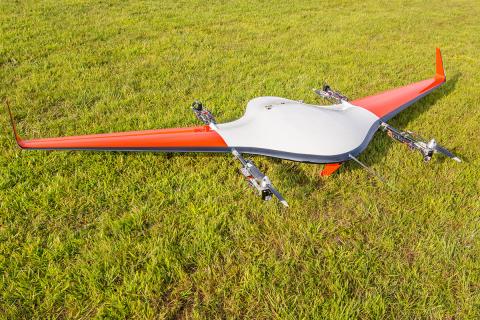
Textron Systems plans to acquire robotics developer Howe & Howe Technologies
Textron Systems is positioning itself as a global leader in autonomy across the air, land and sea domains, after entering into a letter of intent to purchase Howe & Howe Technologies Inc., a developer of advanced robotic land vehicles.
Built and proven for the most extreme conditions in the world, Howe & Howe’s vehicles have earned the trust of customers in the U.S, as U.S. government customers have selected Howe & Howe’s small, highly mobile Ripsaw Super Tank for its speed, mobility and off-road performance, while Howe & Howe’s RS2-H1 SMET was down-selected to compete to be the U.S. Army’s first platoon load-carrying robot, after completing a 60-mile test through swamp and jungle terrains.

Delair acquires key assets of Airware to enhance standing in commercial UAS industry
Delair has announced that it is acquiring the “key assets” of Airware, which develops “innovative software analytics tools” for UAS-based data.
Delair says that the acquisition will result in it getting “leading edge technology assets,” including a proven software offering, a highly skilled engineering and customer success team in Paris, and an installed base of customers and dealers across the world.
Ultimately, Delair’s acquisition will not only accelerate its global growth, but it will also broaden its end-to-end technology for the commercial UAS market, according to the company.
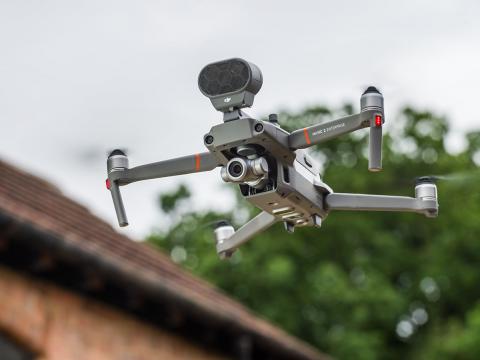
DJI unveils business-themed Mavic 2 Enterprise with added accessories
Dronemaker DJI has unveiled the Mavic 2 Enterprise, a compact, foldable drone with a zoom camera that can be outfitted with accessories such as a beacon or loudspeaker.
The Mavic 2 Enterprise is aimed at businesses, governments, educators and other professionals, the company says, with accessories aimed at boosting its capabilities for firefighting, emergency response, law enforcement and infrastructure inspections.
Insitu equipping its line of UAS with Persistent Systems' Wave Relay MANET technology
Persistent Systems has entered into a five-year agreement with Insitu that will result in Insitu equipping its line of UAS with Persistent’s Wave Relay mobile ad hoc network (MANET) technology.
By incorporating Persistent’s MANET radios on its line of UAS, Insitu will now be a member of the Wave Relay Ecosystem, which is an “alliance of industry-leading companies using Wave Relay MANET radios in their products,” Persistent says.
As a member of the Wave Relay Ecosystem, Insitu’s platforms will work seamlessly with all other Wave Relay MANET-enabled products.
Insitu successfully completes first interim Type Certification Board Meeting in support of ScanEagle3 FAA type certification program
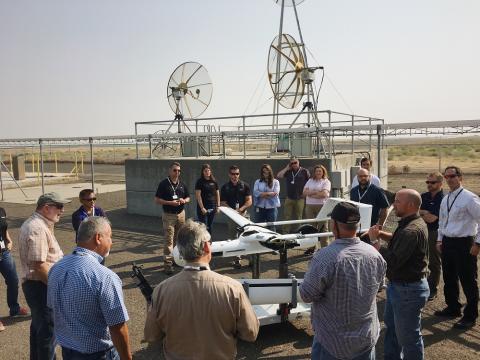
Insitu has successfully completed the first interim Type Certification Board Meeting (TCBM) in support of the ScanEagle3 FAA type certification program.
Key FAA teams including Aircraft Certification (AIR), Aircraft Flight Status (AFS), Air Traffic Organization (ATO), and Aircraft Unmanned Systems (AUS) recently came together at Insitu’s Bingen, Washington headquarters for the TCBM, which was a first for the group of FAA teams.
The FAA teams participated in an overview of Insitu’s Project Plan for Certification. During this overview, they examined Insitu’s “Detect and Avoid” (DAA) capability planning, along with its Safety Management System and proprietary model–based engineering.
Lyft boosts its self-driving efforts with acquisition of Blue Vision Labs
With a mind towards revolutionizing transportation, Lyft has acquired Blue Vision Labs, an Augmented Reality (AR) company that is enabling the next-generation of AR and robotics.
Thanks to the acquisition, Blue Vision Labs will be the first Lyft office in London, and will become part of Lyft’s Level 5 division to build technology for the ride-hailing service’s self-driving efforts.
“We are very excited to be working with Lyft to contribute to their efforts in enabling the future of autonomous mobility,” Blue Vision Labs says in a company blog post.
Addison Lee Group and Oxbotica aim to provide self-driving services to customers in London by 2021
London-based private hire taxi company Addison Lee Group and autonomous vehicle software company Oxbotica have agreed to a “wide-ranging strategic alliance” that accelerates the implementation of autonomous vehicles to the streets of London.
Under the agreement, the two companies will work together on the development, deployment and operation of autonomous vehicles, with a goal of providing self-driving services to customers in London by 2021.

Alion awarded contract to develop, build, and support the U.S. Navy UUV Family of Systems
A McLean, Virginia-based company called Alion Science and Technology has been awarded a multiple award contract (MAC) Indefinite Delivery/Indefinite Quantity (ID/IQ) from the Department of Navy, Naval Undersea Warfare Center, Newport, Rhode Island, to develop, build, and support the U.S. Navy UUV Family of Systems (FoS).
According to Alion, the scope of the contract covers systems and subsystems required to support the advancement of UUV FoS, which not only includes current UUV systems and subsystems, but also any future UUV systems and subsystems.
Alion says that the value of the contract, with all option years, is $794M.

NASA and MTSI to develop framework for autonomous aircraft that can be used to achieve FAA certification
Over the next 24 months, NASA and Modern Technology Solutions Inc. (MTSI) will collaborate to develop a framework for autonomous aircraft that can be used to achieve FAA certification.
Known as Resilient Autonomy, the NASA-led project’s goal is to develop a “robust architecture and methodology” for certifying fully autonomous systems by using a technique known as multi-mode run-time assurance (MM-RTA). MM-RTA places a deterministic "wrapper" around the autonomous system's non-deterministic software to safely bind the untrusted system's behavior.