
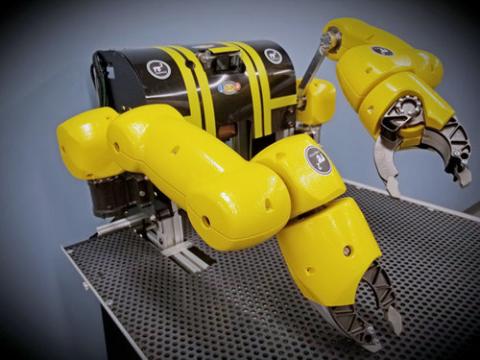
RE2 Robotics, which develops humanlike robotic manipulator arms, has received a $2.5 million contract from the Office of Naval Research to continue developing and commercializing its Dexterous Maritime Manipulation System (DM2S).
Equipped with RE2’s DM2S technology, Navy Explosive Ordnance Disposal (EOD) personnel will be able to “remotely and effectively” address Waterborne Improvised Explosive Devices (WBIEDs).
“As with the majority of our robotic technologies, the goal of the DM2S is to keep humans out of harm’s way while performing dangerous tasks,” says Jorgen Pedersen, president and CEO of RE2 Robotics.
Maritime
Maritime
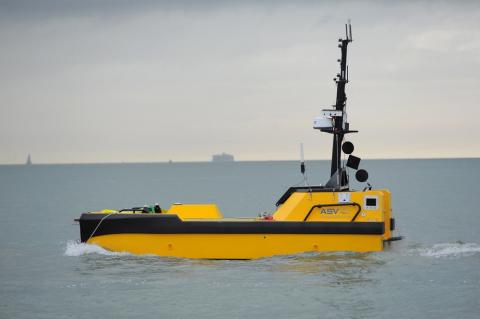
L3 Technologies acquires USV and autonomous vessel control systems company ASV Global
On Sept. 20, L3 Technologies acquired ASV Global, a USV and autonomous vessel control systems company.
This acquisition “strategically enhances” L3’s full spectrum of unmanned maritime capabilities, which includes integrated anti-submarine warfare (ASW) technologies, future surface combatant unmanned off-board sensors, and integrated USV and UUV operations.
The acquisition will result in a new company known as L3 ASV.
Sonardyne Inc.'s underwater target tracking technology selected to use at South Florida Ocean Measurement Facility
The US Naval Surface Warfare Center (NSWC), Carderock Division has selected Sonardyne Inc.’s underwater target tracking technology to use at its South Florida Ocean Measurement Facility (SFOMF).
Described as the largest, most comprehensive establishment of its kind in the world, Carderock Division is the US Navy’s research, engineering, modeling, and test center for surface and undersea technologies. Located close to the Gulf Stream, Carderock’s SFOMF offers a “demanding open ocean test environment” for subsea systems and UUVs being developed for the Navy, as well as the wider maritime industry.

Northrop Grumman and partners showcase unmanned capabilities during ANTX
Last month, Northrop Grumman Corporation and its industry partners participated in the U.S. Navy’s Advanced Naval Technology Exercise (ANTX).
During ANTX, Northrop Grumman and its partners, which included Physical Optics Corp, Ultra Electronics USSI, Hydroid, Optimum Solutions and Silvus, not only demonstrated advanced capabilities in the “command and control of future unmanned maritime missions,” but they also demonstrated the ability to better deliver important information to the warfighter in contested environments.
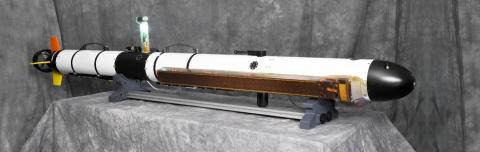
Teledyne Marine and industry partners conduct maritime demonstration during ANTX
During the 2018 Advanced Naval Technology Exercise (ANTX) from Aug. 29 to 31, Teledyne Marine and its industry partners showcased an Autonomous, System of Systems approach to expeditionary Mine-Countermeasures (MCM) using multi domain unmanned assets.
Teledyne Marine has provided a description of the demonstration.
The demonstration, which included multiple vehicles and several companies, begins with a Power Docks Blue Isles Autonomous Power Microgrid platform simulating providing power to all vehicles. The exercise starts with a Teledyne Oceanscience Z-Boat 1800 RP ASV performing a “bathymetric and LiDAR survey” of the basin.
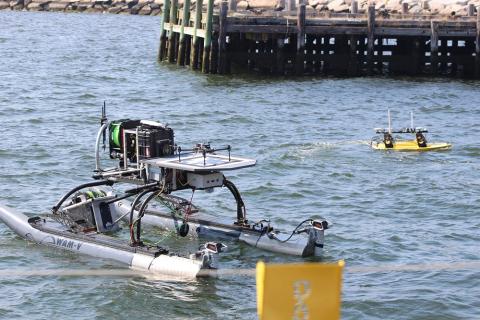
General Dynamics demonstrates C3 capabilities among UUVs, submarines and land-based mission operations centers
As part of the Advanced Naval Technology Exercise (ANTX) 2018, a team led by General Dynamics Mission Systems demonstrated “cross-domain, multi-level command, control and communication (C3) capabilities” among UUVs, submarines and land-based mission operations centers.
The demonstration, which took place at the U.S. Naval Undersea Warfare Center (NUWC) in Newport, Rhode Island, provided technological answers to the challenges of communicating among several platforms in contested underwater environments, from high-level operation planning to tactical mission execution.
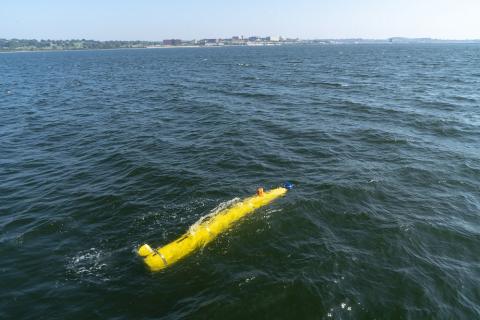
FlightWave demonstrates Edge's capabilities during three-week voyage in Pacific Ocean
Over a three-week period this summer, FlightWave Aerospace participated in the “Exploring Fronts with Multiple Robotics expedition,” as part of a high-tech research mission in the Pacific Ocean, approximately 1,000 miles west of Southern California in an area called the Subtropical Front.
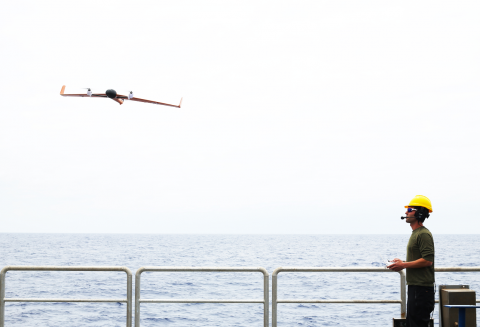
From Unmanned Systems Magazine: U.S. Navy’s new roadmap sees vast potential for unmanned systems
The U.S. Navy sees vast potential for unmanned systems and the capabilities they will bring, according to the service’s Strategic Roadmap for Unmanned Systems.
Use of unmanned and autonomous systems will create nothing less than "fundamental shifts" in the way the Navy operates, says an unclassified summary of the roadmap released in May. Their integration, it says, will allow reductions in manpower and risk to personnel, lower operating costs, increased persistence, faster and more accurate data processing, and a faster decision cycle.
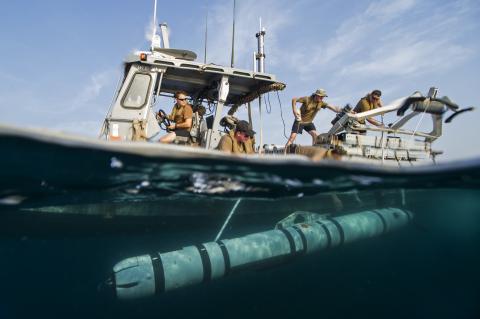
Sea Machines moves to larger work space to ensure successful release of upcoming autonomous tech
Sea Machines, a developer of autonomous control and advanced perception systems for the maritime industry, has moved its team in Hamburg, Germany to a larger, waterfront work space in the Hammerbrook area of Hamburg.
The move was made to support the growing interest in the company’s autonomous controls and advanced perception technology in European markets, and to make sure that Sea Machines' upcoming commercial product release is successful.
“This move strengthens Sea Machines’ foothold in Germany and supports our growing demand for engineering, sales and marketing across Europe,” says Sea Machines CEO Michael Johnson.

Queensland University of Technology and others collaborate to develop underwater robot reef protector
The Queensland University of Technology (QUT), Google and the Great Barrier Reef Foundation have collaborated to develop an underwater drone that can not only keep watch on reef health, but also accurately identify and inject the crown-of-thorns starfish, which can be especially dangerous.
Known as RangerBot, the underwater robotic system is ready to be tested on the Great Barrier Reef.
RangerBot can “see” underwater thanks to its high-tech vision system. Operated using a smart tablet, RangerBot won the 2016 Google Impact Challenge People’s Choice prize, allowing QUT roboticists to develop innovative robotics technology into a real-life reef protector.