
This Week in the Unmanned Systems and Robotics World
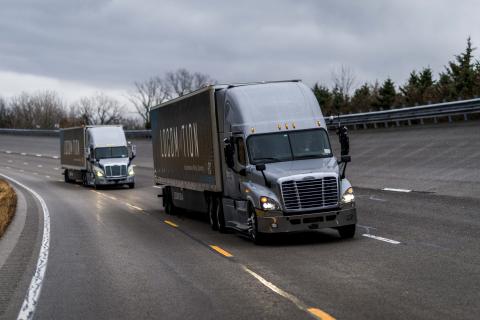
Autonomous trucking startup Locomation announced this week that it has successfully completed its first on-road pilot transporting commercial freight. In partnership with Aon, a risk management consultancy, and Wilson Logistics, a transportation logistics company, Locomation deployed two trucks hauling trailers in a driverless convoy on a 420-mile-long route stretching from Portland to Nampa, Idaho along I-84. (VentureBeat)
Mobility
Mobility
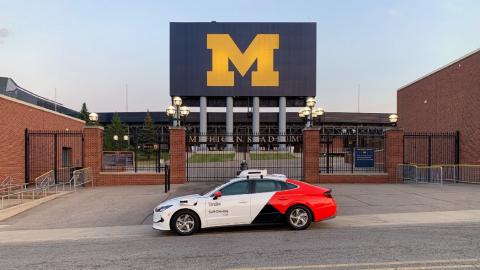
Yandex selects Ann Arbor, Michigan as next testing location for its self-driving cars
Yandex has selected Ann Arbor, Michigan as the third urban testing ground for its self-driving cars.
A variety of factors make the city of Ann Arbor an ideal testing place, Yandex says, including the city’s wealth of research and engineering facilities and many bright young minds, and the state’s “very progressive and supportive” regulatory environment for the development of self-driving cars.
Ann Arbor joins Moscow and Tel Aviv as Yandex's other self-driving testing locations. According to Yandex, it will have more autonomy in Ann Arbor than it does in Moscow and Tel Aviv, as those two locations require engineers to be behind the wheel of self-driving vehicles at all times.
AVS speakers emphasize importance of uniform legislation, safety for autonomous vehicles
From helping address the driver shortage currently plaguing the trucking industry to transporting passengers to and from their destinations, autonomous vehicles (AV) have no shortage of potential use cases for the present and beyond.
“As autonomous technology comes to market, it’ll have a broad and positive impact on the overall industry,” said Shawn Kerrigan, co-founder and chief operating officer of self-driving truck technology company Plus.ai, during the Automated Vehicle Symposium (AVS).
Before these vehicles can hit the roads at scale, though, there first needs to be some sort of uniform legislation to guide this technology, many speakers noted during AVS, which took place as a fully virtual show this year.

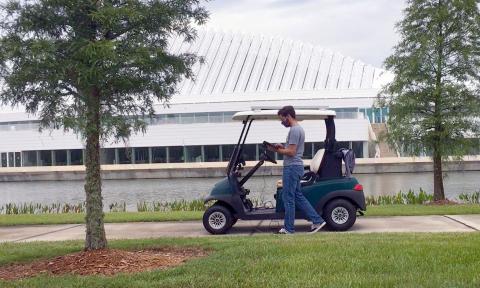
Florida Poly researchers turning disused golf cart into solar-powered autonomous vehicle
In an effort to “advance cutting-edge research for years to come,” a team of researchers at Florida Polytechnic University (Florida Poly) is turning a disused golf cart into a solar-powered autonomous vehicle.
Funded by the University’s Advanced Mobility Institute, the project will support a $350,000 National Science Foundation award to develop a large-scale Hardware-in-the-Loop simulation facility for connected and autonomous vehicles (CAV).
Weekend Roundup: July 31, 2020
This Week in the Unmanned Systems and Robotics World
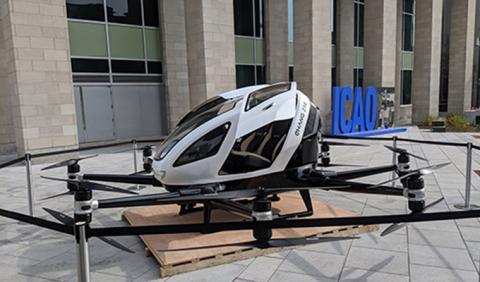
Canada’s civil aviation authority, Transport Canada Civil Aviation (TCCA), has issues a Special Flight Operations Certificate (SFOC) to EHang for its EHang 216 autonomous aerial vehicle (AAV). In addition to this announcement, EHang has also announced plans to build a new AAV production facility in Yunfu city in Guangdong, China.
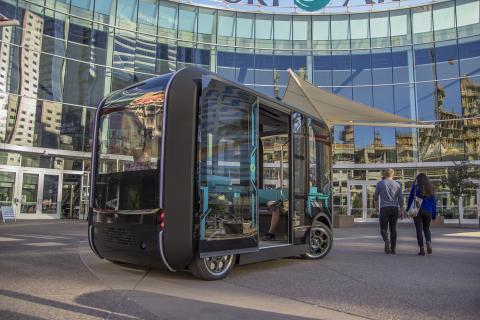
Beep, Local Motors partner to expand number of AV shuttles on public and private roads
Florida-based autonomous Mobility-as-a-Service (MaaS) provider Beep and Local Motors by LM Industries have announced a strategic partnership and new reseller agreement.
Through the collaborative agreement, the companies will seek to significantly expand the number of autonomous shuttles on both public and private roads, which will not only offer more people autonomous transportation options, but also enhance the rider experience through continued testing and safe deployments.
Weekend Roundup: July 17, 2020
This Week in the Unmanned Systems and Robotics World
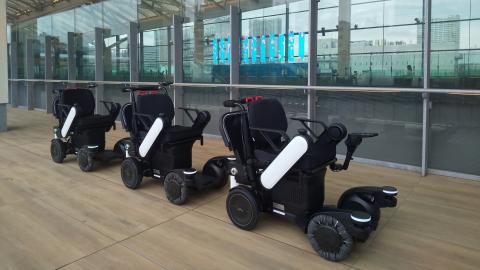
In association with JR East Group, Panasonic Corporation and Panasonic Production Engineering Co., Ltd. have launched a mobility service trial using Panasonic's robotic mobility device, an electric wheelchair with autonomous tracking function. The goal of the trial is to verify serviceability of the devices in a sunny, semi-outdoor environment. (Panasonic)
Navistar, TuSimple partner to co-develop SAE Level 4 self-driving semi-trucks
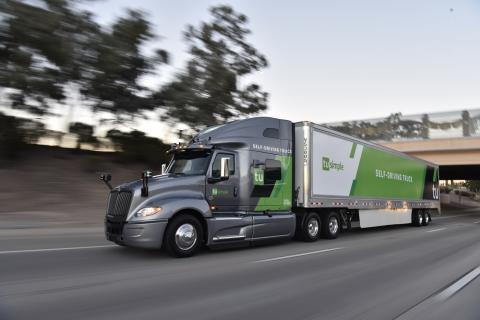
Navistar International Corporation and TuSimple have entered into a strategic partnership to co-develop SAE Level 4 self-driving semi-trucks targeted for production by 2024.
The strategic partnership is the result of a successful technical relationship between the companies for more than two years. Navistar has also taken a minority stake in TuSimple.
“Navistar’s strategic partnership with TuSimple positions us to be a leader in developing solutions for our customers by leveraging our organizations’ collective expertise to integrate our vehicle design and systems integration capabilities with TuSimple’s innovative autonomous technology,” says Persio Lisboa, president and CEO, Navistar.
Navya launches level 4 fully autonomous shuttle service in France
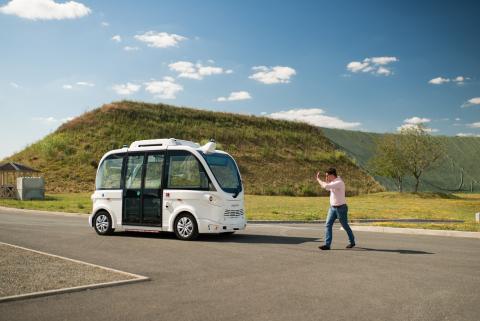
Navya has announced that on June 22, the company launched a level 4 fully autonomous shuttle service, which means there is no safety operator on board the vehicle.
In partnership with Keolis, the service launched at the National Sport Shooting Centre (NSSC) in Châteauroux, France. Since the launch of the service, the shuttle, known as the “Autonom Shuttle Evo,” has been operating within the National Shooting Sport Centre, providing athletes and visitors with a way to move from the car park to the reception area.
The shuttle operates at a maximum speed of 18 kilometers per hour along the 1.5-kilometer route.
Amazon acquires autonomous vehicle company Zoox
Amazon has signed an agreement to acquire autonomous vehicle company Zoox.
Described as a “forward-thinking team that is pioneering the future of ride-hailing by designing autonomous technology from the ground up with passengers front-of-mind,” Zoox will continue to operate as a standalone business under its current leadership of Aicha Evans, Zoox CEO, and Jesse Levinson, Zoox co-founder and CTO.
“Zoox is working to imagine, invent, and design a world-class autonomous ride-hailing experience,” says Jeff Wilke, Amazon’s CEO, Worldwide Consumer.