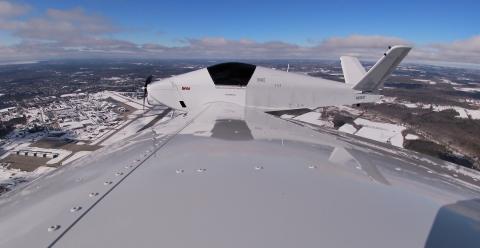
7 June 2021 – Drones and other autonomous vehicles have changed the world with their ability to go where humans can’t. Yet, these machines are vulnerable to accidents that can wipe them and their cargo out instantly because they lack the essential human quality of sight.
USA based LightWare LiDAR is taking autonomous machines to a whole new level by making them as invincible as they need to be with its new SF45 microLiDAR, the world’s smallest, lightest, scanning LiDAR sensor. By giving a machine eyes with the SF45, high cost unmanned autonomous vehicles (UAVs) will be able to do their work with lower risk of catastrophe, including the safe delivery of their equally valuable and often lifesaving payloads.
Payloads
Payloads
COVID-Fighting Collaboration Proves Potential of UAS for Test Transport
Exercise in upstate N.Y. shows how flight could replace drives through downtown traffic.
A team of more than a dozen COVID-19-motivated entities with expertise in public health, public safety and unmanned flight recently enjoyed a hard-won peek into the future of UAS in medical transport in upstate New York.
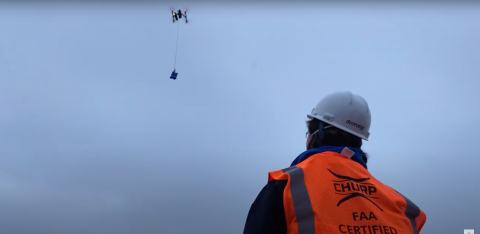
Wingcopter Secures $22 Million in Series A Funding to Aid in COVID-19 Relief
Wingcopter has secured $22 million in Series A funding to strengthen its leadership in drone-based logistics, with a special focus on healthcare-related applications including the distribution of COVID-19 vaccines.
“Our team is driven by tackling the world’s challenges through scalable innovations,” said Wingcopter CEO Tom Plümmer. “This chapter of our journey is dedicated to setting up logistical highways in the sky that leapfrog traditional means of transportation.”

GA-ASI completes month-long demonstration of GE-ER UAS
General Atomics Aeronautical Systems Inc. (GA-ASI) has announced the completion of a month-long demo event that showcased its Gray Eagle Extended Range (GE-ER) UAS equipped with a suite of long-range sensors, Air Launched Effects (ALE) and Scalable Command and Control (SC2).
GA-ASI collaborated with industry to equip the UAS with best-of-breed long-range intelligence, surveillance, and reconnaissance (ISR) payloads and ALEs. During the demo, the UAS showed a persistent stand-off survivability with stand-in capabilities with up to 40 hours of endurance that Army Commanders can use to orchestrate forces in the Multi-Domain Operations (MDO) environment.
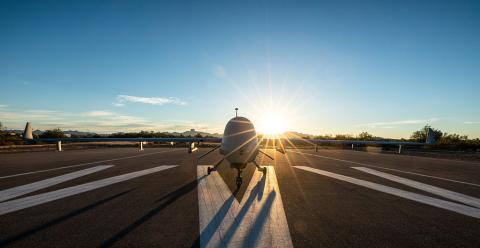
UAVOS, KACST introduce Saker-1C unmanned aircraft
UAVOS and King Abdulaziz City for Science and Technology (KACST), Saudi Arabia are collaborating on the development of the newest member of the Saker MALE UAS family, the Saker-1C unmanned aircraft.
With ambitions to redesign and improve UAS features extending from engineering to operation, UAVOS and KACST are focusing on using advanced manufacturing technologies and integrating next-generation capabilities including state-of-the-art autonomy, navigation, communications, sensor processing and system of counter electronic warfare.
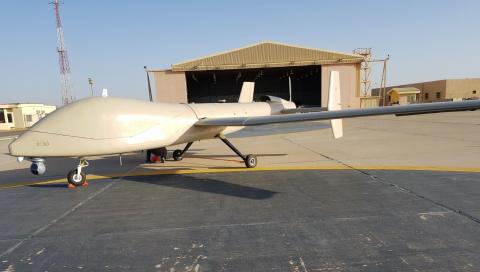
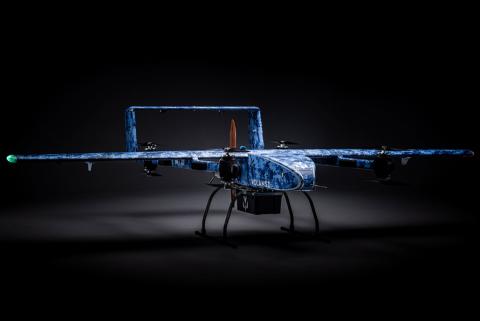
Volansi introduces VOLY M20 UAS
During the United States Air Force’s Agility Prime Virtual Trade Show, autonomous VTOL UAS design, manufacturing and service provider Volansi Inc. announced the launch of its newest UAS, the VOLY M20.
Described as a new generation of dual role aircraft, the UAS provides customers with the ability to simultaneously carry 20 pounds of cargo and a 10-pound ISR or sensor payload. According to Volansi, the UAS was designed to meet the exacting requirements of commercial customers that operate in remote maritime locations, as well as military customers who require a flexible vehicle for resupply and ISR applications.
The American-made VOLY M20 has a 350-mile range, cruising at 75 miles per hour, and more than eight hours of endurance for sensor operations.
Peraton wins spot on contract to support U.S. Navy's Unmanned Surface Vehicle Family of Systems
Unmanned maritime systems contractor Peraton has announced that it has won a spot on an up to 10-year, $982.1 million indefinite-delivery/indefinite-quantity, multiple award contract (IDIQ-MAC) to support the U.S. Navy's Unmanned Surface Vehicle Family of Systems.
Just last month, Peraton announced that it recently received four U.S. Navy Unmanned Maritime Systems Support (UMSS) task orders valued at $27.45M.
Peraton's work with the U.S. Navy on unmanned maritime systems dates back to 2001 when it first supported the Navy's program management office responsible for explosive ordinance disposal.

Black Swift Technologies unveils American-made UAS for automated industrial and structural inspections
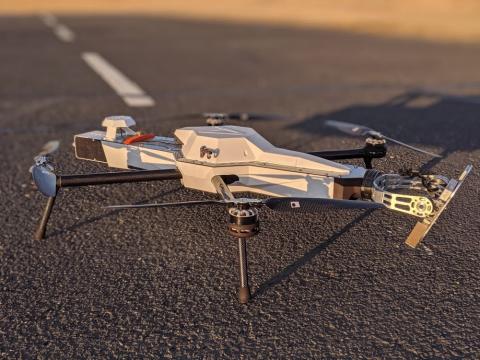
Black Swift Technologies (BST) has introduced its American-made, advanced UAS called the Black Swift E2, which is designed for automated industrial and structural inspections.
Equipped with advanced navigation, the Black Swift E2 UAS can conduct highly accurate, up-close inspections of infrastructures even in extreme environmental conditions. Considered an intelligent drone because of its leveraging of advances in computer vision and machine learning, the UAS can complete autonomous flights when combined with an inspection payload.
The UAS can safely and reliably navigate around complex structures thanks to this optional laser navigation technology, all while providing real-time actionable data to its operator.
Persistent Systems to develop Protected Communications for Manned-Unmanned Teams for U.S. Army
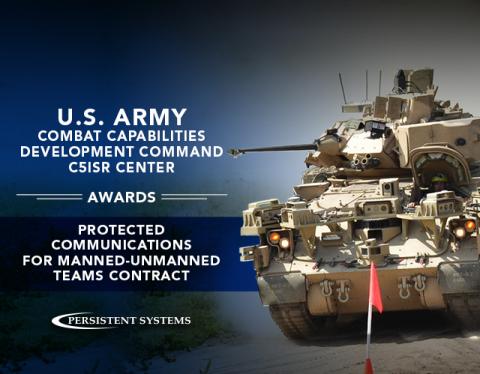
The U.S. Army Combat Capabilities Development Command C5ISR Center has awarded Persistent Systems LLC a $5.4M contract to develop Protected Communications for Manned-Unmanned Teams (MUM-T).
The Army has a vision for a next-generation Optionally Manned Fighting Vehicle (OMFV) that can be networked with up to four unmanned Remote Combat Vehicles (RCVs) and their assorted sensor/weapons payloads. The vehicle would also be networked with the broader force and command structure.
In order to make these manned-unmanned teams a reality, they will need a robust, secure, and high-throughput communications network, which is where Persistent Systems comes in.
NASC successfully completes test flight of NASC TEROS UAV; UAV featured in Super Bowl commercial
Navmar Applied Sciences Corporation (NASC) successfully completed a test flight of the NASC TEROS UAV, Technology Demonstrator at the NASC Unmanned Aerial Systems Flight Operations and Training Center at the Griffiss International Airport in Rome, New York.
During the flight, the UAV flew for approximately an hour and a half in both manual and autonomous flight profiles, which successfully tested the aircraft systems / avionics suite.
“Today’s successful flight is a huge step toward reaching our ultimate goal of TEROS approval for integration into the National Airspace,” says Richard Leverich, senior program engineer, Navmar Applied Sciences Corporation.