Ashtead Technology, a provider of the rental and sale of survey and ROV equipment, has announced that it has acquired Aqua-Tech Solutions, a subsea equipment rental and cutting services specialist.
Ashtead Technology says that the acquisition “significantly strengthens” its ROV and mechanical tooling offering, as it broadens its already established survey sensor rental fleet.
With the introduction of subsea cutting equipment, the acquisition also extends the firm’s specialist subsea services capability.
ROV
ROV
L3 Technologies demonstrates ASV deploying, operating and recovering ROV
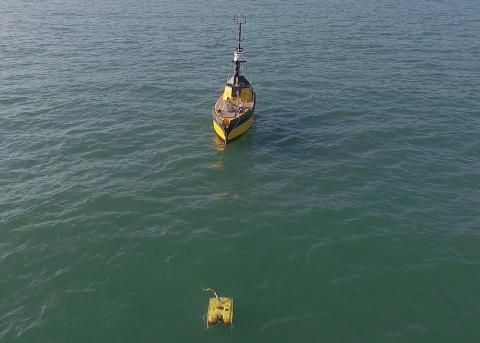
L3 Technologies has announced that the C-Worker 7 autonomous surface vessel (ASV) successfully deployed, operated and recovered an inspection-class remotely operated vehicle (ROV) for vertical and horizontal subsea inspection during a proof of concept demonstration that took place over two weeks in Cawsand Bay, Plymouth, UK.
According to L3, the system has been developed for use in hazardous offshore environments for tasks such as jacket and hull inspections, as well as pipeline and cable survey in oil and gas and renewable energy applications.
“This demonstration is a key milestone in autonomous inspection subsea technology,” says James Cowles, commercial technical sales manager for L3 Unmanned Maritime Systems UK.
RSE launches unmanned undersea robot designed to control population of invasive lionfish
A non-profit called Robots in Service of the Environment (RSE) has unveiled the RSE Guardian LF1, Mark 3 prototype, which RSE describes as an affordable unmanned undersea robot designed to control the population of invasive lionfish in the Western Atlantic.
According to RSE, the robot accelerates the capture of lionfish at the critical action breeding depth below safe diver depth.
“The Lionfish are destroying the coral reef and decimating fish populations in the Atlantic. The latest innovations incorporated into the RSE Guardian LF1, enable the undersea robotic solution to go deeper, fish longer and pull in a larger haul,” explains Colin Angle, co-founder and executive chairman of RSE.

GA-EMS successfully demonstrates Aluminum Power System powering ROV
General Atomics Electromagnetic Systems (GA-EMS) has announced that it successfully completed the first end-to-end demonstration of its Aluminum Power System (ALPS) on an underwater remotely operated vehicle (ROV) during a demonstration at a GA-EMS test tank facility in San Diego.
During the demonstration, a submerged ALPS provided hydrogen and oxygen to a Teledyne Energy Systems fuel cell, which provided electrical power to propel the ROV.
Australian safety authority to use ROVs to search for containers lost from ship
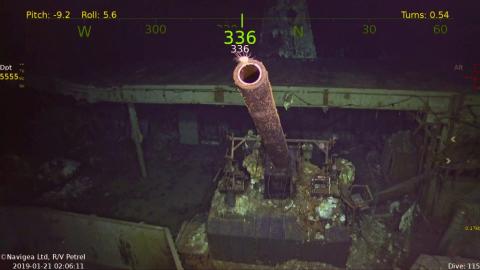
On Nov. 8, the Australian Maritime Safety Authority (AMSA) signed a contract to begin operating remotely operated underwater vehicles, or ROVs, to investigate the containers lost from the YM Efficiency container ship.
The ship lost dozens of cargo containers in the summer due to a massive storm. In July, the ship’s insurer, Aus Ship, and operator, Yang Ming, conducted survey operations in the area and located approximately 37 containers, but there have been delays in further search operations as a result of weather and sea conditions. An analysis by AMSA of the completed surveys indicates that there are as many as 42 containers still missing.

TechnipFMC selects RTI's Connext DDS for its ROVs
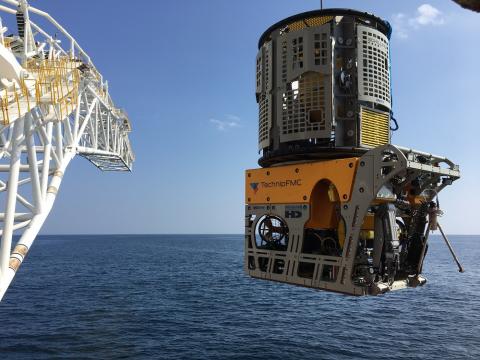
The Schilling Robotics business unit of TechnipFMC, a global leader in Oil & Gas projects, technologies, systems and services, has selected Real-Time Innovations’s (RTI) RTI Connext DDS as the connectivity framework for its underwater ROVs.
A longstanding RTI customer that has been working with the company for nearly 20 years, TechnipFMC is using RTI’s technology to build next-generation remote robotics controls, an integration that is enabling “faster and more secure connectivity” within TechnipFMC’s underwater ROVs.
From Unmanned Systems Magazine —Unmanned systems a valuable part of port security
Terrorist attacks come in all forms, and the worldwide shipping industry is scrambling to find safe harbors.
In June 2017, the Danish shipping giant A.P. Moller-Maersk was crippled by a massive cyberattack that hit 17 of its terminals worldwide, including one of its busiest on the west coast.
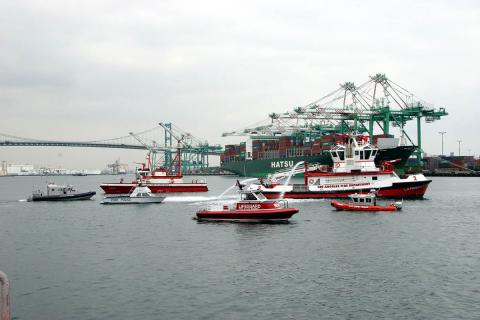
The twin ports of Los Angeles and Long Beach together make for the nation’s largest and busiest seaport, handling nearly 40 percent of all American imported goods. The Maersk attack forced an unprecedented three-day closure of the Port of L.A.’s largest terminal.
Aquabotix introduces Integra AUV/ROV
Aquabotix, which is a U.S. manufacturer of commercial-grade UUVs and underwater cameras for commercial and military applications, has introduced the Integra AUV/ROV, the company’s second-generation hybrid underwater vehicle.
Designed for use across several sectors, the Integra AUV/ROV has a variety of features, including Live Remote Control and data sharing, five pounds of payload capability, and up to eight hours of battery life, just to name a few.
Thanks to these features, users can conduct multiple underwater missions using the Integra AUV/ROV, while providing a “cost-efficient alternative to deploying separate AUVs and ROVs for individualized tasks.”
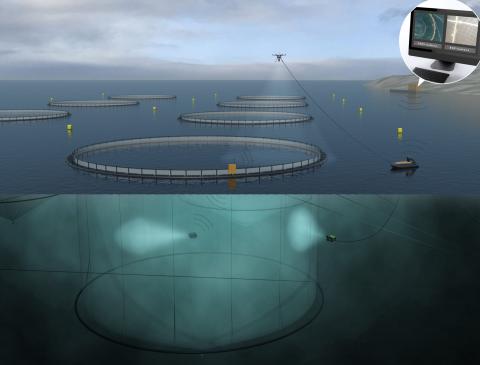
SINTEF, NTNU and others developing robotic systems that could handle tasks at fish farm facilities
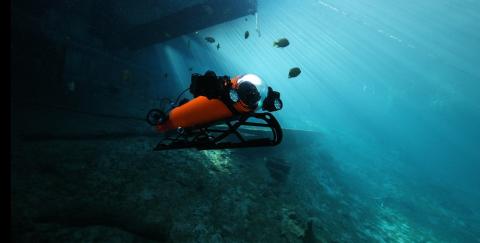
In the future, autonomous and remotely operated systems could play a major role in conducting different tasks at fish farm facilities, being that the industry is “planning to locate facilities in more open waters where weather and sea conditions are harsher,” which would make certain operations more demanding.
Day-to-day tasks on fish farm facilities, such as fish welfare monitoring, facility inspections, control of feed rationing and lice counting, are currently conducted by several crew on board service vessels.