
According to Reuters.com, self-driving buses are being tested in rural communities in Japan, in an effort to provide elderly residents with additional transportation options.
In these communities, elderly residents don’t have access to many bus and taxi services. These communities are also home to populations that are aging and shrinking.
With this in mind, mobile gaming software maker DeNA Co (2432.T), which has branched into automotive software, is testing its driverless six-seater Robot Shuttle in these towns to see if this technology is a realistic form of transportation for the elderly.
Self-driving Cars
Self-driving Cars
DOT issues 'A Vision for Safety 2.0' guidance for automated vehicles
The U.S. Department of Transportation has issued new, updated voluntary guidance for automated vehicles, building on earlier guidance released last September under the previous administration.
The new guidance, named A Vision for Safety: 2.0, loosens some of the requirements from the earlier one, according to a summary sheet released by the Department of Transportation.
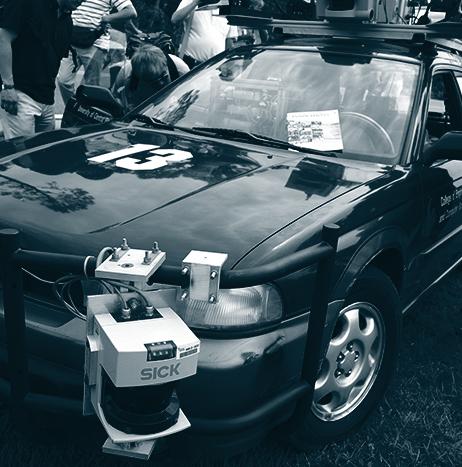
Lyft and Drive.ai partner to work on self-driving cars
In an effort to bring self-driving cars to the Bay Area on its open platform, Lyft has announced a partnership with Drive.ai, which is a Silicon Valley startup that uses deep learning to create artificial intelligence (AI) software for autonomous vehicles.
Weekend Roundup
This Week in the Unmanned Systems and Robotics World
A startup company called May Mobility that is looking to offer its autonomous driving technology to companies with commercial fleets made its official debut on August 21 at Y Combinator’s demo day. May Mobility wants to focus on customers that have vehicle needs in areas where routes can be easily mapped and conditions are fairly predictable. This includes areas such as closed residential communities, business districts and campuses (school and corporate). (TechCrunch)

Weekend Roundup
This Week in the Unmanned Systems and Robotics World
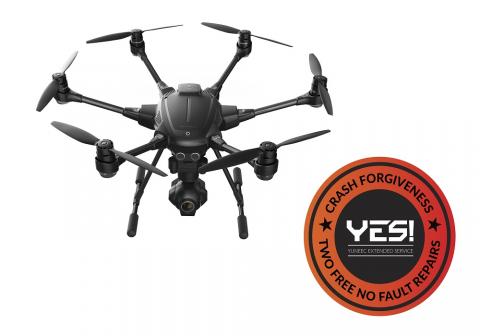
Yuneec will offer unlimited manufacturer defect repairs through its new Yuneec Extended Service (YES!) plan. YES! plans, which offer a variety of services from free shipping to non-warranty repairs, are available as a one or two-year plan for the company’s Breeze, Typhoon H and Typhoon H with Intel RealSense UAS. (sUAS News)
Weekend Roundup
This Week in the Unmanned Systems and Robotics World
LORD Corporation, which develops wireless and embedded sensing systems, has introduced its LXRS+ wireless networking protocol, which features a bandwidth of 16,000 samples per second per channel, and an aggregate system bandwidth of 256,000 samples per second over 16 channels. According to LORD, “the wireless sensor nodes that operate using LXRS+ protocol are designed to operate at incredibly low-power,” which allows battery powered networks to operate for long periods of time, and “makes the use of energy harvesting systems a viable option for permanent installations.”

Self-driving car to be tested in Atlanta in September
According to Atlanta Magazine, a self-driving car will hit the streets of Atlanta on September 14, just a few months after Georgia Governor Nathan Deal approved a law that allows self-driving cars on public streets.
The car, which is a part of a joint pilot project by Georgia Tech, City Hall and others, will drive itself from the campus of Georgia Tech to the Ponce City Market. It will follow the rules of the road and avoid obstacles during its journey using a combination of technologies, including a network of sensors, transmitters, Wi-Fi hotspots, and GPS receivers, to name a few.
Weekend Roundup
This Week in the Unmanned Systems and Robotics World
Simlat, which is a provider of training and simulation systems for UAS, has announced that it will provide its existing and new customers with a high-fidelity maritime simulation, which includes an enhanced dynamic wave model that takes into account the sea state and the weather conditions, along with the characteristics of simulated vessels such as length, weight, drought and center of mass. Applications such as search and rescue operations, security and marine life exploration will benefit from the improved visuals.

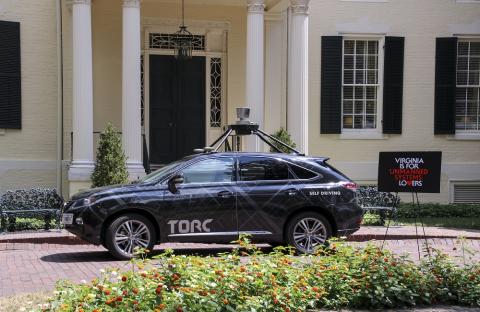
Torc Robotics’ self-driving car successfully completes cross-country road trip
Just a few weeks after unveiling its self-driving car technology, Blacksburg, Virginia-based Torc Robotics has announced that its self-driving car has completed a cross-country road trip, in which the vehicle drove more than 4,300 miles autonomously through 20 states.
According to the Roanoke Times, the vehicle started its journey on July 7 in Washington D.C. with three certified safety drivers and one Torc engineer. During the cross country trip, there was always someone sitting in the driver’s seat just in case of an emergency, and the safety drivers rotated time behind the wheel.
Lyft setting up unit to develop autonomous vehicle technology
According to the Associated Press, San Francisco-based ride-hailing service Lyft is setting up its own unit, called “Level Five,” to develop autonomous vehicle technology. The unit is named after the industry term for fully autonomous vehicles.
Lyft says that it will open its network, and invite automakers and tech companies to use the network to transport passengers in their self-driving vehicles and gather data along the way.
Initially, the network will be open to Lyft’s current partners, which includes companies such as Google's Waymo autonomous vehicle operation and General Motors.