
Aspen Avionics and Sensurion Aerospace will bring certified avionics to the UAS and unmanned air-taxi marketplace, thanks to a recently announced co-development partnership between the two.
The companies will focus on several areas, including FAA certified autopilots, communications, navigation, and surveillance systems for small, medium, and large UAS, including future cargo and passenger carrying aircraft.
“The real winners in this partnership are the UAS users, system integrators and manufacturers,” says Aspen President and CEO, John Uczekaj.
Software
Software
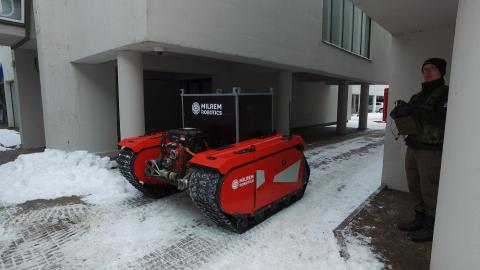
Milrem Robotics developing firefighting and search and rescue UGV
Milrem Robotics is developing a firefighting and search and rescue UGV called Multiscope Rescue.
The UGV, which is being developed together with rescue services, is built to reach areas that are unreachable by human personnel or too dangerous for firefighters to go into, such as tunnels or other structures that may collapse at any time.
The UGV can be equipped with firefighting equipment such as a water tank and a remotely controlled water cannon. It can also be equipped with thermal cameras and powerful lights to locate missing people in harsh environments or remote forested areas.
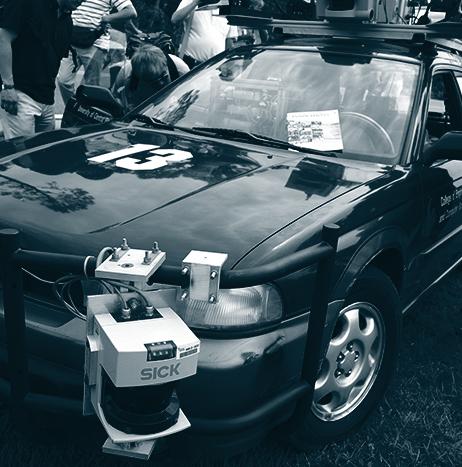
Magna and Lyft partner to develop and manufacture self-driving systems
Magna, which is a mobility technology company and automotive supplier, and Lyft have announced a multi-year collaboration in which the companies will “jointly fund, develop, and manufacture self-driving systems.” Magna will also invest $200 million in Lyft equity.
As a result of the collaboration, Lyft will lead the co-development of the self-driving system at its Palo Alto-based self-driving engineering center; Magna will lead manufacturing and join Lyft's development team onsite, where it will contribute its vehicle systems knowledge, safety and ADAS expertise, and manufacturing capabilities; and Magna and Lyft will share jointly created IP and utilize Lyft data to improve systems.
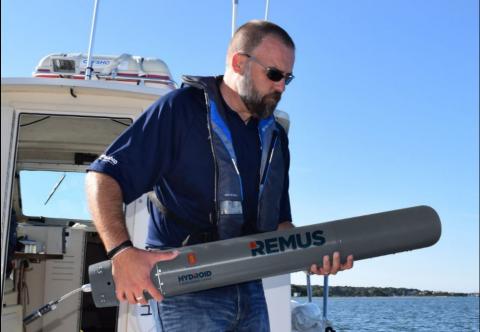
Hydroid releases compact, one-man portable REMUS M3V AUV
Hydroid Inc. has announced the release of the REMUS M3V, a compact, one-man portable AUV that is low cost and ready to use right out of the box.
Capable of diving up to 300 meters in depth, the REMUS M3V can be used to support a variety of applications, including search and survey; intelligence, surveillance and reconnaissance (ISR); marine research; and multi-vehicle missions.
Considered a “true A-size (36" x 4.875") vehicle,” the micro AUV has no fins or appendages outside the A-size envelope, and can be used for multi-domain deployments.
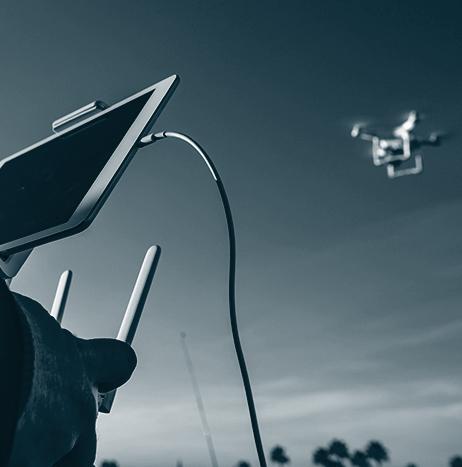
Sinclair Community College partners with Consortiq to increase UAS safety
The Sinclair Community College National UAS Training and Certification Center has announced a partnership with Consortiq that will result in Sinclair incorporating Consortiq’s UAS fleet management software, CQNet, to support the management of the college’s UAS missions.
CQNet, which is a comprehensive fleet management system that also captures crucial platform and pilot data, provides a critical element of safe UAS missions.

Unifly and Integra Aviation Academy collaborating to set up UTM system for UAS
In an effort to create an environment where UAS can be flown safely and under control in the vicinity of airports, Unifly and Integra Aviation Academy have announced that they will work together to set up an Unmanned Traffic Management (UTM) system that makes it possible to “detect, monitor and document” UAS operations on a national scale.
The entities will seek to accomplish this goal by working with some of the top manufacturers within the field.
“Airports and their surroundings are a highly specific and vulnerable area where it is vital for manned and unmanned aviation to coexist safely,” says Mark Kegelaers, CEO of Unifly.
Toyota establishing new company to accelerate its efforts in 'advanced development for automated driving'
In the latter part of March, Toyota will establish a new company in Tokyo called the “Toyota Research Institute-Advanced Development” (TRI-AD). The company is expected to accelerate Toyota's efforts in “advanced development for automated driving.”
TRI-AD will be led by Toyota Research Institute, Inc. (TRI) Chief Technology Officer Dr. James Kuffner, who will serve as the company’s CEO.
“Building production-quality software is a critical success factor for Toyota’s automated driving program,” Dr. Kuffner says.
Skyguide and AirMap team up to develop and deploy first national UAS traffic management system in Europe
Skyguide, which is a Swiss air navigation service provider, and AirMap, which is the leading global airspace management platform for UAS, have announced that they will develop and deploy the first national UAS traffic management system in Europe.
The resulting system from this partnership between the two companies will be the first national deployment of U-space, which is Europe’s vision for the “digital infrastructure that will support safe and secure access to European skies for millions of drones.”
U-space is similar to the U.S. “Unmanned Traffic Management (UTM)” initiative, in that it is a “collaborative effort to enable situational awareness, data exchange, and digital communication for the European drone ecosystem.”
ECA Group unveils AUV A18-M for underwater mine warfare
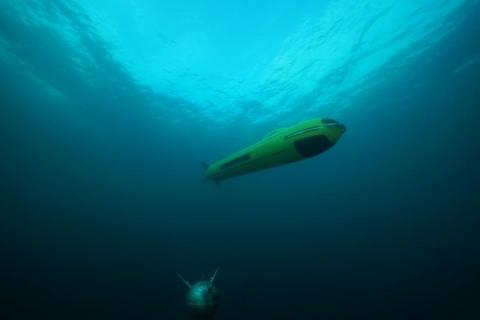
France’s ECA Group has unveiled its new generation mid-size AUV A18-M for underwater mine warfare.
Built for “efficient mine detection and classification in all water depths up to 300m,” AUV A18-M is specifically designed to operate in the close vicinity of the smartest mines without triggering them, according to ECA Group.
Regarding AUV A18-M, ECA Group says that “with its compactness and its unequaled high-quality imagery this new generation underwater drone becomes the reference in the category of autonomous underwater vehicles dedicated to mine hunting.”
Locust USA and U.S. Army to collaborate on development of technology for UAVs
Through its wholly-owned subsidiary UAV Turbines, Inc. (UAVT), Locust USA, Inc has entered into a $19 million Technology Investment Agreement (TIA) with the U.S. Army to collaborate on the development of an “efficient and reliable/durable small turboprop gas turbine engine” for propulsion in the UAV space.
The development goals surround engine capabilities beneficial to both military and commercial markets. This initiative is part of the Army’s “Reliable Advanced Small Power Systems (RASPS) Technology Demonstration” program. The goal of the program is to design, manufacture and test a “200 shp class advanced technology engine to technical readiness level (TRL) 6.”