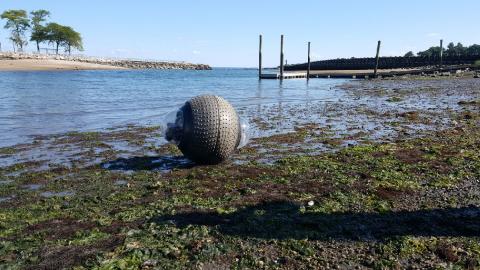
Cloud and drone technologies company Aquiline Drones (AD) has announced that it will power the spherical and amphibious robotic vehicles from engineering company GuardBot using the AD Cloud (ADC).
Aquiline notes that ADC takes full advantage of its capacity, modularity and truly salient features for autonomous assignments, operations and quests, which makes it ideal for unmanned vehicle operations.
“In the coming months, ADC will undergo rigorous testing, hosting and management trials with GuardBot’s proprietary software application. ADC’s highly modular AI architecture is suitable for crucial customization of solutions typically not available in the open marketplace,” explains Barry Alexander, founder and CEO of Aquiline Drones and AD Cloud Services.
Business Solutions
Business Solutions
Waymo raises $2.25 billion in first external investment round
Waymo raised $2.25 billion in its first external investment round.
The investment round was led by Silver Lake, Canada Pension Plan Investment Board, and Mubadala Investment Company. Additional investors included Magna International, Andreessen Horowitz, AutoNation and Alphabet.
“Waymo is the proven leader in self-driving technology, is the only autonomous vehicle company with a public ride-hailing service, and is successfully scaling its fully driverless experience,” says Egon Durban, co-CEO, Silver Lake, and nominee for Waymo's Operating Board.
“We’re deeply aligned with Waymo’s commitment to making our roads safer, and look forward to working together to help advance and scale the Waymo Driver in the U.S. and beyond.”

UToledo awarded grant to purchase new equipment to train students in autonomous vehicle tech, robotics
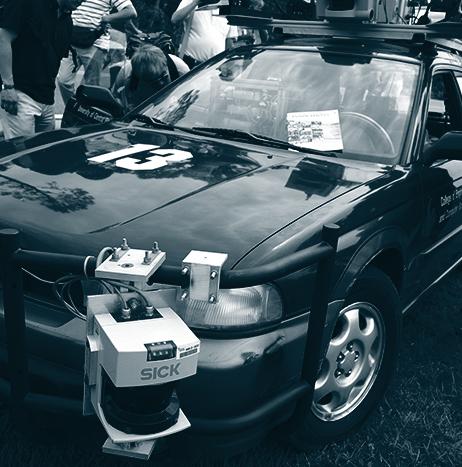
Thanks to a $474,287 grant from the state of Ohio, the University of Toledo (UToledo) will purchase new state-of-the-art equipment to train students in the areas of autonomous vehicle-sensing technologies, robotics and vision-based systems for automation.
The grant is part of $975,000 in funding in the region and $8 million across the state through the Department of Higher Education’s Regionally Aligned Priorities in Delivering Skills (RAPIDS) program for universities, community colleges and technical career centers to work together to improve education and job preparedness in different fields of strategic importance for Ohio employers.
U.S. Air Force orders 180-plus FLIR Systems Centaur UGVs
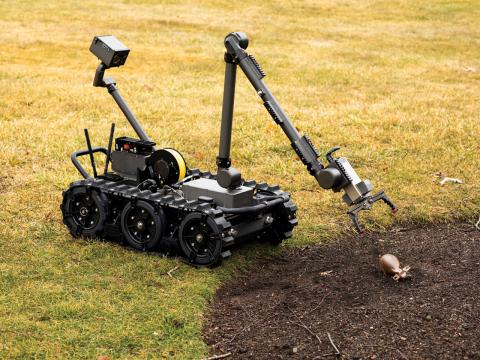
Through a $23 million contract sourced through the Dept. of Defense Man Transportable Robotic System Increment II (MTRS Inc II) program, the United States Air Force has ordered more than 180 of FLIR Systems’ Centaur UGVs, plus spares.
A remotely operated, medium-sized UGV system, Centaur provides a standoff capability to detect, confirm, identify, and dispose of hazards. The open-architected robot, which weighs approximately 160 pounds, is equipped with an advanced EO/IR camera suite, a manipulator arm that reaches more than six feet, and the ability to climb stairs. The robot's modular payloads can be used for CBRNE detection and other missions.
Shipments of the UGVs are expected to begin in the second quarter of 2020.
Pony.ai raises $400 million from Toyota to advance development of autonomous driving tech
Autonomous driving company Pony.ai has raised $400 million from Toyota Motor Corporation, which will be used to advance the companies’ joint efforts in autonomous driving technology development and mobility service deployment. The new funding totals $462 million and puts Pony.ai’s valuation at just over $3 billion.
An extension of a business partnership that Pony.ai and Toyota established in 2019, the latest strategic investment will expand the partnership’s scope of collaboration, as the companies will not only co-develop autonomous driving technology, but they will also look beyond the vehicle itself to explore further possibilities on mobility services.

Peraton wins spot on contract to support U.S. Navy's Unmanned Surface Vehicle Family of Systems
Unmanned maritime systems contractor Peraton has announced that it has won a spot on an up to 10-year, $982.1 million indefinite-delivery/indefinite-quantity, multiple award contract (IDIQ-MAC) to support the U.S. Navy's Unmanned Surface Vehicle Family of Systems.
Just last month, Peraton announced that it recently received four U.S. Navy Unmanned Maritime Systems Support (UMSS) task orders valued at $27.45M.
Peraton's work with the U.S. Navy on unmanned maritime systems dates back to 2001 when it first supported the Navy's program management office responsible for explosive ordinance disposal.

Matternet, Robotic Skies partner to provide field service and repair support for Matternet M2 UAS operators
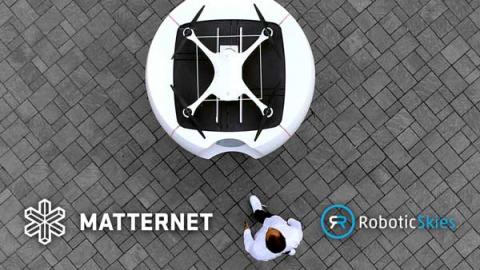
Matternet has partnered with Robotic Skies to provide field service and repair support for operators who fly the Matternet M2 drone logistics system.
Currently, Matternet’s systems operate at WakeMed Health & Hospitals and UC San Diego Health. Since 2017, the systems have also served hospitals in Switzerland.
“Our technology has the power to transform healthcare and the world of logistics at large. As we expand Matternet’s U.S. and global operations, maintenance by certified technicians in the geographies where we operate is an important component to scaling our operations,” says Matternet CEO and founder Andreas Raptopoulos.
Swiss Army selects Parrot as its micro-UAS provider
As part of the “Swiss Mini UAV Program” (Swiss MUAS) call for tender against major civilian UAS players, Parrot has been selected to provide the Swiss Armed Forces with micro-drones.
A number of factors played into Parrot’s selection, including the company’s knowledge in professional UAS, the performance of its technologies dedicated to Defense and Security, and Parrot's ability to meet the high level of cyber security that the Swiss armed forces required.

DGI awards North Carolina A&T State University $50,000 to prototype and deploy self-driving shuttles
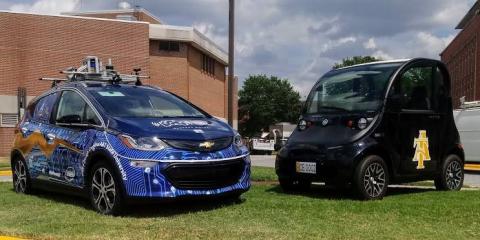
Economic development organization Downtown Greensboro Inc. (DGI) has given North Carolina Agricultural and Technical (A&T) State University $50,000 to prototype and deploy two self-driving shuttles.
Persistent Systems to develop Protected Communications for Manned-Unmanned Teams for U.S. Army
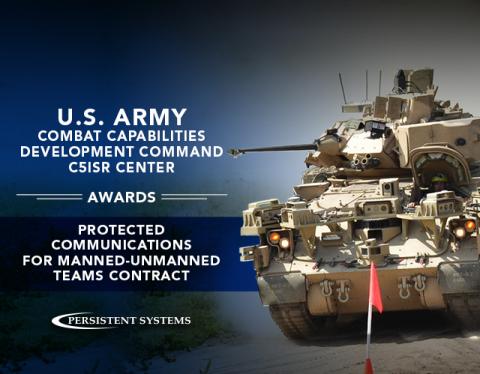
The U.S. Army Combat Capabilities Development Command C5ISR Center has awarded Persistent Systems LLC a $5.4M contract to develop Protected Communications for Manned-Unmanned Teams (MUM-T).
The Army has a vision for a next-generation Optionally Manned Fighting Vehicle (OMFV) that can be networked with up to four unmanned Remote Combat Vehicles (RCVs) and their assorted sensor/weapons payloads. The vehicle would also be networked with the broader force and command structure.
In order to make these manned-unmanned teams a reality, they will need a robust, secure, and high-throughput communications network, which is where Persistent Systems comes in.