
AUVSI and SAE International recently hosted the first Business of Automated Mobility Forum, bringing together industry leaders and experts from across the automated mobility industry to develop guiding strategies for success.
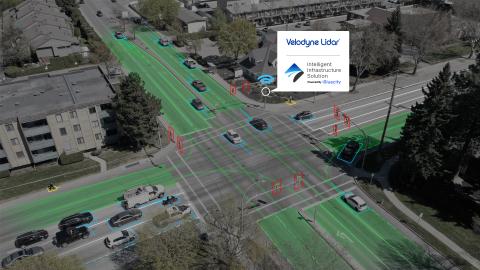
During an Enterprise Solutions Series presented by Jon Barad, VP of Business Development at Velodyne Lidar, Forum attendees learned about how lidar-based solutions are transforming infrastructure to make communities smarter and safer, today and in the future.
Technology
Technology
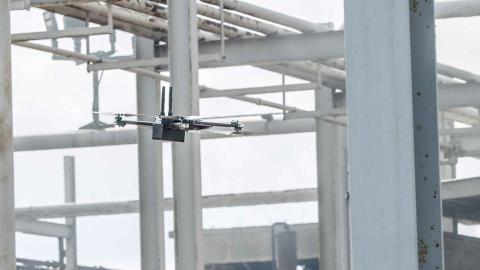
Autonomy, Connectivity Unlock the Future of UAS
Last month, AUVSI and SAE International hosted the first Business of Automated Mobility Forum, bringing together participants and speakers from across the automated mobility industry to develop actionable roadmaps to success.
During a keynote address by Skydio CEO Adam Bry and an Enterprise Solutions Series presented by Roy Goldman, VP of Product Management and Mike Ross, Sr. Director of Product Management at Skydio, Forum attendees learned about the importance of combining software advancements in autonomous flight and cloud connectivity to ensure drone uses across verticals can provide the most value possible.
Autonomy Will Unlock a New UAS Paradigm
Compact LiDAR enables data-informed decision-making
Advancements in autonomous vehicle (AV) technology are driving innovations in a variety of use cases and hold the potential to provide a myriad of social benefits. As cities and states increasingly recognize the value of these benefits and grant authorizations for autonomous vehicles (AVs) to operate on shared streets, demonstrating safety to regulators and earning the trust of the public is top of mind for the AV industry.
AVs advancing along the continuum of autonomy rely on high-definition, precise digital maps to conduct routine, safe operations. One challenge facing AVs is that this data must be constantly updated in order to present realistic representations of road conditions.

Contest provides young Nigerian entrepreneurs inspiration, education to help Africa fly toward drone-enabled future
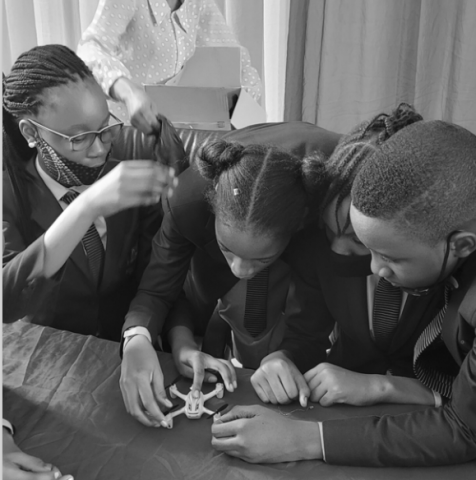
Public safety. Healthcare. Hunger. These were among the humanitarian challenges that young entrepreneurs targeted recently – perhaps even more passionately than profits – in the 2021 Nigerian Drone Business Competition.
Almost 1,000 aspiring business leaders, ages 16 to 30, entered the contest, representing every state in Africa’s largest nation. The turnout stunned planners, who had feared that a pandemic-necessitated shift from an in-person to a virtual event would stunt participation.
“That just kind of shows you the entrepreneurial spirit that is here in Nigeria,” said Eno Umoh, primary organizer of the competition. “There is a lot of interest in drone technology here, and we want to harness that.”
Mayflower Autonomous Ship is loaded with future-focused technology as it prepares for historic, fully unmanned trans-Atlantic voyage
Roughly 400 years ago, 101 people known as pilgrims made a risky, historic trans-Atlantic voyage from Plymouth, UK, toward Plymouth, Mass., in a ship called the Mayflower. This month, a collaboration of maritime boundary pushers aims to launch a second Mayflower to repeat the journey – this time with no humans aboard.

Military minds discuss ways to ensure solid integration of unmanned systems that increasingly come from different developers
Bringing unmanned systems into service for the U.S. military increasingly requires integrating complex hardware, software, algorithms and other elements from different vendors and developers. Five experts on the challenges of safe, effective integration offered their insights Wednesday in a panel discussion called, “Advancing Autonomy Through Platform Integration.”
Moderator Kevin Hagan, unmanned systems account executive for Peraton, opened the discussion with a description of its scope.
Kate Darling Discusses the Future of Human-Robot Interaction
Robotic systems are increasingly moving from behind factory walls into homes, workplaces and other where they interact with humans. What societal challenges will we face in a future with robots as a result?
Over the course of her XPONENTIAL keynote and Q&A session, Kate Darling, PhD, addressed this and other complex questions that must be faced on the pathway to assured autonomy. A leading expert in robotic ethics, Dr. Darling is a research specialist at the Massachusetts Institute of Technology (MIT) Media Lab, where she investigates social robotics and conducts experimental studies on human-robot interaction.

Assured Onboard Autonomy Architecture for AUVs
Autonomous Underwater Vehicles (AUVs) are becoming widely used in naval defense operations and commercial applications such as oil and gas surveying, environmental monitoring and search and rescue.
During a breakout session today at XPONENTIAL, Arjuna Balasuriya, Senior Scientist at Charles River Analytics presented a new whitepaper on, “Assured Onboard Autonomy Architecture for Unmanned Underwater Vehicles.” Balasuriya’s remarks and whitepaper focused on how building trust with end-users to support limited human interaction with enable AUVs to be integrated in a way that reaches their fullest potential.
A successfully integrated AUV must be adaptable to varying environmental and internal state changes, with top consideration being accuracy, bias and complexity.
Singer spotlights increasingly urgent questions for society as AI revolution picks up speed
Futurist Peter Warren Singer drew lessons from the past in Wednesday’s XPONENTIAL 2021 keynote as he challenged his audience to grapple with the overarching questions that the prospect of an unmanned revolution raises for society.
The questions, Singer noted, are increasingly urgent, given that advances toward the revolution have picked up dramatic speed during the pandemic.
He cited a statistic from Stanford University’s AI Index, global investment in artificial intelligence grew 40 percent from 2019 to 2020, compared with growth of only 12 percent from 2018 to 2019. That statistic reflects what average consumers have witnessed in the form of heightened use of remote technologies for things like distance learning, telemedicine and drone delivery.

The Use of AI in Industrial Application Inspection
From small drones for retail sales to larger maritime vessels for public safety uses, specification requirements for manufacturers of unmanned systems vary as widely by the types of systems being made, materials and methods employed, and the sites of production.
TeledyneDALSA, part of the Teledyne Imaging Group, is a leading provider of technologies for industrial growth markets, and understands the challenges US manufacturers face and offers solutions enabled by artificial intelligence (AI) and machine learning (ML) to meet these needs throughout the full manufacturing workflow.