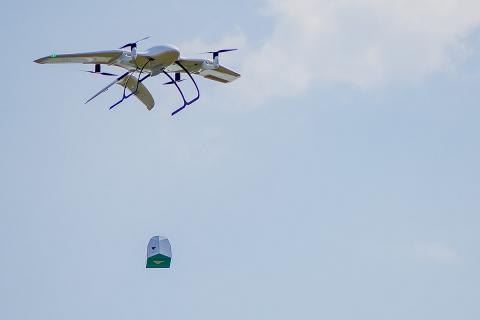
On Tuesday, May 5, the organizing committee of the Lake Kivu Challenge announced that Wingcopter was the winner of the Emergency Delivery category of the Flying Competition, which was part of the 2020 African Drone Forum that took place in February in Rwanda.
Also the recipient of a special award for its safety procedures, Wingcopter will receive prize money of GBP 65,000.
“We are very proud to be winners of the Lake Kivu Challenge, as this challenge and the African Drone Forum embody the innovative spirit of humanitarian aid and the African drone community as well as the great potential for sustainable drone deployments,” says Tom Plümmer, CEO and co-founder of Wingcopter.
Technology
Technology
Auterion introduces Skynode for UAS manufacturers
Auterion has introduced Skynode, a first-of-its-kind reference design of a fully integrated and connected family of drone avionics modules that offers manufacturers a variety of benefits.
By helping to lower costs, save time, and reduce overall risk, Skynode streamlines the process of bringing enterprise-ready drones to market or retrofitting existing products, the company says. It also breaks through the complexity of integrating drone hardware and software while leveraging the full capabilities and features of the company’s enterprise software platform.

Volansi introduces VOLY M20 UAS
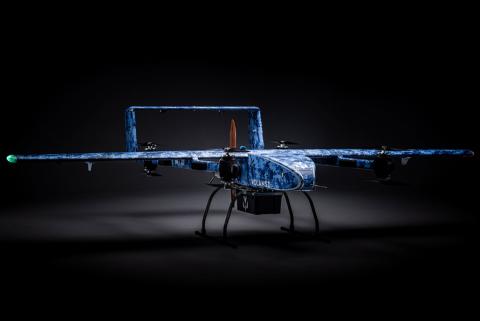
During the United States Air Force’s Agility Prime Virtual Trade Show, autonomous VTOL UAS design, manufacturing and service provider Volansi Inc. announced the launch of its newest UAS, the VOLY M20.
Described as a new generation of dual role aircraft, the UAS provides customers with the ability to simultaneously carry 20 pounds of cargo and a 10-pound ISR or sensor payload. According to Volansi, the UAS was designed to meet the exacting requirements of commercial customers that operate in remote maritime locations, as well as military customers who require a flexible vehicle for resupply and ISR applications.
The American-made VOLY M20 has a 350-mile range, cruising at 75 miles per hour, and more than eight hours of endurance for sensor operations.
Parrot providing Human Rights Watch with UAS and technical support
In support of Human Rights Watch’s mission of investigating human rights abuses around the world, Parrot has announced that it will provide the organization with its ANAFI drones and advanced software and technical support to help it accomplish its goals.
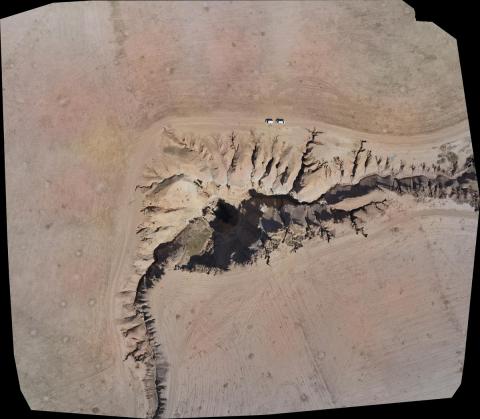
As part of a Human Rights Watch investigation into ISIS atrocities in northern Syria, Parrot recently provided its ANAFI drones and on-call support for piloting and technical assistance. The UAS helped capture aerial imagery and 3D data of the al-Hota gorge near Raqqa, which is a suspected mass grave site used by ISIS. Due to the dangerous terrain and steep cliffs of al-Hota, drones were the safest way to capture imagery at the bottom of the gorge.
Weekend Roundup: May 1, 2020
This Week in the Unmanned Systems and Robotics World
The Virginia Tech Transportation Institute (VTTI) is working with stakeholders across various communities to study challenging, dynamic scenarios involving automated driving systems. The collaborative team is also examining ways to facilitate communications between these systems and their supporting physical infrastructure. (Virginia Tech Daily)

Sierra-Olympic Technologies releases new Vayu HD camera
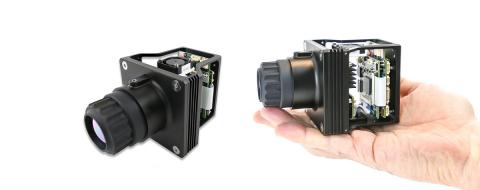
Sierra-Olympic Technologies Inc. has released its new Vayu HD camera.
Compact enough to fit into the palm of someone’s hand and weighing just over one pound, the camera is the world’s first Full HD 1920 x 1200 x 12μm uncooled VOX Microbolometer Array, according to Sierra-Olympics. The company adds that it is the highest resolution uncooled Long Wave Infrared (LWIR) camera on the market, as it exceeds the current 640 x 480 resolution benchmark with 7.5 times the pixel count.
Sierra-Olympic describes the camera as a “major evolution in low SWaP-optimized thermal imagery,” thanks to its combination of reduced size and weight, superior image quality and the reliability of an uncooled LWIR platform.
MIT's 'Conduct-A-Bot' uses human muscle signals to pilot a robot's movement
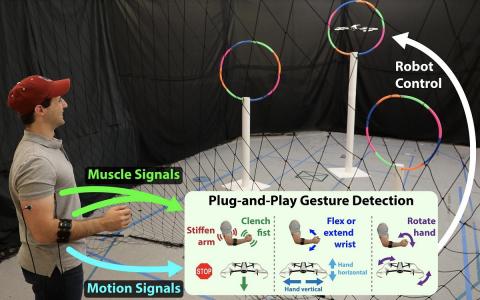
A team from MIT’s Computer Science and Artificial Intelligence Laboratory (CSAIL) has developed a system called “Conduct-A-Bot,” which pilots a robot’s movement using human muscle signals from wearable sensors.
The team says that Conduct-A-Bot could potentially be used for various scenarios, including navigating menus on electronic devices or supervising autonomous robots.
“We envision a world in which machines help people with cognitive and physical work, and to do so, they adapt to people rather than the other way around,” explains Daniela Rus, MIT professor and director of CSAIL, and co-author on a paper about the system.
UAVOS tests new two-stage parachute system for UAS
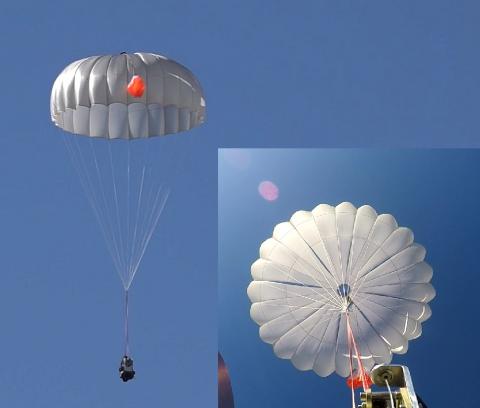
UAVOS has announced that it has successfully tested its new two-stage parachute system, which is designed to help UAS traveling at high speeds slowly descend to the ground.
The system includes two parachutes: the pilot chute and the main chute used to slow and stabilize the UAS. The pilot chute allows the UAS to slowly descend safely during the main parachute deployment. It also allows the main chute to open up at a minimum altitude.
After the pilot chute opens, the main chute’s opening delay function causes the decrease in the load speed on the UAS. UAVOS says that the parachute system is designed for UAS that can travel at speeds of up to 280 miles per hour, and that weigh up to 110 pounds.
Olds College to deploy fully autonomous DOT Power Platform on its Smart Farm
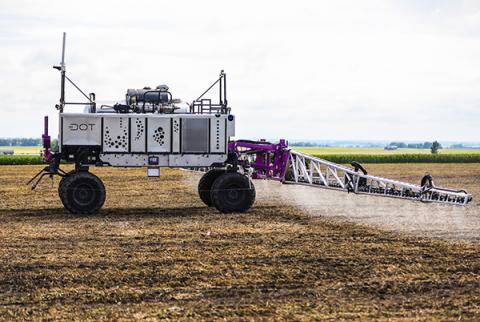
Olds College in Olds, Alberta, Canada has announced that it will be the only post-secondary institution in the world to deploy the fully autonomous DOT Power Platform as a teaching and research tool on the College’s Smart Farm.
UAV Navigation continues researching and developing technologies for UAS and RPAS
With ambitions of designing technologies that help overcome the challenges faced by UAS and remotely piloted aircraft systems (RPAS), UAV Navigation is helping research and develop innovative and cutting-edge flight control technologies that address what the company describes as the “need of the hour.”
UAV Navigation’s Research and Development Project, Visual Navigation System (VNS), largely reduces the accumulated positional error during Dead-Reckoning Navigation.