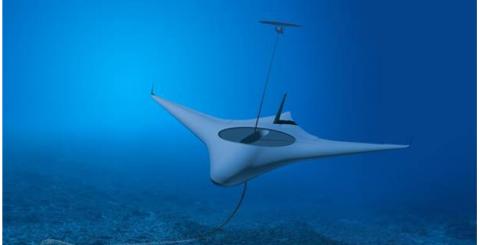
DARPA has awarded contracts to four companies to work on its Manta Ray Program, which seeks to demonstrate critical technologies for a new class of long duration, long range, payload-capable UUVs.
Lockheed Martin Advanced Technology Laboratories, Northrop Grumman Systems Corporation and Navatek LLC have been selected to focus on the development of an integrated platform for Manta Ray technology and operational areas. The fourth company, Metron Inc., will work on developing critical technology and platforms specific to the field of undersea energy harvesting techniques at the necessary depths for successful operations.
Technology
Technology
EHang, city government of Seville partner to launch first UAM pilot program in Spain
EHang and the city government of Seville, Spain have entered into a cooperation agreement to launch the first Urban Air Mobility (UAM) pilot program in Spain.
Under the agreement, EHang and the Seville government will work together to develop the urban air mobility, which includes passenger transportation, air logistics and command and control platforms in the city. In accordance with Spanish and European legislation, the city will also collaborate on applications for permission to conduct test flights, and it will coordinate with EHang to plan flight routes.

Planck Aerosystems awarded contract to help small UAS operate in challenging environments
The United States Air Force Research Lab has awarded Planck Aerosystems Inc. (Planck Aero) a contract to develop guidance, navigation, and control solutions for small UAS operating in challenging environments.
The result of the most recent solicitation from the Air Force’s Open Innovation topics of the competitive awards-based Small Business Innovation Research Program (SBIR), the contract will result in Planck Aero developing a visual compass for small UAS in environments where existing commercial offerings may suffer degraded performance.
To help the small UAS operate safely and reliably without having to rely just on GPS or other expensive and heavy installed hardware, Planck Aero is leveraging existing products, as well as its expertise in vision-based navigation.
DHL Supply Chain, Locus Robotics to deploy autonomous mobile robots to new locations
Through the expansion of their partnership, supply chain management and third-party logistics company DHL Supply Chain and autonomous mobile robots (AMR) developer Locus Robotics will launch 10 new, nationwide deployments of the Locus AMR platform this year.
“The agreement with Locus Robotics further enables us to bring productivity-enhancing technology to our customers quickly, so they are well-positioned to capitalize on new and emerging opportunities,” says Jim Gehr, president, Retail at DHL Supply Chain North America.

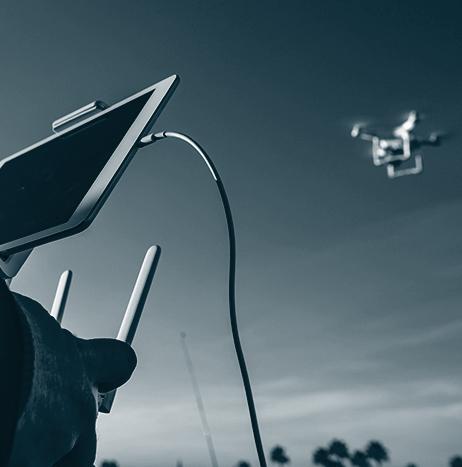
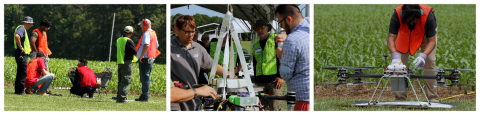
First Responder UAS Endurance Challenge seeks out 'last drone standing'
You’ve heard the expression last man standing. Beginning April 1, a new competition will seek out the last drone standing.
In an effort to help equip first responders with the necessary technology to aid them during various operations, the First Responder UAS Endurance Challenge is designed to crowd-source as many inventive drone designs as possible for first responders.
TRI-AD, Carmera announce new results from mapping exercises for autonomous vehicles
Toyota Research Institute-Advanced Development Inc. (TRI-AD) and Carmera Inc. have announced the new results from their ongoing partnership.
During the latest phase, commercially available dashboard-mounted cameras were used to detect key road features with the relative accuracy performance necessary for automated driving. Using a combination of Carmera’s technologies, key road features such as lane markings, traffic signals and signs were detected and placed along Michigan roadways in central Detroit and Ann Arbor.

Mathematicians equip drone with speaker and microphones to make it echolocate like bats
Mathematicians have discovered that a drone equipped with microphones and a speaker—with the help of algebra and geometry—can echolocate similarly to how bats use echolocation to orient themselves with their surroundings.
According to Purdue University associate professor of mathematics and electrical and computer engineering Mireille “Mimi” Boutin, this signal processing research could have potential applications for people, underwater vehicles and even cars.


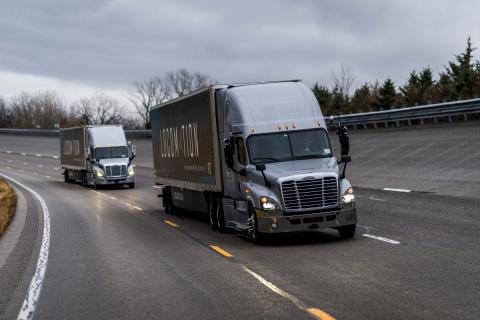
Locomation, Wilson Logistics partner for autonomous trucking pilot
The provider of what it says is the world’s first trucking technology platform to offer human-guided autonomous convoying, a company called Locomation has announced a multi-year partnership with transportation logistics company Wilson Logistics that will result in Locomation’s autonomous technology being put on the road across several critical Wilson Logistics shipping routes.
During the three-year pilot, Locomation’s Autonomous Relay Convoy (ARC) technology will be integrated onto 11 separate Wilson Logistics ARC segments. With ARC, one driver can pilot a lead truck equipped with technology augmentation while a follower truck operates in tandem through Locomation’s fully autonomous system, allowing the follower driver to log off and rest during this time.
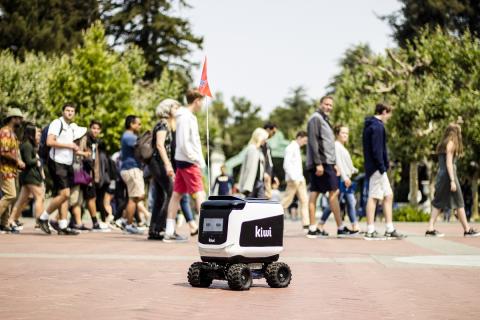
Kiwibots help University of Denver students learn how to build successful business
Delivery robots are popping up on college campuses across the United States, but the journey behind the Kiwibots currently operating on the campus of the University of Denver (DU) ironically enough did not begin on U.S. pavement.
Initially launched as a human-based food delivery company in Bogotá, Colombia, the first iteration of Kiwibot as a company was sold, which led to the team behind Kiwibot wanting to replicate its model where students could conduct deliveries for other students in the United States. The team found out, however, that the cost structure was not replicable from Latin America to the U.S., according to David Rodríguez, Kiwibot’s head of business.
“This was the point we decided we needed to start building robots,” Rodríguez tells AUVSI.