By Lynn Manning
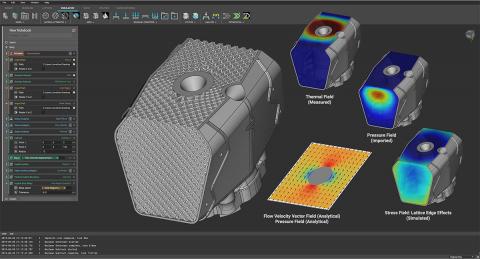
When a fast-growing company designs and manufactures some 2,000 small engines per year, it likes to stay abreast of the latest digital-engineering tools. Yet Sean Hilbert, president of Cobra Aero, is also adamant that the final proof of the integrity of every power and propulsion product he creates for his drone and motorcycle customers is always the test bench.
“In my experience with moving back and forth between the computer-aided engineering and the testing realms, honing in on that final design always requires a real-world check,” Hilbert says. “You need those digital-to-physical iterative loops in order to calibrate your models and make a great design.”
Technology
Technology
vHive partners with DAS, Consortiq to extend drone software platform offering to enterprise customers
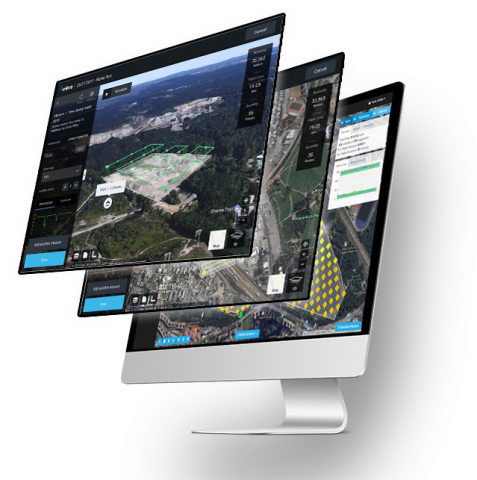
In an effort to extend its drone software platform offering to enterprise customers, global software provider vHive has partnered with DFS Autonomous Systems LLC (DAS) and its subsidiary Consortiq.
According to vHive, it is the only software platform that allows enterprises to digitize their field assets and operations using autonomous drone hives. Enterprises can use vHive’s software platform to deploy autonomous drone hives to capture and analyze data, allowing them to accomplish a variety of tasks including reclaim lost revenue, generate new revenue streams and cut operational costs. All this can be done while keeping field staff safe on the ground.
Corpus Christi Regional Transportation Authority introduces autonomous shuttle at Texas A&M University-Corpus Christi
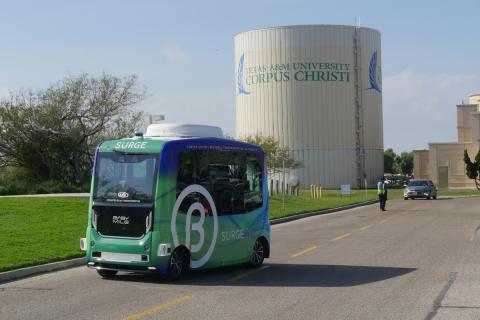
During a VIP event at Texas A&M University-Corpus Christi, the Corpus Christi Regional Transportation Authority (CCRTA) introduced the first autonomous shuttle in the region.
According to CCRTA, the shuttle service is one of the first in the nation to operate on a complex route that is exposed not only to vehicular traffic, but also foot traffic.
“This new shuttle is one more way the Island University continues to lead in cutting edge innovation and the use of new technology,” says Dr. Kelly M. Miller, Texas A&M-Corpus Christi president.
“We are excited to partner with CCRTA on this project that will enhance campus life and show how research turns into usable innovations.”
Speakers highlight importance of collaboration for developing, integrating unmanned maritime systems
As the U.S. Navy continues to develop and integrate unmanned maritime systems into its repertoire, members of the government and the unmanned systems industry agree they will need to continue relying on each other to make these systems a regular part of the armed forces.
“What I really appreciate is industry’s willingness to get on board with the Navy’s vision for the family of systems that can be upgraded throughout their life,” said Capt. Pete Small, USN, program manager, PMS 406, on a government panel during the Unmanned Systems Integration Seminar, presented by the Naval Submarine League and AUVSI.

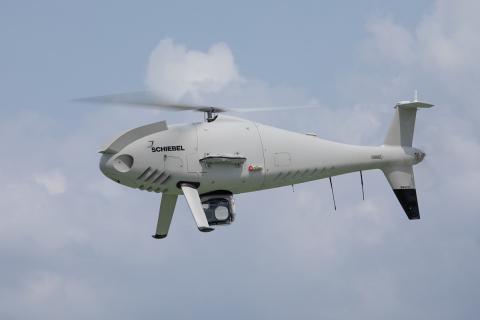
Schiebel's Camcopter S-100 UAS provides situational information during toxic pollution crisis in Malaysia
During the Kim Kim river toxic pollution crisis in Malaysia last year, Schiebel’s Camcopter S-100 UAS was used to provide critical situational information, the company has announced.
Last March, more than two tons of illegal chemical waste were dumped in the Kim Kim river, which is located near Johor Malaysia, the largest industrial area in the South of Malaysia. This resulted in toxic fumes being released throughout the adjoining area, which impacted more than 6,000 people, resulting in many being hospitalized, and several schools being closed.
Silent Falcon UAS E1 surpasses 500 hours of successful flight testing and operations
Silent Falcon UAS Technologies (SFUAS) has announced that the Silent Falcon E1 UAS has completed 500 hours of successful flight testing and operations.
The solar electric, fixed wing UAS is considered an ideal platform to use to collect data in both harsh and peaceful environments, thanks in large part to its payload capacity of 20 pounds and its ceiling of 20,000 feet above ground level (AGL). The UAS is also noise and emission free, and it provides long range, low cost intelligence, surveillance and reconnaissance (ISR) capability.

Aptiv's self-driving vehicles picking up and dropping off passengers at McCarran International Airport
Aptiv’s self-driving vehicles have been selected to pick up and drop off a select group of passengers at the McCarran International Airport in Las Vegas.
Described as the “first-of-its-kind airport access to autonomous vehicles,” this access will help Aptiv in its development of a production-ready Level 4 autonomous driving platform in 2022, the company says.
Aptiv adds that this access will also help it and McCarran learn more about the utilization and deployment of robotaxis, and how they can be used to make ground transportation in and out of the airport more efficient.

Simlat delivers small UAS simulation platform to FAA UAS simulation lab
Simlat has announced the delivery of its small UAS simulation platform to the UAS simulation lab at the FAA William J. Hughes Technical Center (WJHTC) NextGen Integration & Evaluation Capability (NIEC).
Compliant with the MAVLink protocol, the Simlat INTER simulator can easily be integrated to UAS control software that supports MAVLink such as UgCS and MissionPlanner.
Using the AviationSimNet standard, INTER was also integrated to the FAA simulation infrastructure as part of this delivery, which will allow distributed exercises and experiments with other FAA simulations.
Autonomous shuttle set to begin operating on NCSU's Centennial Campus next month
EasyMile’s EZ10 autonomous shuttle will begin operating on North Carolina State University’s (NCSU) Centennial Campus in February, according to the News & Observer.
Known as CASSI, which is short for Connected Autonomous Shuttle Supporting Innovation, the shuttle can carry up to 12 people on pre-programmed routes.
According to Mike Kennon, the assistant director of transportation at NCSU, CASSI will operate on a loop through the heart of Centennial Campus on weekdays and during special events on weekends. The campus is home to NCSU’s engineering school, as well as several technology companies, which Kennon says makes it an ideal place to showcase such technology.