
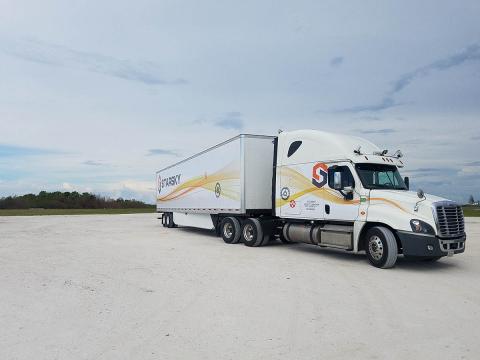
Starsky Robotics says that it is the first company to test an unmanned 18-wheeler on a stretch of U.S. highway.
Starting June 16, Starsky began testing a Volvo semi-truck equipped with cameras and radar on a 9.4-mile stretch of the Florida Turnpike in Orlando. The vehicle was connected to a Starsky “teleoperations” center in Jacksonville.
During testing, the truck performed several tasks, including navigating a highway rest area, merging onto the Turnpike and changing lanes, all while maintaining an average speed of 55 miles an hour.
Technology
Technology
Aurrigo develops autonomous baggage carrying dolly for airports
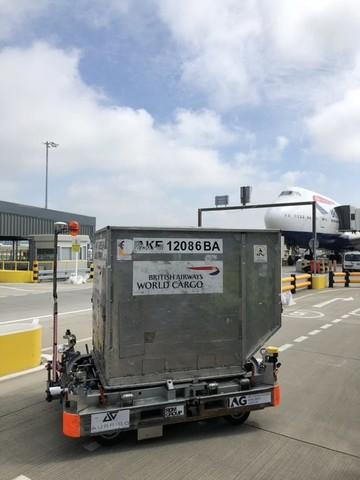
After being approached by the International Airlines Group (IAG) about using its expertise in driverless technology to develop the world’s first autonomous baggage carrying dolly, UK-based autonomous tech company Aurrigo has developed and deployed an autonomous ‘baggage’ platform that can transport luggage around airports.
Since March, an existing dolly that was converted into a self-driving, electric vehicle using lidar and GPS technology has been operating in Terminal 5 at Heathrow Airport, and it is now operating in the baggage handling area.
Aurrigo worked with British Airways (BA) to get the dolly operational at Heathrow Airport.
NDDOT receives four-year waiver to operate UAS over people
The North Dakota Department of Transportation (NDDOT) has announced that it has received a four-year waiver from the FAA to operate UAS over people.
According to NDDOT, this is the first time that a North Dakota state agency has received a waiver to routinely conduct UAS operations over people. The approval was for a DJI Mavic 2 series equipped with a ParaZero SafeAir parachute recovery system.

MIT researchers develop technique for driverless cars and robots to spot objects amid clutter
Researchers at MIT say that they have developed a technique that allows robots to quickly identify objects hidden in a three-dimensional cloud of data.
According to the researchers, sensors that collect and translate a visual scene into a matrix of dots help robots “see” their environment. The researchers note, though, that conventional techniques that try to pick out objects from such clouds of dots, or point clouds, can do so with either speed or accuracy, but not both.

From Unmanned Systems magazine: Fiscal 2020 defense budget request includes billions for unmanned systems
In March, the White House released a fiscal 2020 defense budget request totaling $718.3 billion, which it said would invest in space and cyber warfighting domains, modernize air, maritime and land domains, innovate more rapidly to strengthen the nation's competitive advantage, and sustain the forces and readiness.
As part of the request, the services release budget estimates that detail unclassified procurement and research, development, test & evaluation (RDT&E) efforts.
EasyMile's quality management system receives ISO 9001 certification
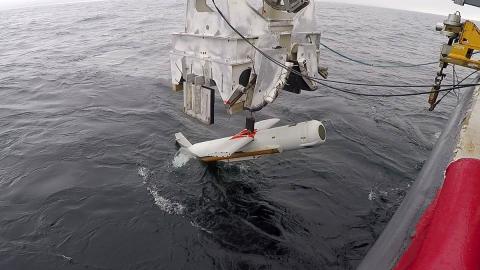
Known for its EZ10 electric driverless shuttle, EasyMile has announced that international certification agency Bureau Veritas has awarded ISO 9001:2015, an international standard related to quality management, to the company's quality management system.
“The ISO 9001:2015 is a very important step for EasyMile towards worldwide Autonomous Transport System acceptance,” says Gilbert Gagnaire, founder & CEO of EasyMile.
UAVOS develops advanced leaf spring leg for heavy UAS
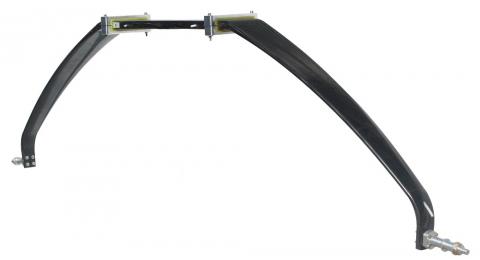
UAVOS has developed an advanced leaf spring leg for the main landing gear of UAS that weigh up to 2,400 pounds.
According to UAVOS, the spring leaf is stronger, thinner and lighter by 38 percent in comparison with fiberglass, thanks to being made of “aircraft carbon prepreg by the high-temperature molding procedure.”
A duct for the brake hose and the landing sensor wire is inside the spring leaf. Its modern material and chassis design allows it to save seven kilograms of the spring weight (in comparison with fiberglass), which reduces aerodynamic resistance, ensuring the protection of the brake hydraulic system and electrical wiring leading to the chassis.

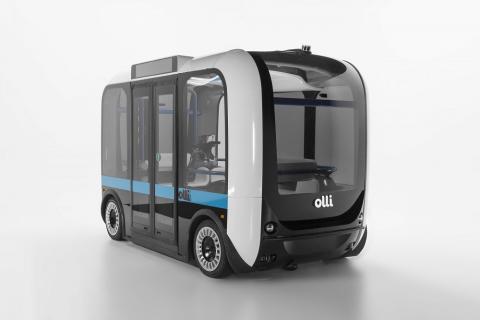
Local Motors' autonomous shuttles begin operating at Joint Base Myer-Henderson Hall near D.C.
On Wednesday, June 19, Local Motors deployed a fleet of its Olli autonomous shuttles at Joint Base Myer-Henderson Hall, which is an Army and Marine Corps joint base adjacent to Arlington National Cemetery near Washington, D.C.
The deployment is the result of Joint Base Myer-Henderson Hall winning a regional fleet challenge, which asked entrants to propose use-case scenarios for the Olli autonomous shuttle.
Black Swift Technologies to develop UAS that can autonomously track eyewall of tropical cyclones and hurricanes
The National Oceanic and Atmospheric Administration (NOAA) has awarded Black Swift Technologies (BST) a contract to develop an air-deployed UAS to perform lower boundary layer observations in difficult atmospheric conditions that are commonly encountered in convective storms such as hurricanes and tropical cyclones.
Known as the S0 Air-Deployed UAS, the proposed vehicle would be tube-launched from an aircraft such as NOAA’s Lockheed P3 Orion.