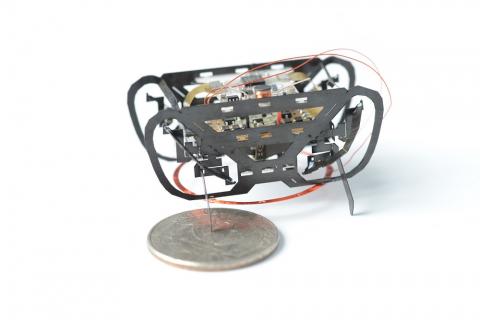
Engineers from Draper and Harvard University’s Wyss Institute for Biologically Inspired Engineering and Paulson School of Engineering and Applied Sciences (SEAS) are collaborating to create a small climbing robot that could be used for search and rescue operations in high-risk environments.
Technology
Technology
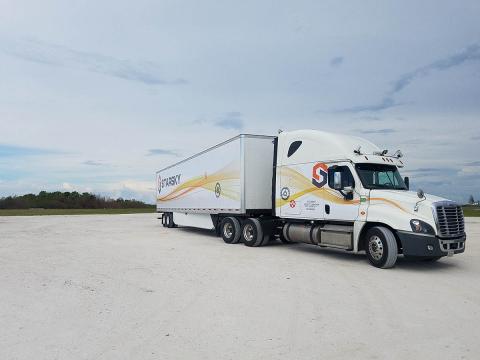
From Unmanned Systems Magazine: Automated trucks gain traction
When it comes to self-driving vehicles, cars seem to get most of the publicity but many new and established players are seeking to transform commercial trucking by developing automation technology that helps or removes the driver.
Companies have equipped trucks with various sensors, software, tracking devices and wireless communications gear and are testing their souped-up vehicles on real roads, sometimes with customer freight onboard.
According to proponents of such efforts, autonomous trucking offers many benefits, including increased safety. In the United States, about 4,000 people a year die in truck accidents, most of which are caused by human error.
Driverless trucks could also save money and boost productivity.
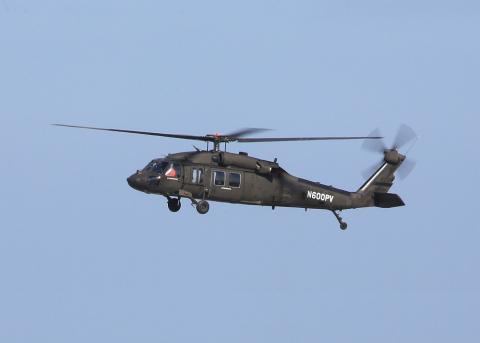
Sikorsky's optionally piloted vehicle technology used to fly Black Hawk helicopter for first time
On May 29, a Black Hawk helicopter was operated with full-authority, fly-by-wire flight controls for the first time using a technology kit developed by Sikorsky.
The flight marked the official start to the flight test program for the soon-to-be optionally piloted aircraft. Follow-on flight testing will look to include envelope expansion throughout the summer leading to fully autonomous flight (zero pilots) in 2020.
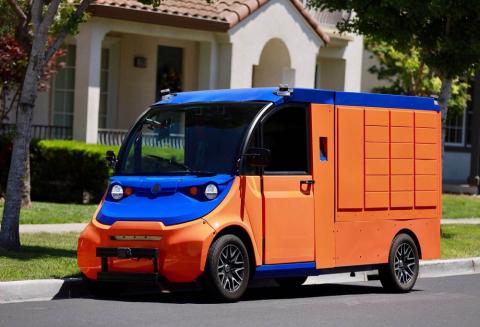
Boxbot unveils new last-mile delivery system featuring self-driving vehicles
A last-mile logistics and automation startup called Boxbot is reimagining the way e-commerce packages and other shipments are delivered to consumers with its new last-mile delivery system featuring
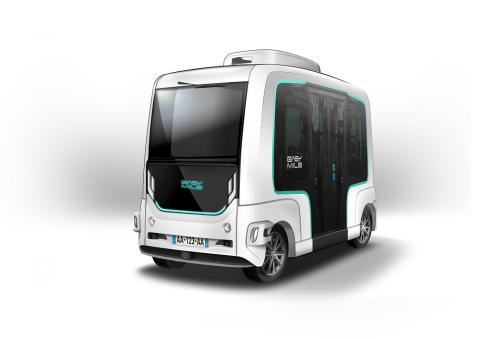
EasyMile launches driverless shuttle capable of being remotely supervised
EasyMile has announced the launch of its new EZ10 electric driverless shuttle, which is the first such vehicle in the world ready to operate without an on-board attendant, according to EasyMile.
With most driverless operations including one or two attendants on board the vehicle, EasyMile has spent the last eight months conducting one of the first deployments in the world that relies purely on a remote supervisor. The shuttle is supervised by a fully trained supervisor from a remote control center, who uses a real-time data stream to monitor the autonomous vehicle, and ensure communication with passengers.

Honeywell unveils new tech for autonomous and Urban Air Mobility vehicles
Honeywell has unveiled a new compact “fly-by-wire” system for autonomous and Urban Air Mobility vehicles.
According to Honeywell, the flight control computer, which packs the “brains” of an airliner's flight controls into one system, adds stability to the designs of autonomous and Urban Air Mobility vehicles, by driving electric actuators and dynamically adjusting flight surfaces and motors for smoothly following flight paths.
The computer, which also reduces turbulence, allows designers to push the limits of aerodynamics, ultimately eliminating the need for heavy hydraulics, control cables or pushrods.

Amazon unveils latest Prime Air drone design
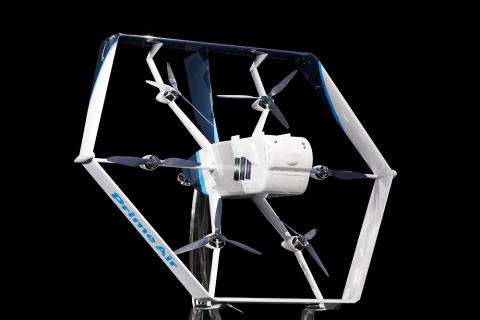
During Amazon’s re:MARS Conference (Machine Learning, Automation, Robotics and Space) in Las Vegas, the company unveiled its latest Prime Air drone design.
Amazon has been actively working to build fully electric UAS that can fly up to 15 miles and deliver packages under five pounds to customers in less than 30 minutes. The company says that with the help of its fulfillment and delivery network, it expects to scale Prime Air “both quickly and efficiently,” using the UAS to deliver packages to customers within months.
Amazon's newest drone design is equipped with advances in efficiency, stability and safety. The UAS also “advances the state of the art,” Amazon says, thanks to its hybrid design, and ability to perform vertical takeoffs and landings like a helicopter.
Embry-Riddle, UCF partner to examine how UAS can be used to map oyster reefs
With a focus on 21 oyster reefs near Edgewater, Florida, Embry-Riddle Aeronautical University and the University of Central Florida (UCF) have partnered to develop methodologies for remotely mapping regions that are difficult, and expensive, to monitor on site.
The goal of the research is to utilize UAS to collect different types of information while surveying the reefs, without ever visiting the locations in person.
If the project is successful, it would represent progress, signaling a clear change in the way environmental data has traditionally been collected, according to Dr. Dan Macchiarella, professor of Aeronautical Science.
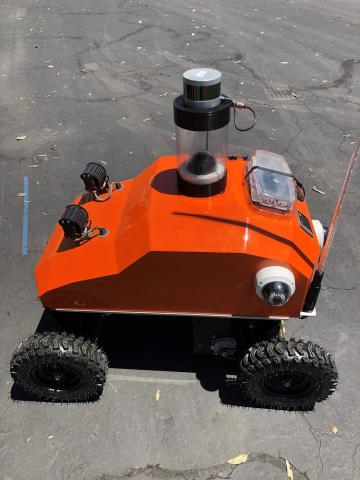
NXT Robotics Corp. launches Maverick UGV
NXT Robotics Corp. recently launched “Maverick,” its Generation 5 autonomous vehicle and cognitive software platform.
The baseline model of Maverick is equipped with four high resolution PTX security cameras that can be used to conduct artificial intelligence (AI) based analysis of a physical environment, along with license plate detection and facial and object recognition.
Maverick can also open a two-way audio stream, allowing the robot to communicate with people it encounters along its patrol routes, which are largely autonomous. The audio system can also stream pre-recorded messages and noises in response to particular situations it encounters.