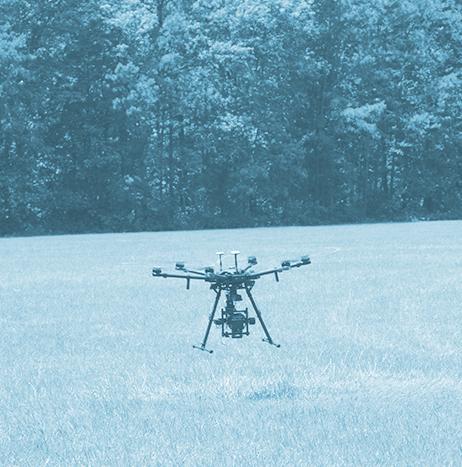
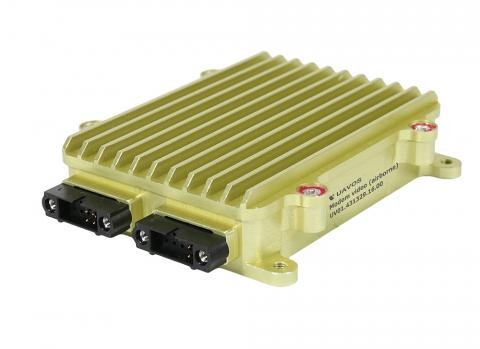
UAVOS has released its pMDDLRadio Data Link, which the company describes as an advanced UAS communication system designed for the unmanned systems market.
According to UAVOS, the pMDDLRadio is an “easy plug & play device” that packages all UAS communication into a single RF channel, with the exception of using separate technologies for control, telemetry and payload, which reduces costs and weight.
The system, which uses open architecture, enables “full duplex wideband with cybersecurity protection, digital link, error correction techniques and high-rate communication in the Uplink (UPL) and Downlink (DNL) channels,” UAVOS says.
Technology
Technology
Dynautics launches modular and scalable Dynautics Phantom AUV
Dynautics Ltd, a developer of intelligent marine electronics for unmanned boats, has announced the launch of the Dynautics Phantom, which the company describes as a modular and scalable AUV.
According to Dynautics, the Dynautics Phantom AUV represents a new concept in modular AUV design that can be adapted to carry a variety of payloads, and scalable to make sure it can be adapted to suit the mission of the end user.
“We designed the Phantom AUV to be modular to ensure we can adapt the design to meet the needs of our potential customers,” says Dr Henry Robinson, Dynautics CEO.

Brain Corp introduces AutoDelivery robot for retail facilities, warehouses and factories
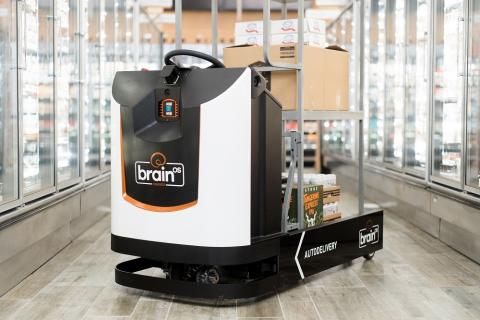
Brain Corp has introduced a new proof-of-concept robot called AutoDelivery, which is powered by the company’s commercial operating system, BrainOS.
Described as an “autonomous tug” powered by BrainOS, AutoDelivery can operate across a number of different public environments, enabling the seamless transportation and delivery of goods from point A to B, Brain Corp says.
The robot can tow several common cart types, providing “easily customized, automated delivery solutions” for commercial and retail facilities, as well as warehouses and factories. According to Brain Corp, the robot will allow users to improve workflows, boost productivity, increase efficiency, and reduce interruptions.
Maryland's Ocean Pines Police Department using UAS to search for missing people
The Ocean Pines Police Department in Ocean Pines, Maryland is now utilizing UAS to search for missing people.
Just last week, the department used its UAS to help in the search of a missing 79-year-old woman. The department also recently had two separate incidents of missing persons within the same week.
“There’s a large retirement population in Ocean Pines and the police department deals with its share of elderly residents with dementia who walk off and are reported missing,” says Sawyer, marketing and public relations director for the Ocean Pines Association.
“These residents need to be found quickly, which is capable with the help of the new unmanned aircraft system.”
L3 Technologies demonstrates ASV deploying, operating and recovering ROV
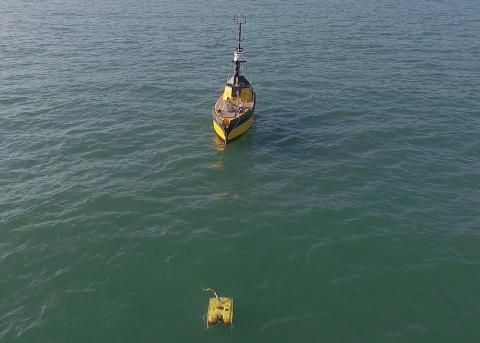
L3 Technologies has announced that the C-Worker 7 autonomous surface vessel (ASV) successfully deployed, operated and recovered an inspection-class remotely operated vehicle (ROV) for vertical and horizontal subsea inspection during a proof of concept demonstration that took place over two weeks in Cawsand Bay, Plymouth, UK.
According to L3, the system has been developed for use in hazardous offshore environments for tasks such as jacket and hull inspections, as well as pipeline and cable survey in oil and gas and renewable energy applications.
“This demonstration is a key milestone in autonomous inspection subsea technology,” says James Cowles, commercial technical sales manager for L3 Unmanned Maritime Systems UK.
Stanford University researchers develop system to help autonomous cars safely navigate unknown circumstances
Stanford University researchers have announced that they have developed a new way of controlling autonomous cars that integrates prior driving experiences, which will help cars perform more safely in extreme and unknown circumstances.
Two of Stanford’s autonomous vehicles, Niki and Shelley, were used to test the system at the limits of friction on a racetrack. Researchers say that the system performed about as well as an existing autonomous control system and an experienced racecar driver.

Starship's delivery robots now operating on campus of Northern Arizona University
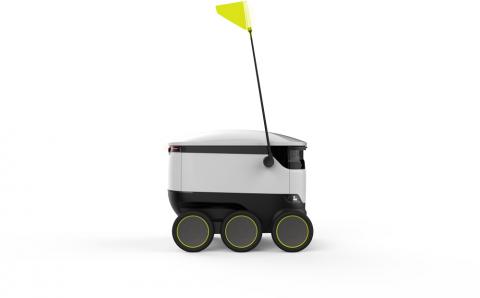
Just a few months after launching a robot food delivery service at George Mason University’s campus in Fairfax, Virginia, Starship Technologies and Sodexo Inc. have launched their robot food delivery service at Northern Arizona University’s (NAU) Flagstaff campus.
Milrem Robotics' Multiscope UGV used to determine condition of pillars in mine
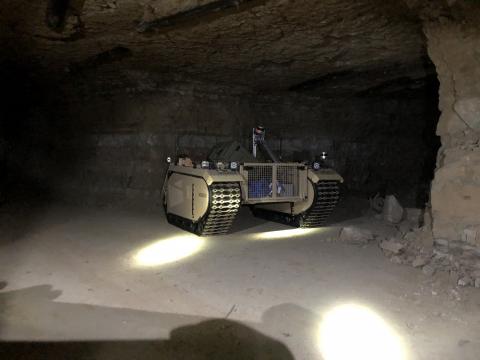
Milrem Robotics has announced that an energy company in Estonia called Enefit used its Multiscope UGV to determine the condition of the pillars in a mine in which mining ended ten years ago.
Equipped with 3D lidars, the Multiscope UGV was used in the Estonia Mine in closed underground locations. People are no longer allowed to enter these areas being that the anchor structure used to support the ceiling is being removed following the end of mining operations.
“An unmanned vehicle is an excellent solution for conducting surveys in an area which may be unsafe or prohibited for people to enter,” says Veljo Aleksandrov, development project director at Enefit.
Valqari introduces Smart Drone Delivery Mailbox
A Chicago-based start-up called Valqari says that its patented Smart Drone Delivery Mailbox solves the last inch logistic problems associated with drone delivery.
Described as a “universal drone receptacle for package delivery and pick-up,” the smart mailbox is equipped with agnostic capabilities to ensure seamless integration and communication with any UAS manufacturer during a fully-automated delivery process.
Valqari says that with its smart mailbox, it can “revolutionize drone deliveries” for a variety of industries, including pharmaceuticals, meal delivery and grocery services, governments and residential e-commerce.

Peachtree Corners helping local STEM high school launch UAS program
Through a collaboration with Peachtree Corners, Georgia and the city’s startup incubator, Prototype Prime, the new Paul Duke STEM High School in Norcross, Georgia was awarded a 2019 Infinite Energy STEAM Education Grant of $2,000, which will be used to launch the school’s UAS program.
The UAS program will be designed to engage students in the full life cycle of designing, building and operating UAS for professional applications, as well as racing.