
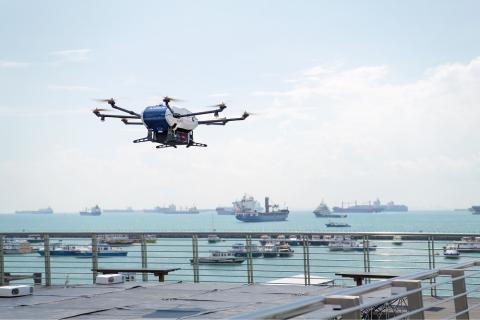
Airbus has announced that it has started shore-to-ship trials in Singapore using its Skyways parcel delivery drone.
According to Airbus, this is the first time that UAS technology has been utilized in real port conditions to deliver small, time-critical maritime essentials to working vessels at anchorage.
“We are thrilled to launch the first trial of its kind in the maritime world,” says Airbus’ Skyways lead, Leo Jeoh.
“Today’s accomplishment is a culmination of months of intense preparation by our dedicated team, and the strong collaboration with our partner, as we pursue a new terrain in the maritime industry.”
Technology
Technology
RSE launches unmanned undersea robot designed to control population of invasive lionfish
A non-profit called Robots in Service of the Environment (RSE) has unveiled the RSE Guardian LF1, Mark 3 prototype, which RSE describes as an affordable unmanned undersea robot designed to control the population of invasive lionfish in the Western Atlantic.
According to RSE, the robot accelerates the capture of lionfish at the critical action breeding depth below safe diver depth.
“The Lionfish are destroying the coral reef and decimating fish populations in the Atlantic. The latest innovations incorporated into the RSE Guardian LF1, enable the undersea robotic solution to go deeper, fish longer and pull in a larger haul,” explains Colin Angle, co-founder and executive chairman of RSE.

Link: GM's first autonomous car heads to Henry Ford Museum
Photo below: Jay Harris, 77, of Plymouth and The Henry Ford antique vehicle specialist Gordon Michael, 66, of Oak Park check out GM's first self-driving Bolt EV while GM President Mark Reuss speaks in the background Tuesday at the Henry Ford Museum in Dearborn. (Photo: Mandi Wright, Detroit Free Press)

University of Washington's robotic system can feed people who need assistance eating
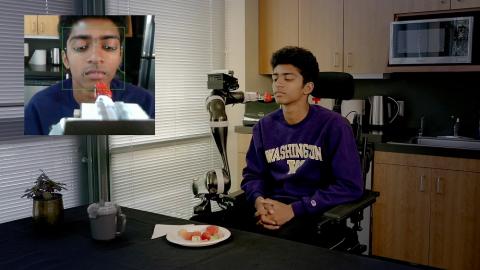
Researchers at the University of Washington are working on a robotic system that can feed people who need someone to help them eat.
The robot identifies different foods on a plate, and then strategizes how to use a fork to pick up and deliver the desired bite to a person’s mouth.
“Being dependent on a caregiver to feed every bite every day takes away a person’s sense of independence,” says Siddhartha Srinivasa, the Boeing Endowed Professor in the UW’s Paul G. Allen School of Computer Science & Engineering. Srinivasa is a corresponding author in a series of papers that the researchers published their results in.
AirMap and Honeywell developing UAS tracking platform
To provide airspace safety authorities with situational awareness of both unmanned and manned aircraft operations within an airspace system, AirMap and Honeywell have announced the development of a cost-effective UAS tracking platform.
The companies say that they will collaborate on the development of a cost-effective hardware device that allows UAS to maintain consistent communication with a UAS Traffic Management (UTM) system.
The UAS tracking platform will support several communication options, including 4G and satellite in areas without 4G coverage, to facilitate the broadcast of real-time drone telemetry feeds to a UTM system.
AP uses Sonardyne's tech to stream first live broadcast to global audiences from an underwater submersible
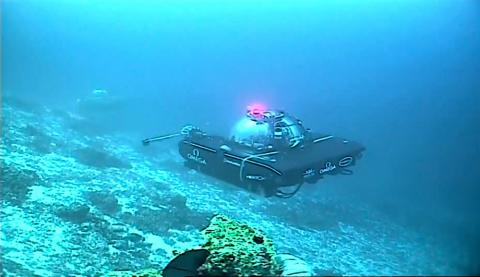
Sonardyne International Ltd. has announced that the Associated Press used its BlueComm wireless through-water optical modem technology to stream the first live broadcast to global audiences from an underwater submersible.
Coming from a two-person submersible operating in waters off the Seychelles, in the Indian Ocean, the live broadcast via YouTube was “the first multi-camera live signal in full broadcast quality from manned submersibles using optical video transmission techniques, in which the pictures transmit through the waves using the electromagnetic spectrum,” according to the AP.
SenseFly and MicaSense unveil senseFly eBee X with MicaSense RedEdge-MX
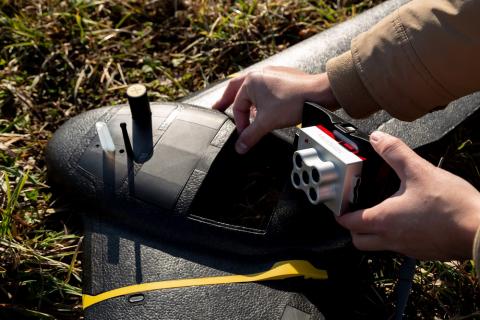
SenseFly and MicaSense have introduced the senseFly eBee X with MicaSense RedEdge-MX, a new dual platform for efficient, in-depth crop analysis.
Described as a “rugged, built-to-last” professional multispectral sensor, the RedEdge-MX captures red, green, blue, near-infrared, and red-edge spectral bands. The data that the RedEdge-MX captures can be used to generate true color composites, basic crop health indexes, and advanced analytical tools like flower identification and weed detection.
SenseFly and MicaSense say that this capability, combined with the sensor’s durable design, makes RedEdge-MX a “multispectral powerhouse.”
GA-EMS successfully demonstrates Aluminum Power System powering ROV
General Atomics Electromagnetic Systems (GA-EMS) has announced that it successfully completed the first end-to-end demonstration of its Aluminum Power System (ALPS) on an underwater remotely operated vehicle (ROV) during a demonstration at a GA-EMS test tank facility in San Diego.
During the demonstration, a submerged ALPS provided hydrogen and oxygen to a Teledyne Energy Systems fuel cell, which provided electrical power to propel the ROV.
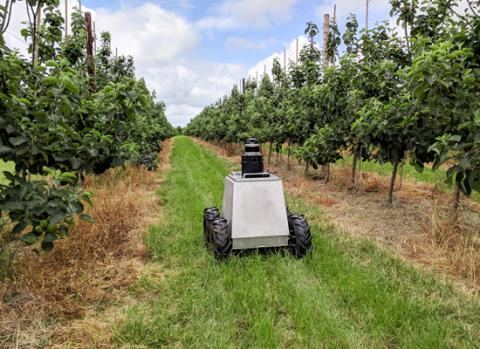
Cambridge Consultants unveils Mamut autonomous robot for agriculture
Cambridge Consultants has unveiled its autonomous robot, Mamut, which is built to explore crop fields, and capture data on health and yield at the level of individual plants on a large scale.
According to Cambridge Consultants, Mamut automates data capture, providing growers with regular, precise and actionable information on their crops, which allows them to predict and optimize yields.
Powered by artificial intelligence, Mamut is equipped with a wide range of sensors, and can map and navigate its surroundings without GPS or a fixed radio infrastructure. Its cameras capture detailed crop data at the plant level as it makes its way through rows of a field, orchard or vineyard, allowing for accurate predictions of yield and crop health.
Flirtey granted permission to conduct BVLOS UAS delivery flights under UAS IPP
The city of Reno, Nevada has announced that Flirtey—one of its partners in the UAS Integration Pilot Program (IPP)—has received approval from the FAA to conduct beyond visual line of sight (BVLOS) UAS delivery flights.
With the approval, Flirtey will be able to conduct UAS delivery operations with a pilot controlling the flights from a remote location.
“Flirtey’s industry-leading technology is now approved for drone delivery beyond visual line of sight, a major milestone that brings life-saving and commercial drone delivery another step closer to your doorstep,” says Flirtey Founder and CEO Matthew Sweeny.