
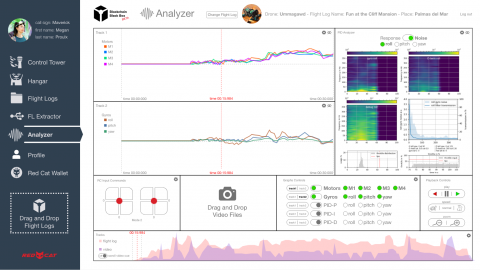
A company called Red Cat that provides distributed data storage, analytics and services for the UAS industry has announced the beta release of its blockchain-based black box storage, analytics and services platform, which makes UAS trackable and accountable.
Red Cat says that its platform release includes several integrated systems that allow industry regulators to track and review UAS flight data, insurance companies to insure UAS with reliable third-party data, and pilots to ensure compliance with regulators.
According to Red Cat, its black box flight recorder is the first distributed system with secure and encrypted third-party data that regulators and insurance companies can trust.
Technology
Technology
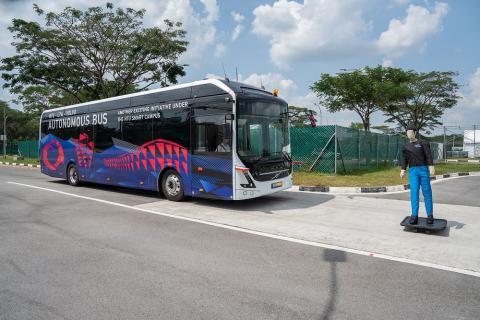
Volvo Buses and Nanyang Technological University demonstrate full size autonomous bus
Volvo Buses and Singapore’s Nanyang Technological University (NTU) have demonstrated what they are calling the world’s first full size autonomous electric bus.
Having already undergone preliminary rounds of testing at the Centre of Excellence for Testing and Research of Autonomous vehicles (CETRAN) in Singapore, the bus, which is Volvo’s first autonomous fully electric bus in public transportation, will soon begin trials on the campus of NTU.
There are also plans to extend the route beyond the university.
Northwest UAV's NW-44 Multi-Fuel Engine surpasses 10,000 combat flight hours
Northwest UAV (NWUAV) has announced that its NW-44 Multi-Fuel Engine has flown more than 10,000 combat flight hours and logged more than 1000 flights.
The NW-44 Engine was built specifically for small UAS that require extreme endurance and high reliability. The lightweight, multi-fuel UAS engine has been designed and built to be easily adaptable so that it can meet the most challenging mission requirements.

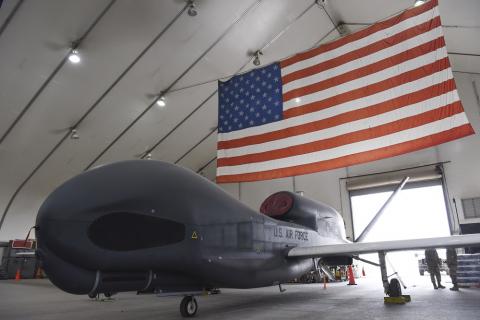
EQ-4 Global Hawk at Al Dhafra Air Base equipped with beyond line of sight capability
The EQ-4 Global Hawk flying missions from Al Dhafra Air Base (ADAB) can now operate beyond line of sight (BLOS), the Air Force has announced.
Previously, the remotely piloted aircraft required coordination with other bases to control it while in the air, but now this can be done locally.
“The BLOS plays a major role because it allows us to fly the jet farther than any Launch and Recovery Element could ever before, utilizing Satellite communication as its main link rather than a Line Of Sight link,” says Senior Airman Seth Oatridge, 380th Expeditionary Aircraft Maintenance Squadron ground communication technician.
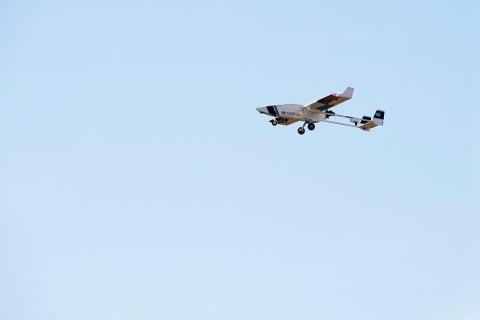
Mississippi State University's Raspet Flight Research Laboratory acquires TigerShark XP3 UAS
Mississippi State University’s Raspet Flight Research Laboratory has acquired two of the latest TigerShark XP3 aircraft, which will help expand its UAS research and support capabilities.
Expected to substantially increase Raspet’s UAS core flight research capabilities, the TirgerShark XP3 UAS will allow the Raspet team to fly at higher altitudes and for a longer period of time, which will increase the research lab's ability to meet the needs of its federal research partners, and directly support Mississippians in times of emergency, according to Raspet Lab Director Dallas Brooks.
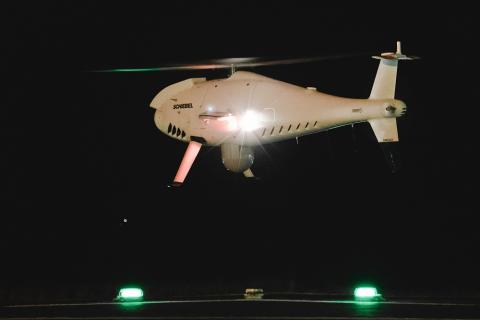
Schiebel demonstrates Camcopter S-100 UAS during trials in Nigeria
Schiebel has announced that during trials in Rivers State, Nigeria from January 27 to 30, its Camcopter S-100 UAS demonstrated its capabilities to a large European oil and gas corporation.
According to Schiebel, the international oil and gas industry has shown increasing interest in using UAS to effectively monitor and control oil and gas infrastructure, both onshore and offshore.
With this in mind, the flight trials in Nigeria were designed to further investigate the implementation and potential advantages of UAS technology, as Schiebel says that its vertical takeoff and landing (VTOL) Camcopter S-100 UAS offers a “substantial enhancement” for Intelligence, Surveillance and Reconnaissance (ISR) missions in an oil and gas production environment.
Exyn Technologies' Advanced Autonomous Aerial Robot designed for data collection in GPS-denied environments
Exyn Technologies Inc. has announced that its Advanced Autonomous Aerial Robot (A3R) is now available commercially.
Driven by the company’s exynAI proprietary software, the Exyn A3R is the first and most advanced fully autonomous aerial system for data collection in GPS-denied environments, according to Exyn.
The vehicle has already proven beneficial to customers, as a Canadian-based international mining company called Dundee Precious Metals (DPM) selected Exyn as its technology partner, in an effort to advance its initiative for digitization and automation of its underground gold mining operations.
Boeing unveils newest unmanned platform designed for global defense customers
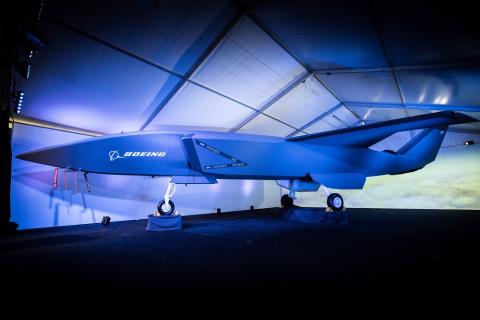
Boeing has introduced the Boeing Airpower Teaming System, which is the company’s newest unmanned platform.
According to Boeing, the Boeing Airpower Teaming System is the company's largest investment in a new unmanned aircraft program outside the United States, as the platform was designed by Boeing Australia for global customers.
Boeing says that the unmanned platform will have a number of capabilities. Measuring 38 feet long, the Boeing Airpower Teaming System will provide fighter-like performance, as it will be able to fly more than 2,000 nautical miles.
FedEx unveils its autonomous delivery robot; plans to test it this summer
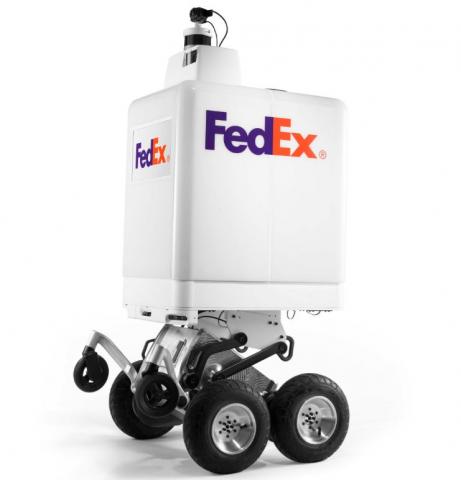
On Wednesday, Feb. 27, FedEx Corp. unveiled its FedEx SameDay Bot, which is an autonomous delivery robot designed to help retailers make same-day and last-mile deliveries to their customers.
According to FedEx, retailers will be able to accept orders from nearby customers and deliver them directly to customers’ homes or businesses the same day using the robot.
FedEx notes that on average, more than 60 percent of merchants’ customers live within three miles of a store location, which shows the potential for on-demand, hyper-local delivery. With this in mind, FedEx has also announced that it is partnering with several companies including AutoZone, Pizza Hut, and Target to help assess retailers’ autonomous delivery needs.
Corteva Agriscience to use DroneDeploy in its fleet of more than 400 UAS
Corteva Agriscience, which is the agricultural division of chemical company DowDuPont, has announced a global agreement with DroneDeploy to use DroneDeploy in its fleet of more than 400 DJI UAS across its global Seed Production and Supply Chain, as well as its Pioneer Strategic Account Management and Agronomy teams in the U.S., Canada, Brazil and Europe.
“This agreement fortifies Corteva Agriscience as a leader in the use of advanced UAV technology,” says Jeremy Groeteke, Corteva Agriscience U.S. Digital Agriculture Lead.