
Broadband satellite networks and services provider Hughes Network Systems LLC has begun shipping its specialized, multiband HM400 SATCOM modems to General Atomics Aeronautical Systems Inc. (GA-ASI).
The HM400 SATCOM modems will be used to power beyond-line-of-sight (BLOS) communications for GA-ASI’s MQ-9B SkyGuardian Remotely Piloted Aircraft (RPA).
According to Hughes, its specialized Hughes HM400 delivers enhanced satellite-based communications for RPA’s, as it leverages an open system architecture and software-definable modem and waveform technology.
The Hughes HM400 modems support both military and commercial satellite frequencies, opening up applications such as search and rescue or disaster response for Predator-variant aircraft.
Technology
Technology
Planck Aero's Shearwater small UAS autonomously takes off and lands onto moving ground vehicle
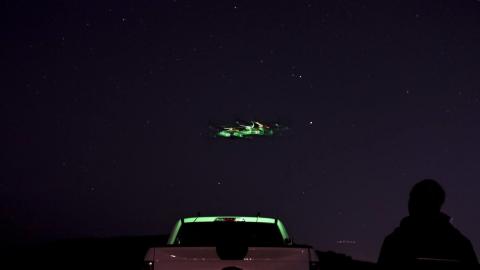
Marine Corps Air Station (MCAS) Miramar, Air Traffic Control (ATC) recently gave Planck Aerosystems (Planck Aero) permission to test its Shearwater small UAS in controlled airspace and at night.
During testing, the Shearwater small UAS routinely conducted successful autonomous takeoffs and precision landings onto a moving, off-road ground vehicle with centimeter-level accuracy in complete darkness. The UAS performed these tasks without GPS or a pilot in the loop.
According to Planck Aero, the ability to perform nighttime operations from moving vehicles represents a “major step” forward in demonstrating the maturity of the company's vision-based navigation technology.

Cranfield University and Blue Bear conduct first UAS test flights to establish principles for NBEC project
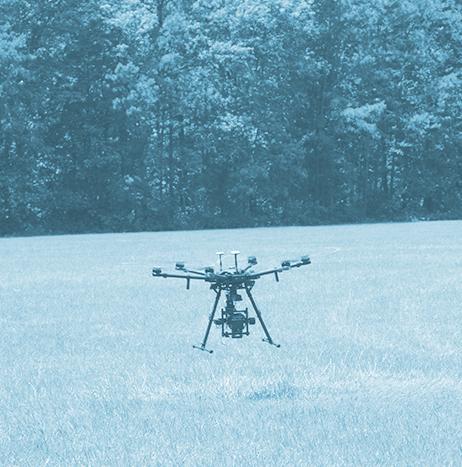
Cranfield, England's Cranfield University has announced that the first test flights to establish the principles for the National Beyond visual line of sight Experimentation Corridor (NBEC) were successfully conducted at Cranfield Airport.
A collaboration between Cranfield University and Blue Bear Systems Research Ltd, NBEC seeks to create an experimentation corridor that will enable UAS to fly in the same airspace as manned aircraft.
Using its Blackstart UAS towards its facility in Oakley, Bedfordshire, Blue Bear executed three-kilometer Extended Visual Line of Sight (EVLOS) race track flights within the Cranfield Air Traffic Zone.

Grossmont College to offer free UAS training starting in March
Grossmont College in El Cajon, California has announced that it will offer a comprehensive UAS training program starting in March.
Funded by a $6 million federal America’s Promise grant through the U.S. Department of Labor, the UAS program will be free to anyone who is at least 18 years old and a U.S. citizen, as required by the grant.
The noncredit program will be geared towards a variety of groups, including but not limited to, veterans, Native Americans, military spouses, ex-offenders, women, high school students and the unemployed and underemployed.
Teledyne Gavia to formally introduce SeaRaptor AUV in April
Teledyne Gavia has announced that it will formally introduce its new 6000-meter rated AUV, SeaRaptor, in April.
SeaRaptor incorporates a variety of Teledyne components, including ascent and descent weight releases, multi-beam echosounders, obstacle avoidance multi-beam sonar (Teledyne RESON, Denmark) and Current, Temperature, and Depth sensor (CTD) (Teledyne RD Instruments, San Diego, CA).
Teledyne Gavia notes that the first vehicle delivered also carried an Edgetech Side Scan Sonar with Dynamic Focus capability, an iXblue Phins 6K INS system, and a CathX Camera and strobe system.
UAVOS and Stratodynamics Aviation complete flight tests of HiDRON stratospheric aircraft
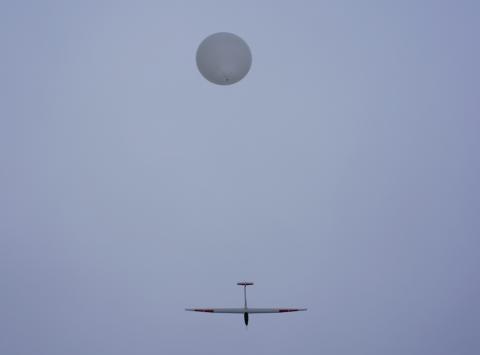
UAVOS Inc. and Stratodynamics Aviation Inc. have successfully completed the next stage of flights tests for their HiDRON stratospheric aircraft.
Reaching an altitude of 82,000 feet, the HiDRON carried an atmospheric measurement system onboard, as a result of a collaboration with researchers from the University of Kentucky.
The night-time flight, which was conducted in collaboration with the regional Air Traffic Control Agency, lasted four hours. There was a one-hour weather balloon launch period that had an average climb rate of 22 feet per second. At release altitude, the HiDRON was 22 miles away from the launch site where it headed home and was above launch area at an altitude of 59,000 feet.
Drone Delivery Canada begins testing its newest cargo delivery drone
After receiving approvals from Transport Canada to begin testing its newest cargo delivery drone, Drone Delivery Canada (DDC) has begun testing the Falcon UAS within Southern Ontario.
DDC notes that the Falcon, which has been in development for almost a year, is the big brother of the company’s Sparrow UAS, which is also designed for cargo delivery.
L3 ASV delivers long-endurance autonomous vessel to Royal Navy
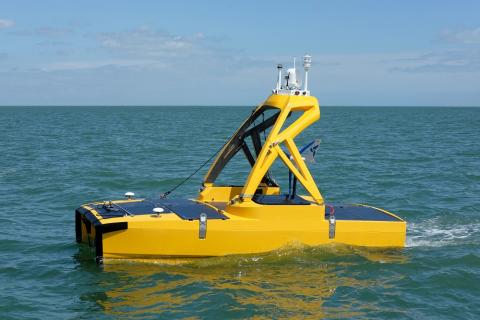
L3 ASV has delivered a long-endurance autonomous vessel known as the C-Enduro to the Royal Navy.
According to L3 ASV, the vessel will be used for military data gathering trials by the Mine countermeasures and Hydrographic Capability (MHC) program, as the Navy looks to utilize autonomous technology.
“We are proud to support the Royal Navy in their plans to explore the uses of marine autonomy as they continue to invest in new and exciting technology,” says Vince Dobbin, sales and marketing director for L3 ASV.
Intel's Shooting Star UAS return to the Super Bowl
During the Halftime Show of Super Bowl 53 on Sunday, Feb. 3 in Atlanta, Intel teamed up with the NFL to create the first live drone light show during a Super Bowl Halftime Show.
During a performance by pop band Maroon 5, 150 enhanced Intel Shooting Star UAS floated up and over the field in a choreographed performance to the music to form the words “ONE” and “LOVE.” With this performance, Intel broke its own world record for UAS flown indoors, which the company previously set with 110 during CES 2018.