
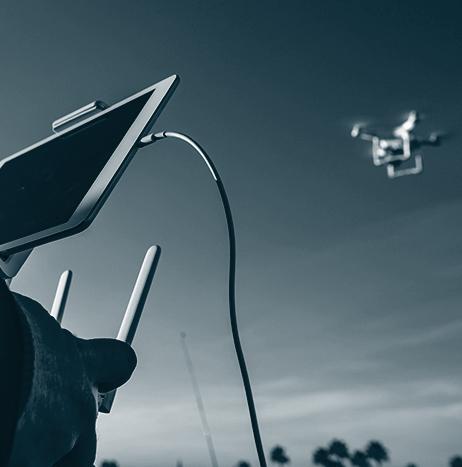
California’s Fremont Police department recently used a UAS to locate a missing teen.
After being reported missing, the teen’s location was narrowed down with help from the juvenile’s friends. Shortly afterwards, a Fremont Police UAS operator launched a UAS while other officers began searching railroad tracks on foot.
After being guided to the location, the UAS—equipped with a FLIR camera—located a heat spot. Information was being shared to the officers on foot, while the missing juvenile’s friends, also on foot, approached their friend who was hiding in bushes.
Technology
Technology
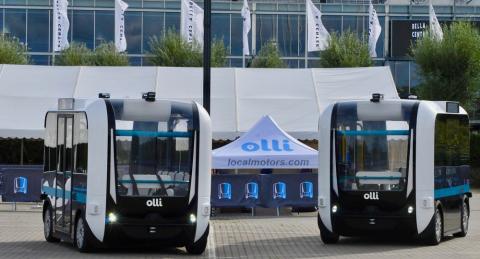
Sacramento State welcomes Olli self-driving shuttle to campus
After winning an Olli fleet challenge for presenting a best-use scenario for Local Motors' Olli self-driving shuttle, Sacramento State welcomed the autonomous shuttle to its campus on Thursday, Feb. 21.
In cooperation with Sacramento State, Local Motors officials have mapped a route that two Olli shuttles will use for the next few months.
“This deployment is a big moment for Sacramento State and for Local Motors, and follows months and months of co-creation, design and development,” says Jay Rogers, Local Motors co-founder and CEO.
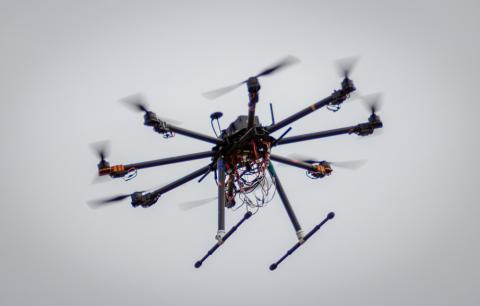
University of Connecticut engineering students work to build firefighting UAS
With help from mentors from Sikorsky, three University of Connecticut (UConn) engineering seniors are working to build and program an autonomous firefighting UAS to battle fires without a pilot’s guidance.
Once the UAS is complete, it will be equipped with a thermal imaging camera to identify a fire, object avoidance technology to steer clear of any obstacles, and a softball-sized fire-extinguishing ball that will be dropped over the flames.
The students will develop coding language that will tie the drone’s technology together, and it will operate based on inputted coordinates.
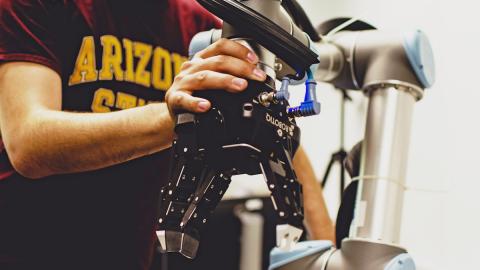
Arizona State University creates new master's degree program in robotics and autonomous systems
Arizona State University’s Ira A. Fulton Schools of Engineering has created a new master’s degree program in robotics and autonomous systems.
The program is designed to train the next generation of robotics researchers with multidisciplinary knowledge in a variety of advanced topics, including but not limited to, artificial intelligence, computer science and machine learning.
“In the future, we’re going to be interacting with intelligent machines a lot in our everyday lives,” says Panagiotis Artemiadis, the robotics and autonomous systems graduate program chair and an associate professor of aerospace and mechanical engineering.
Rhode Island Department of Transportation begins testing autonomous vehicles
On Wednesday, Feb. 20, Rhode Island Department of Transportation (RIDOT) Director Peter Alviti, Jr., along with state and local officials, hosted a demonstration of autonomous vehicle technology at the Quonset Business Park in North Kingstown, Rhode Island.
With the initial phase of a pilot project scheduled to launch in Providence, Rhode Island this spring, the autonomous vehicles are being tested this week on low-volume roads in the Park.
“This is a very exciting day as we kick-off testing of autonomous vehicles, putting Rhode Island on the map as a leader in this new high-tech field in transportation,” says Governor Gina Raimondo.

Drone Delivery Canada unveils next generation drone delivery cargo aircraft
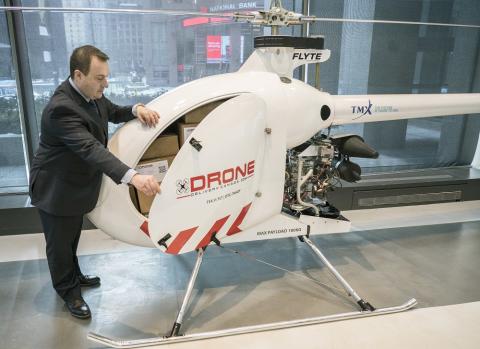
Drone Delivery Canada (DDC) has unveiled its Condor UAS, which represents the company’s next generation of drone delivery cargo aircraft.
According to DDC, the Condor “pushes the limits in both cargo capacity and distances,” as it features a payload capacity of 400 pounds, and a potential travel distance of up to 200 kilometers. The Condor is powered by a next generation gas propulsion engine.
Beep and Navya bringing autonomous shuttles to Central Florida
A Florida-based autonomous mobility technologies provider called Beep has announced an exclusive dealer arrangement for the state of Florida with Navya.
Beep and Navya have also announced a development partnership for shared mobility and autonomous vehicle research, which will result in Beep leading the testing and pilot deployments of Navya’s driverless and fully electric AUTONOM Shuttle in Florida.
Beep is working with Lake Nona—a smart community within the City of Orlando and Orange County where the company is headquartered— to bring the first autonomous shuttles to Central Florida. Service is expected to begin this spring.
In-Flight Data awarded three Guinness World Records for recent BVLOS UAS flights
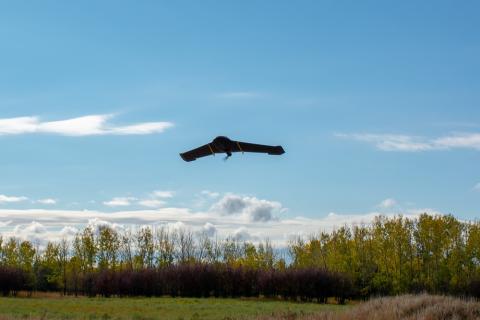
In-Flight Data has been awarded three Guinness World Records for UAS flights it recently conducted as part of a beyond visual line of sight (BVLOS) project in collaboration with senseFly.
Through the project, In-Flight Data conducted the longest cumulative BVLOS battery-powered UAS flight, covering 2,723.04 kilometers; the longest cumulative urban flight for a BVLOS civilian UAS (small class – up to 25 kilograms), covering 414 kilometers; and the longest single urban flight for a BVLOS civilian UAS (small class – up to 25 kilograms), covering 40 kilometers.
Elroy Air optimistic that its autonomous VTOL air cargo system will unlock the logistics potential of the sky
A company called Elroy Air that is developing an autonomous vertical takeoff and landing (VTOL) air cargo system has closed a $9.2 million seed round of funding, according to VentureBeat.
The company says that it is developing its autonomous VTOL air cargo system for three primary reasons. First, it believes “access to express shipping improves quality of life and economic opportunities for people, and should be available to everyone.”
Second, it believes that “now is the moment in history when autonomous VTOL aircraft can be developed to expand the reach of air cargo at scale.”