
Technology
Technology
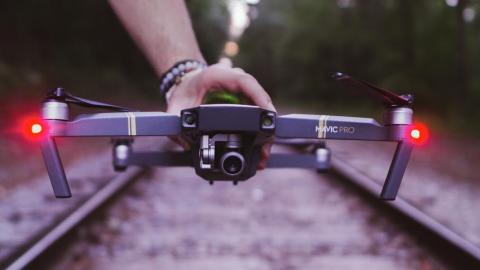
FLIR to deliver Black Hornet Personal Reconnaissance Systems to U.S. Army
FLIR Systems Inc. recently announced that it has been awarded a $39.6 Million order to deliver its FLIR Black Hornet Personal Reconnaissance Systems (PRS) in support of the U.S. Army.
As part of the Soldier Borne Sensor (SBS) Program, FLIR’s nano-UAS will be used to support platoon and small unit level surveillance and reconnaissance capabilities.

FlightWave Aerospace's tiltpod enables smooth, stable flights of quadcopters
With the development of its new tiltpod — which the company describes as a compact motor, propeller and servo with a thrusting and tilting function — FlightWave Aerospace Inc. believes that it can effectively eliminate the pitch and roll aspect of quadcopters, which will lead to improved stability for the UAS.
Known for its FlightWave Edge UAS, which is equipped with the tiltpod, FlightWave says that the tiltpod allows an aircraft to hover without tilting its whole body forward, enabling pilots to eliminate pitch and roll. So instead of tilting the aircraft, only the motor would need to be tilted.
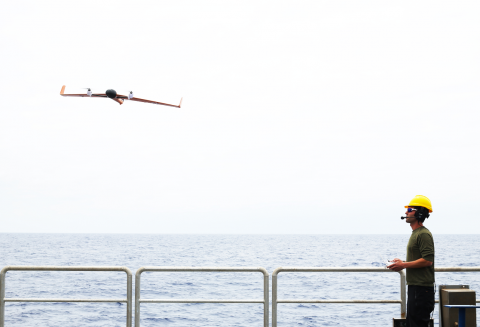
LCS Mission Module Program successfully completes shipboard integration testing of unmanned systems
The Naval Sea Systems Command (NAVSEA) has announced that on Jan. 14, the Littoral Combat Ship (LCS) Mission Module Program successfully completed shipboard integration testing of two unmanned systems on board USS Independence (LCS 2).
The Knifefish UUV and Unmanned Influence Sweep System (UISS) are part of the Mine Countermeasures Mission Package (MCM MP), which targets specific portions of the water column and segments of the MCM detect-to-engage sequence using a system-of-systems approach.
During the integration events, the Knifefish UUV and UISS both successfully verified the communications link between Independence and the unmanned systems. Additionally, several launch and recovery evolutions from the ship were also executed.
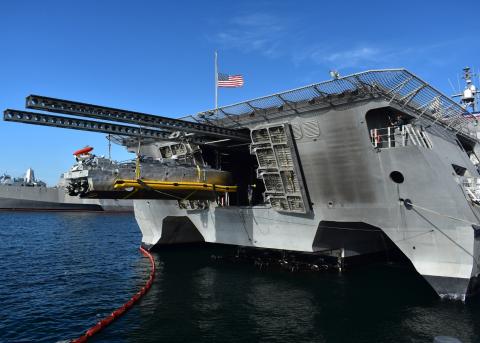

Autonomous ocean robots spend year traveling under ice sheet and reporting long-term observations
Over the last year, a team of autonomous ocean robots has successfully traveled under an ice sheet and returned to report long-term observations, the University of Washington (UW) has announced.
A partnership between a number of entities including the University of Washington’s College of the Environment, the UW Applied Physics Laboratory, the Lamont-Doherty Earth Observatory of Columbia University, the Korean Polar Research Institute and Paul G. Allen Family Foundation, the robotic mission has traveled under the ice shelf 18 times, and has routinely reached more than 25 miles into the cavity.
Texas Department of Transportation to create Connected and Autonomous Vehicle Task Force
The Texas Department of Transportation (TxDOT) has announced plans to create a Connected and Autonomous Vehicle (CAV) Task Force, which will serve as a central point for CAV advancement in Texas.
The task force will serve as a one-stop resource for information and coordination on all ongoing CAV projects, investments and initiatives in Texas. It will also be used to document the efforts of both public and private entities, and help facilitate partnerships.
Along with these responsibilities, the task force will also host industry forums and report lessons learned to enable progress and encourage more collaboration.
Georgia State researcher and collaborators awarded grant to develop UAS to battle wildfires
Through the National Robotics Initiative 2.0: Ubiquitous Collaborative Robots program, the United States Department of Agriculture-National Institute of Food and Agriculture has awarded Georgia State researcher Xiaolin Hu and collaborators a four-year federal grant worth $1.2 million to develop the use of UAS in wildfire management.
The goal of the project is to provide more timely data that could allow authorities to give residents in affected areas more time to evacuate, while also helping firefighters working on the ground.
Boeing completes first test flight of its autonomous passenger air vehicle prototype
On Tuesday, Jan. 22, Boeing successfully completed the first test flight of its autonomous passenger air vehicle (PAV) prototype in Manassas, Virginia.
During the flight, the PAV prototype, which is 30-feet long and 28-feet wide, completed a controlled takeoff, hover and landing, which tested its autonomous functions and ground control systems.
Boeing says that future flights will test forward, wing-borne flight, as well as the transition phase between vertical and forward-flight modes—a phase that is usually the most important engineering challenge for any high-speed vertical takeoff and landing (VTOL) aircraft, according to Boeing.

Ontario looks to grow its autonomous vehicle industry
During a recent visit at the University of Waterloo, Ontario, Canada’s Minister of Transportation Jeff Yurek showed his support for the innovation and growth of the autonomous vehicle industry within the Canadian province.
Ontario has updated its Automated Vehicle Pilot program to allow for more testing of emerging technologies, as well as to support future sales of the next generation of automobiles. These actions are a part of a recent package to create jobs by eliminating red tape and burdensome regulations.