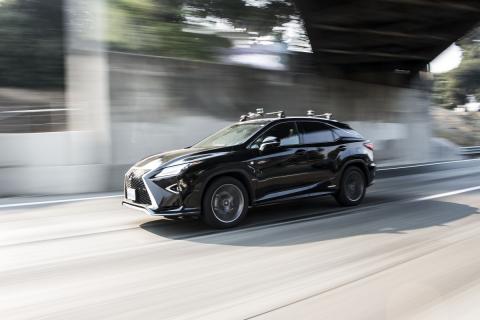
Self-driving technology company COAST Autonomous has signed a Memorandum of Understanding with Saint Leo University in Florida to collaborate on the development of a plan for introducing an autonomous system onto the university's campus that works alongside existing campus transportation.
The deployment will include identifying routes and running simulations to determine the ideal fleet size and vehicle types that are needed to provide an efficient and useful service. This could include COAST P-1 shuttles and/or self-driving golf carts.
Autonomous Vehicles
Autonomous Vehicles
COAST Autonomous, Saint Leo University developing plan for autonomous system for university's campus
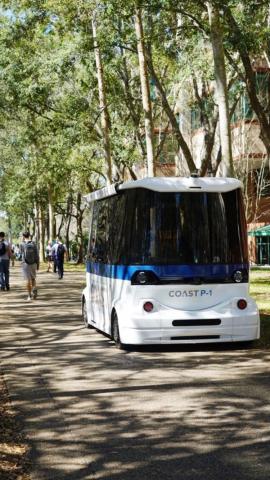
DGI awards North Carolina A&T State University $50,000 to prototype and deploy self-driving shuttles
Economic development organization Downtown Greensboro Inc. (DGI) has given North Carolina Agricultural and Technical (A&T) State University $50,000 to prototype and deploy two self-driving shuttles.
Self-driving shuttles to connect residents to community resources in Linden neighborhood of Columbus
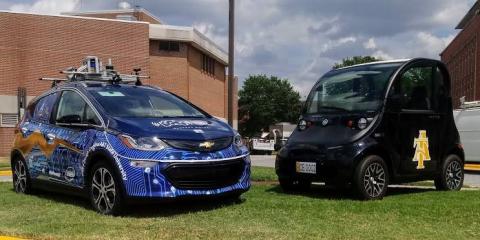
A one-year self-driving shuttle pilot program is set to launch in Columbus, Ohio.
Known as the Linden LEAP (Linden Empowers All People), the pilot program, which is being funded by Columbus’ win of the U.S. Department of Transportation’s Smart City Challenge, will service destinations around the South Linden neighborhood of Columbus from 6 a.m. to 8 p.m. daily, with stops in service during school arrival and dismissal times.
Linden LEAP is being described as the nation’s first public self-driving shuttle in a residential area.
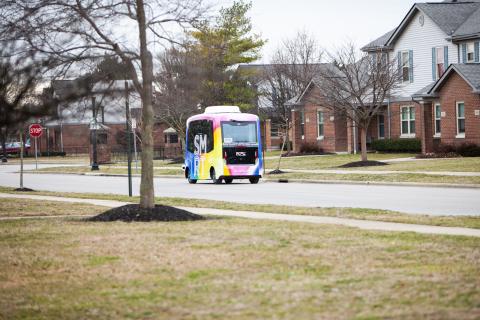
Autonomous vehicle pilot program set to launch in Peoria, Arizona in late February
Peoria, Arizona’s city council has approved the funding for a 60-day autonomous vehicle pilot program with Beep, an autonomous mobility technologies company based in Florida.
The program will result in Arizona’s first shared-ride, autonomous shuttle operating on a public street.
“This transportation pilot is a unique experiment for our community,” says Mayor Cathy Carlat.
“We see this as an important step as we seek to understand some of the innovative solutions that exist around the world, and how they bring value to Peoria residents.”
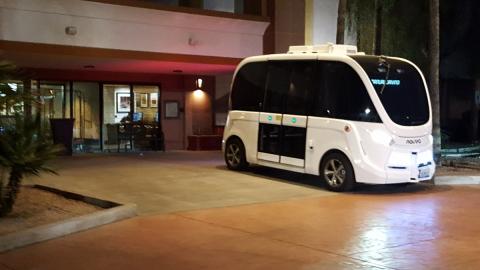
Autonomous shuttle begins offering test rides between downtown Gainesville and UF campus
An autonomous shuttle began operating between downtown Gainesville and the University of Florida (UF) campus on Monday, Feb. 3.
The Florida Department of Transportation (FDOT) funded the shuttle, and the City of Gainesville’s Regional Transit System (RTS) is operating it.
The pilot project is part of a real-world testbed called I-STREET. The testbed offers unique opportunities to test transportation technologies, and allows for the development and deployment of innovative research throughout the city and the UF roadway network. The testbed is a result of a partnership between the University of Florida Transportation Institute (UFTI), FDOT, and the City of Gainesville.
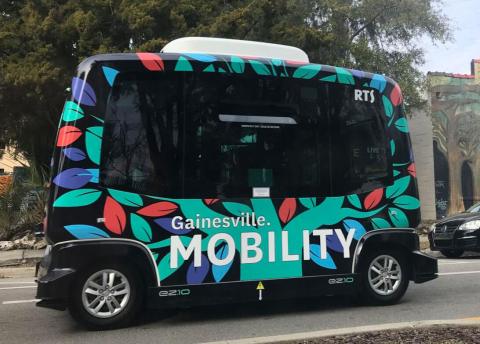
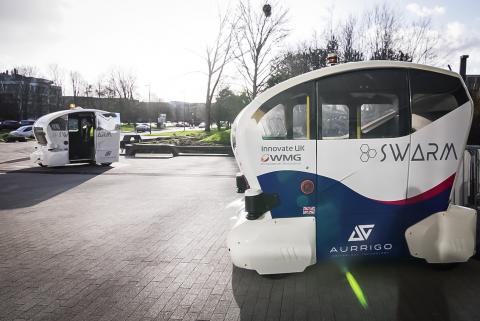
WMG at University of Warwick, partners develop autonomous pods capable of swarming
WMG at the University of Warwick in Coventry, England, Aurrigo and Milton Keynes council have conducted research that has made the concept of swarming autonomous pods a reality.
Researchers envision a scenario where passengers would be able to use an app to hail a pod, and if they are traveling in a group, they could hail a platoon of pods.
Designed for pedestrian areas and shared spaces to enable first and last mile service, the pods have been equipped with swarming skills typically used by birds and insects.
RoboSense LiDAR and the future of self-driving cars
To achieve large-scale commercialization of autonomous vehicles, a new generation of high-precision 3D environment sensing solid-state LiDAR technology products will be required to fulfill the industry’s strict requirements.
Q&A with Dr. Leilei Shinohara, VP of R&D

Apex.AI announces availability of Apex.OS 1.0 for autonomous vehicles
Autonomous driving software developer Apex.AI has announced the availability of Apex.OS 1.0 for its customers and partners.
Apex.OS is based on open-source ROS 2. According to Apex.AI, ROS is the “de facto standard” for robotics. With Apex.OS, that standard is now extending to the autonomous driving industry, which gives companies a head start on bringing safety to the autonomous driving software layer, ultimately allowing these companies to “focus their business on their own key differentiators, and much faster time to market,” Apex.AI says.