This week (and last) in the Unmanned Systems and Robotics World
Mississippi State University (MSU) engineers in the university’s Raspet Flight Research Laboratory are leading research efforts that could make UAS operational by the U.S. government, as well as civilian aviation, in icy conditions. The U.S. Department of Defense is hoping that the icing system development and technology team being led by MSU will result in lightweight anti-icing systems, which would lead to certification for UAS to operate in forecasted icing conditions. (Mississippi State University)
Autonomy
Autonomy
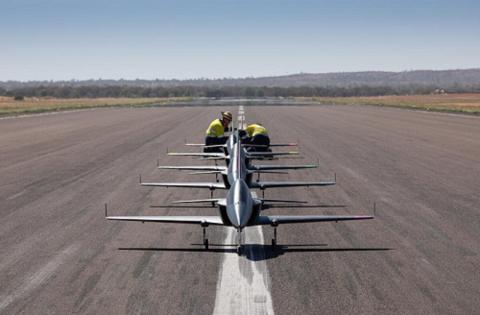
Boeing completes tests of its advanced autonomy technology
Boeing has announced that it recently completed flight tests with five high-performance surrogate jets operating autonomously in a team at the new Queensland Flight Test Range in Cloncurry, Australia.
The 11-foot aircraft were used to test Boeing’s advanced autonomy technology, including on-board command and control and data sharing capabilities.
“The tests demonstrated our success in applying artificial intelligence algorithms to ‘teach’ the aircraft’s brain to understand what is required of it,” says Emily Hughes, director of Phantom Works International.
Weekend Roundup: November 20, 2020
This Week in the Unmanned Systems and Robotics World
Students and faculty at James Madison University in Harrisonburg, Virginia are working on an autonomous vehicle that can transport the elderly. The JMU Autonomous Cart (JACart) research group tested its second autonomous (AV) golf cart on the university’s campus in a fixed course on Wednesday, Nov. 18. (WHSV-TV)
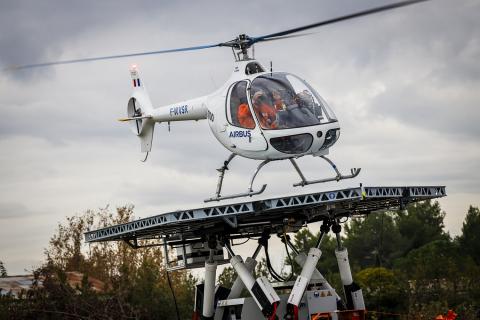
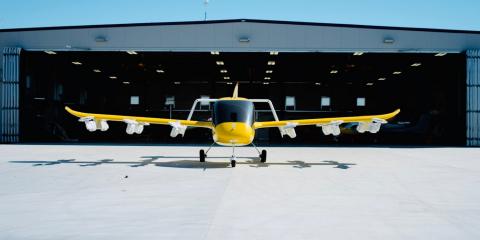
Wisk, NASA partner to safely integrate autonomous aircraft systems into UAM applications at national level
Urban Air Mobility (UAM) company Wisk is partnering with NASA to focus on the safe integration of autonomous aircraft systems into Urban Air Mobility applications at a national level.
The partnership is part of NASA's Advanced Air Mobility National Campaign strategy to develop key guidance for UAM operations. To accelerate U.S. leadership in emerging automated aviation technology, the partnership will also address key challenges such as certification and standards development.
Initially, the partnership will address critical National Campaign safety scenarios, with a focus on autonomous flight and contingency management, including collision avoidance and flight path management.
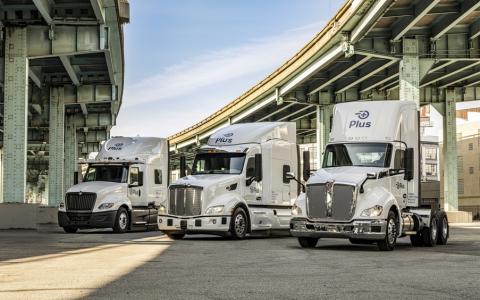
Plus selects BlackBerry technology for its automated driving system for Class 8 trucks
Plus has selected BlackBerry Limited’s QNX technology for the global commercial deployment of its automated driving system for Class 8 trucks.
Plus is the first automated truck developer to use BlackBerry QNX technology for its next-generation self-driving systems. The systems are expected to be commercialized and deployed beginning in 2021 by Plus and FAW, which is China’s largest heavy-duty truck maker. In the next two years, Plus also plans to deploy thousands of intelligent, automated trucks in the US.
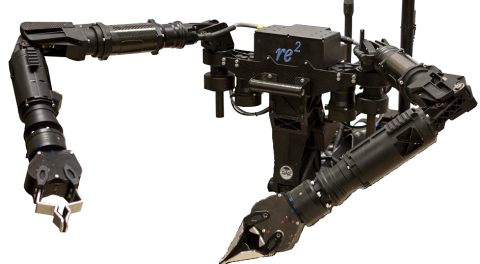
RE2 Robotics receives $1.1 million in funding to develop mobile robotic manipulation system for U.S. Army
RE2 Robotics has received $1.1 million in Phase II Small Business Innovation Research (SBIR) funding from the U.S. Army Telemedicine and Advanced Technology Research Center (TATRC) to develop a mobile robotic manipulation system that will allow combat medics to remotely assess and extract injured soldiers on the battlefield.
Known as Autonomous Casualty Extraction (ACE), the program will utilize RE2 Robotics’ dual-arm Highly Dexterous Manipulation System (HDMS) mounted to a FLIR Kobra UGV from FLIR Systems Inc., to autonomously locate a casualty in the field.
Weekend Roundup: November 6, 2020
This Week in the Unmanned Systems and Robotics World
Drones are being used to survey seven UC natural reserves that were damaged during August wildfires. The drones are revealing the extent of the damage, and providing scientists with data that can help them understand the long-term and short-term damage caused by the fires. (Phys.org)
Weekend Roundup: October 16, 2020
This Week in the Unmanned Systems and Robotics World
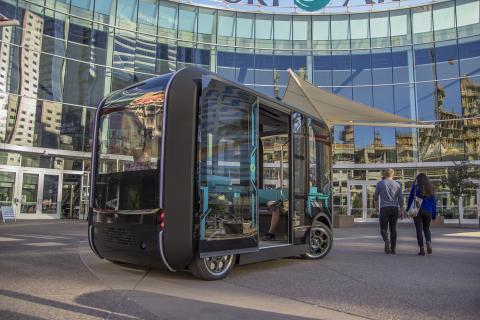
As part of an automated transportation trial in spring 2021, the latest version of Local Motors’ Olli driverless shuttles will begin operating in the city of Toronto next year. Expected to last six to 12 months, the test run will measure how well the autonomous vehicles will bolster Toronto’s mass transit system. (Engadget)
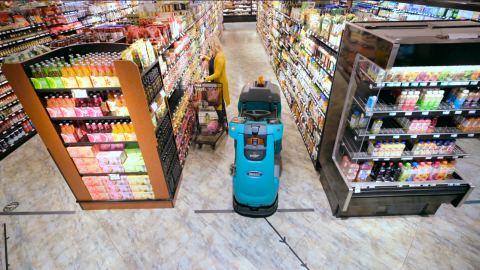
Brain Corp launches new UX design and reporting capabilities for autonomous mobile robots
Artificial intelligence software technology company Brain Corp has launched new user experience (UX) design and reporting capabilities that revolutionize the ease of which autonomous mobile robots (AMRs) can be used and managed at scale.
Designed to optimize usage of robots powered by BrainOS—an AI software platform that is used to build, operate, and manage multiple robotic applications—for different types of users on a global basis, the software enhancements also include powerful new software features for BrainOS-enabled robotic scrubbers that deliver improved cleaning efficiency and flexibility for commercial locations.
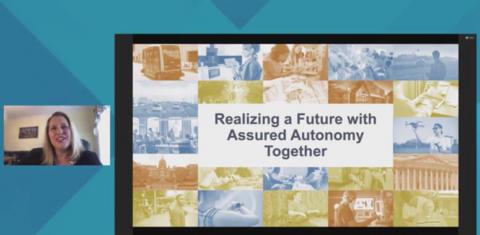
Dr. Cara LaPointe provides an overview of Assured Autonomy, the theme of Xponential 2021
As autonomy and artificial intelligence continue to be integrated into systems across society, making sure these systems work properly continues to be of the utmost importance.
“It’s really important to make sure these systems work like they’re supposed to, but it can be really hard,” says Dr. Cara LaPointe, co-director, Institute for Assured Autonomy, Johns Hopkins University Applied Physics Laboratory.
The goal is to reach a point of assured autonomy, where people can be confident that the autonomous systems around them are, and will, operate the way they are designed to. Reaching this point requires making sure that these systems are safe, secure, resilient and capable of operating within an ecosystem alongside humans and other technologies.