Sea Machines Robotics has closed a new $15 million financing round, which marks one of the largest venture rounds for an advanced technology company serving the marine and maritime industries, according to Sea Machines.
“This reinforces Sea Machines’ position as the leading developer of autonomous navigation and wireless vessel control systems,” says Michael G. Johnson, CEO, Sea Machines.
“Our ability to secure significant financing during a challenging economic environment is an indicator of investors’ confidence in our ability to reshape and retool the marine industries with modern-day, advanced technologies.”
Autonomy
Autonomy

Weekend Roundup: July 17, 2020
This Week in the Unmanned Systems and Robotics World
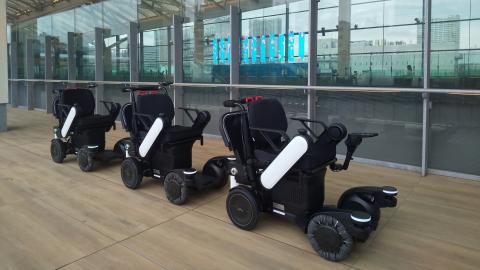
In association with JR East Group, Panasonic Corporation and Panasonic Production Engineering Co., Ltd. have launched a mobility service trial using Panasonic's robotic mobility device, an electric wheelchair with autonomous tracking function. The goal of the trial is to verify serviceability of the devices in a sunny, semi-outdoor environment. (Panasonic)
UAVOS joins HAPS Alliance to promote use of high-altitude solar-powered autonomous aircraft
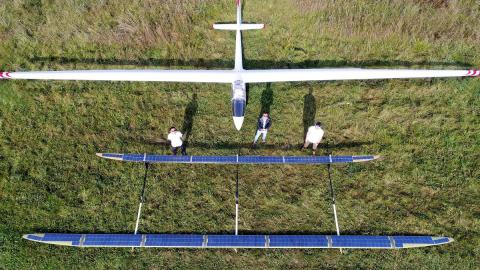
UAVOS has joined the High Altitude Platform Station (HAPS) industry Alliance to promote the use of high-altitude solar-powered autonomous aircraft for facilitating global research missions, communication, connectivity, intelligence, surveillance and reconnaissance from the stratosphere.
By joining the HAPS Alliance, UAVOS will collaborate with member companies towards accelerating the development and adoption of HAPS technology into the evolution of the high altitude unmanned platforms market.
UAVOS says that its HAPS knowledge is based on test flights for more than 1000 hours of HAPS flight tests at altitudes of up to 66,000 feet. The ApusDuo project is the second generation of UAVOS’ HAPS solar airplane.
Weekend Roundup: June 19, 2020
This Week in the Unmanned Systems and Robotics World
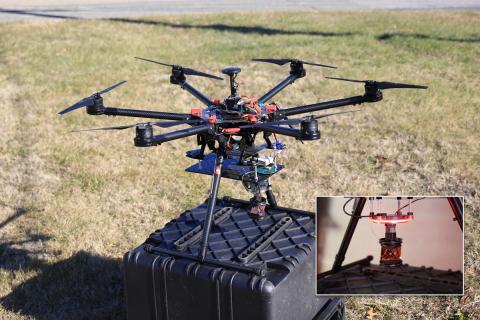
A proof of concept experiment by a multi-institutional research team shows that deploying sterile mosquitoes via drones could accelerate efforts to control their populations and reduce insect-borne disease. The project is a collaborative effort between French, Swiss, British, Brazilian, Senegalese and other researchers, and seems to be the most effective and practical approach to releasing sterilized male mosquitoes into the wild, where they compete with the other males for food and mates but produce no offspring. (TechCrunch)
Chinese construction machinery manufacturer XCMG unveils autonomous Road Roller
Following successful tests conducted at the end of May, Chinese construction machinery manufacturer XCMG has unveiled its autonomous Road Roller, which it developed in collaboration with the Sichuan Railway Investment Group and Tsinghua University.
The autonomous Road Roller made its debut along the Panda Expressway, which is currently under construction between Panzhihua, Sichuan Province and Dali, Yunnan Province.
“Over 81% of Panda Expressway consists of bridges and tunnels, making it one of China's key smart transportation infrastructure projects,” says Cui Jisheng, general manager of XCMG Road Machinery.

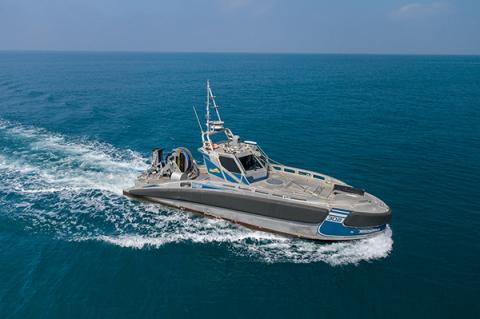
Elbit Systems UK uses Seagull USV during Anti-Submarine Warfare trials with UK MoD
Elbit Systems UK has announced that it completed a series of Anti-Submarine Warfare (ASW) trials with the UK Ministry of Defence (MoD).
Delivered via Defence Science and Technology Laboratory's (DSTL) Progeny Framework, the trials explored how future ASW operations could be supported by autonomous systems.
“Elbit Systems has world leading technology to offer to the maritime and littoral environment,” says Martin Fausset, CEO of Elbit Systems UK.
BAE Systems to provide autonomy and artificial intelligence capabilities for DARPA's Squad X program
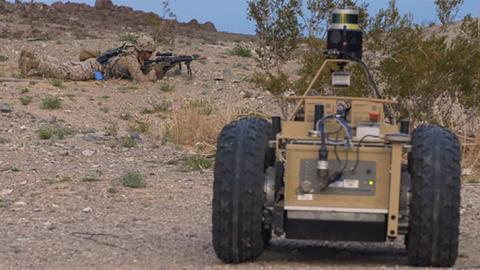
Lockheed Martin, the prime contractor for DARPA’s Squad X program, has awarded BAE Systems a $3.5 million contract to provide key autonomy and artificial intelligence capabilities that would not only advance the effectiveness of tactical robotic air and ground vehicles, but also create true partnerships between ground warfighters – Soldiers and Marines – and machines at the small-unit level.
EHang granted approval to use EHang 216 passenger-grade AAV for air logistics purposes
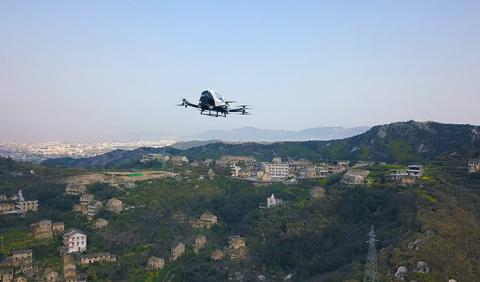
EHang has obtained the world’s first commercial pilot operation approval to use passenger-grade autonomous aerial vehicles (AAVs) for the purpose of air logistics. The approval came from the Civil Aviation Administration of China (CAAC), and is for the EHang 216 AAV.
RE2 Robotics to equip Maritime Dexterous Manipulation System with autonomous capabilities
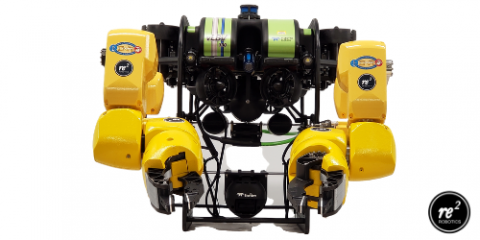
RE2 Robotics will continue the development and commercialization of its technology under the Dexterous Maritime Manipulation System (DM2S) program after receiving $2.5 million in funding from the Office of Naval Research.
Equipped with RE2’s DM2S technology, Navy personnel will be able to autonomously perform mine countermeasure (MCM) missions.
During the next phase of the program, RE2 Robotics will upgrade its dual-arm prototype, known as the Maritime Dexterous Manipulation System (MDMS), for deep ocean use. To enable autonomous manipulation capabilities, the company will also apply computer vision and machine-learning algorithms. Lastly, RE2 says that it will integrate with underwater vehicles that can autonomously navigate.
Weekend Roundup: May 8, 2020
This Week in the Unmanned Systems and Robotics World
The FAA recently awarded a $1.6 million contract to advance unmanned traffic management (UTM) at the New York UAS Test Site. A team of five commercial companies—led by CAL Analytics—will develop a single, integrated contingency management platform (CMP) for UAS integration. (NUAIR)