Bell Textron Inc. has announced that its Autonomous Pod Transport (APT) 70 has successfully completed its first autonomous flight at the company’s testing site near Fort Worth, Texas.
Throughout the rest of 2019, Bell plans to continue testing the vehicle under an experimental type certificate.
“We are excited to reach this milestone, and look forward to continuing to advance this technology for our customers,” says Scott Drennan, vice president, Innovation.
Autonomy
Autonomy
Sea Machines demonstrates how autonomous tech can increase safety of marine oil-spill response ops
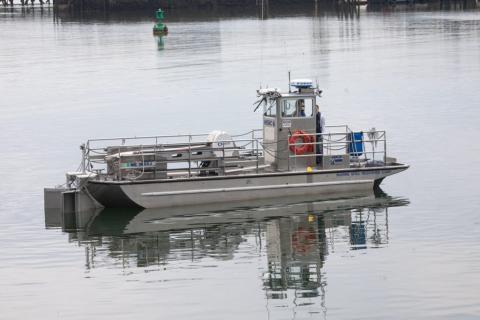
Sea Machines Robotics has announced that as part of its cooperative agreement with the U.S. Department of Transportation Maritime Administration (MARAD), it successfully demonstrated its autonomous systems for use onboard a Kvichak Marco skimmer boat during events held along the Portland harbor on Aug. 21.
A Vigor/Kvichak Marine Industries-built skimmer boat was utilized during the on-water demonstrations. According to Sea Machines, the boat, which is owned by Marine Spill Response Corp. (MSRC), is the world’s first autonomous spill response vessel.
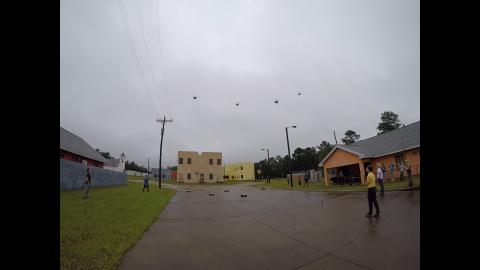
Swarms of air and ground robots tested during second field experiment for DARPA's OFFSET program
DARPA has announced that during the second field experiment for its OFFensive Swarm-Enabled Tactics (OFFSET) program, teams of autonomous air and ground robots tested tactics on a mission to isolate an urban objective.
During the experiment, which took place in June at the Selby Combined Arms Collective Training Facility in Fort Benning, Georgia, the robots started off by identifying locations of interest, and then created a perimeter around the focal point, similarly to how a firefighting crew establishes a boundary around a burning building.
Sea Machine Robotics, MARAD to showcase how autonomous tech can increase safety of marine oil-spill response ops
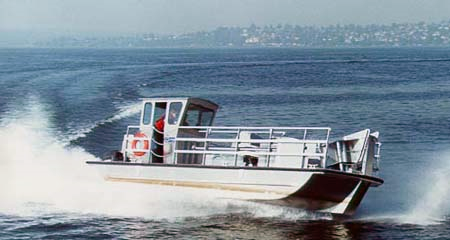
Sea Machines Robotics and the U.S. Department of Transportation’s Maritime Administration (MARAD) have entered into a cooperative agreement to showcase how Sea Machines’ autonomous technology can be used to increase the safety, response time and productivity of marine oil-spill response operations.
On-water exercises will be conducted once Sea Machines equips a Marine Spill Response Corp. (MSRC)-owned MARCO skimming vessel—manufactured by Kvichak Marine Industries—with its SM300 autonomous-command system. Sea Machines will train MSRC personnel on how to operate the system.
Grand Sky to purchase Firebird aircraft from Northrop Grumman
Grand Sky Development Company LLC (Grand Sky) has announced that it will purchase Northrup Grumman’s optionally piloted intelligence, surveillance, and reconnaissance (ISR) aircraft system, Firebird.
Designed to provide critical ISR capability to meet the mission needs of customers, Firebird is available in manned, autonomous and optionally piloted configurations.
“We are excited to bring Firebird to Grand Sky to utilize its long-endurance and variable payload capabilities for commercial customers,” says Grand Sky Development Co. President Thomas Swoyer Jr.

Northland Community & Technical College awarded grant to form National Center for Autonomous Technologies
The National Science Foundation (NSF) has awarded Northland Community & Technical College and five partner agencies a $7 million grant to form the National Center for Autonomous Technologies (NCAT), which will be hosted on Northland’s Aerospace site in Thief River Falls, Minnesota.
The NCAT will join the NSF’s large circle of Advanced Technological Education Centers (ATE).
“We will build upon the work of several other NSF ATE program investments, including Northland’s DRONETECH programs, MATE, CAAT, and GeoTech,” says Jon Beck, Northland Unmanned Aerial Systems (UAS) instructor & NCAT principal investigator.
UAV Navigation announces autopilot for USVs and ASVs
UAV Navigation has announced that it has developed an autopilot for USVs and ASVs.
Designed to comply with IP66—which means that it can work in humid conditions, including salt spray and saline environments—UAV Navigation’s autopilot is capable of completely autonomously controlling a USV mission from beginning to end.
According to UAV Navigation, all of the advanced features available for UAS can be used by USV operators, including multiple waypoints, multiple onboard mission plans, and no-go zones.
One of the most useful features of the autopilot, according to UAV Navigation, is ‘relative routes,’ which is the ability to install the Ground Control Station (GCS) on a moving ship, and then to fix a mission plan relative to the moving vessel.
Sikorsky's optionally piloted vehicle technology used to fly Black Hawk helicopter for first time
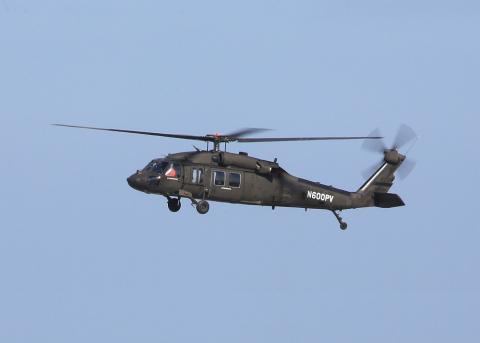
On May 29, a Black Hawk helicopter was operated with full-authority, fly-by-wire flight controls for the first time using a technology kit developed by Sikorsky.
The flight marked the official start to the flight test program for the soon-to-be optionally piloted aircraft. Follow-on flight testing will look to include envelope expansion throughout the summer leading to fully autonomous flight (zero pilots) in 2020.
Sonardyne acquires maritime software and equipment specialist EIVA
Sonardyne International Ltd. has announced that it has acquired maritime software and equipment specialist EIVA A/S, marking the latest step in the company’s long-term growth strategy.
“We are committed to a sustainable future for Sonardyne, which includes investing in complementary technologies and enterprises that supplement our core expertise in underwater communications, navigation, monitoring and imaging systems,” says Simon Partridge, Sonardyne’s strategy director.
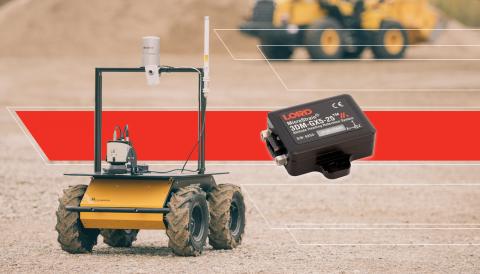
LORD equipping Clearpath research robot platform with inertial sensors through new partnership
LORD Corp. has partnered with Clearpath Robotics to equip the Clearpath research robot platform with LORD’s inertial sensors.
LORD inertial sensors enhance the autonomous capabilities of Clearpath’s robots, helping provide them with precise navigation in applications such as 3-D mapping in difficult terrain.