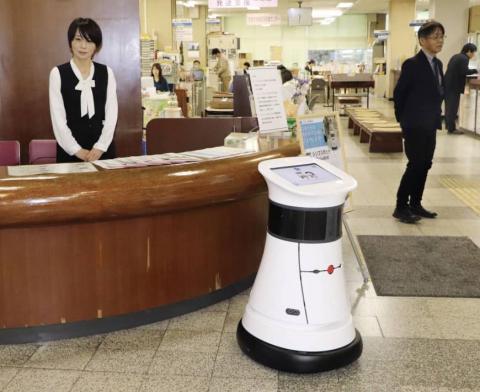
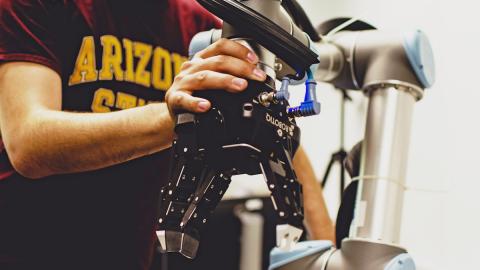
Arizona State University’s Ira A. Fulton Schools of Engineering has created a new master’s degree program in robotics and autonomous systems.
The program is designed to train the next generation of robotics researchers with multidisciplinary knowledge in a variety of advanced topics, including but not limited to, artificial intelligence, computer science and machine learning.
“In the future, we’re going to be interacting with intelligent machines a lot in our everyday lives,” says Panagiotis Artemiadis, the robotics and autonomous systems graduate program chair and an associate professor of aerospace and mechanical engineering.
Autonomy
Autonomy
Elroy Air optimistic that its autonomous VTOL air cargo system will unlock the logistics potential of the sky
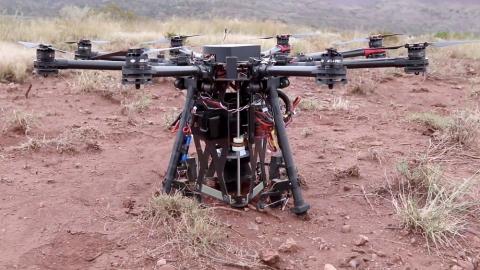
A company called Elroy Air that is developing an autonomous vertical takeoff and landing (VTOL) air cargo system has closed a $9.2 million seed round of funding, according to VentureBeat.
The company says that it is developing its autonomous VTOL air cargo system for three primary reasons. First, it believes “access to express shipping improves quality of life and economic opportunities for people, and should be available to everyone.”
Second, it believes that “now is the moment in history when autonomous VTOL aircraft can be developed to expand the reach of air cargo at scale.”

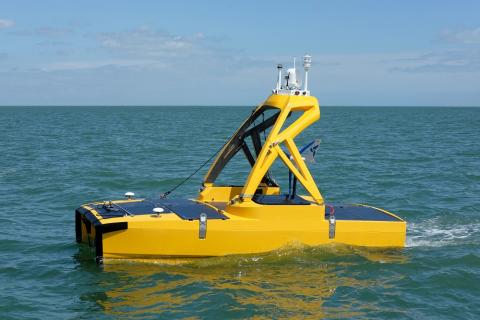
L3 ASV delivers long-endurance autonomous vessel to Royal Navy
L3 ASV has delivered a long-endurance autonomous vessel known as the C-Enduro to the Royal Navy.
According to L3 ASV, the vessel will be used for military data gathering trials by the Mine countermeasures and Hydrographic Capability (MHC) program, as the Navy looks to utilize autonomous technology.
“We are proud to support the Royal Navy in their plans to explore the uses of marine autonomy as they continue to invest in new and exciting technology,” says Vince Dobbin, sales and marketing director for L3 ASV.
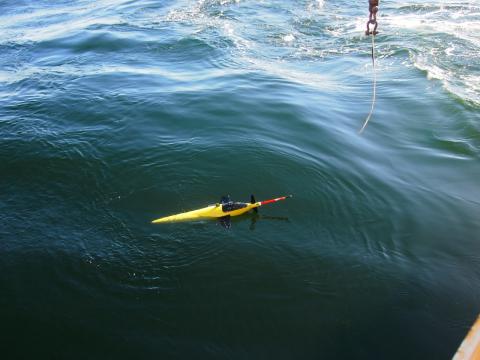
Autonomous ocean robots spend year traveling under ice sheet and reporting long-term observations
Over the last year, a team of autonomous ocean robots has successfully traveled under an ice sheet and returned to report long-term observations, the University of Washington (UW) has announced.
A partnership between a number of entities including the University of Washington’s College of the Environment, the UW Applied Physics Laboratory, the Lamont-Doherty Earth Observatory of Columbia University, the Korean Polar Research Institute and Paul G. Allen Family Foundation, the robotic mission has traveled under the ice shelf 18 times, and has routinely reached more than 25 miles into the cavity.
Boeing completes first test flight of its autonomous passenger air vehicle prototype
On Tuesday, Jan. 22, Boeing successfully completed the first test flight of its autonomous passenger air vehicle (PAV) prototype in Manassas, Virginia.
During the flight, the PAV prototype, which is 30-feet long and 28-feet wide, completed a controlled takeoff, hover and landing, which tested its autonomous functions and ground control systems.
Boeing says that future flights will test forward, wing-borne flight, as well as the transition phase between vertical and forward-flight modes—a phase that is usually the most important engineering challenge for any high-speed vertical takeoff and landing (VTOL) aircraft, according to Boeing.

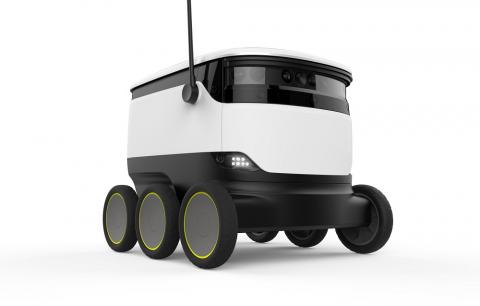
Starship Technologies and Sodexo launch robot food delivery service at George Mason University
On Tuesday, Jan. 22, Starship Technologies and global food and facilities management services provider Sodexo Inc. launched a robot food delivery service at George Mason University’s campus in Fairfax, Virginia.
The service will allow George Mason’s 40,000 students, faculty and staff to order food and drinks that can be delivered anywhere on campus, within minutes, via Starship's robots.
Some of the initial retailers participating in the service include Blaze Pizza, Starbucks, and Dunkin’, with more retailers expected to be announced in the coming weeks.
University of Iowa graduates develop robotic quarterback for football players
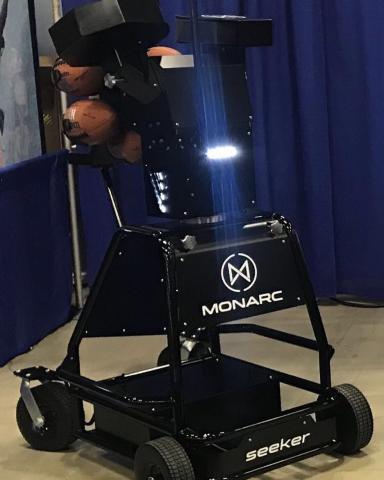
University of Iowa (UI) graduates have developed what they are calling the first autonomous training device for football receivers.
Known as the Seeker, the robotic quarterback throws footballs to receivers autonomously, allowing players to practice independently. The robot also provides a plethora of beneficial data that allows coaches to track the work ethic of their players, including the time of day the player practiced, the number of repetitions, and how quickly they were completed.
Video footage of the Seeker in action can be seen below: