
KPIT Technologies has partnered with a Silicon Valley-based lifelong learning platform called Udacity to upskill and build the engineering talent ecosystem for autonomous technology, including self-driving cars and autonomous flight.
A global technology partner to OEMs and Tier 1s, KPIT helps these companies accelerate the implementation of next generation vehicle technologies, including autonomous driving.
Autonomy
Autonomy
MIT researchers believe autonomous system could guide fleet of UAS during searches for lost hikers
This week during the International Symposium on Experimental Robotics conference, MIT researchers will present a paper in which they describe an autonomous system for a fleet of UAS that would enable UAS to search for lost hikers in forests.
GPS signals used to guide UAS can be unreliable or nonexistent in forest environments, so the MIT researchers propose a strategy where UAS only use onboard computation and wireless communication—effectively eliminating the need for GPS—as they collaboratively search under dense forest canopies.

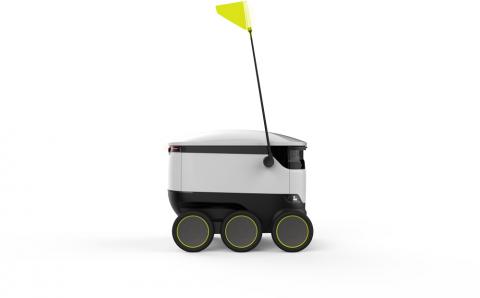
Starship Technologies' autonomous delivery robots take to the streets of the UK
On Oct. 31, Starship Technologies launched what it calls the world’s first autonomous package delivery service, as hundreds of the company’s robots will be used to deliver packages straight to the front doors of consumers.
Right now, the service is available through Starship’s official app for residents living in the UK (Milton Keynes). By simply clicking a button, these residents can have packages delivered to their front door whenever they choose.
According to Starship, once people sign up on the app, they will receive a ‘personal address’ in place of their home address or whichever location they normally get parcels delivered to. This personal address will be the location of a Starship managed local facility.
Automated drone startup Airobotics receives $30 million in funding
Automated drone startup Airobotics has announced a $30 million Series D round of funding, which brings its total capital raised to $101 million. Based in Israel, Airobotics says that it will use this round of funding to further scale its operations in the U.S. and Australia.
Recently, Airobotics launched its North American headquarters in Scottsdale, Arizona. From this location, Airobotics will run all North America, South America and Central America operations. The Scottsdale office will also become the company’s global headquarters as Airobotics continues to scale.
Airobotics will also use this latest round of funding to continue servicing the mining industry and other industrial facilities across the world.
General Dynamics releases new Bluefin-9 autonomous UUV
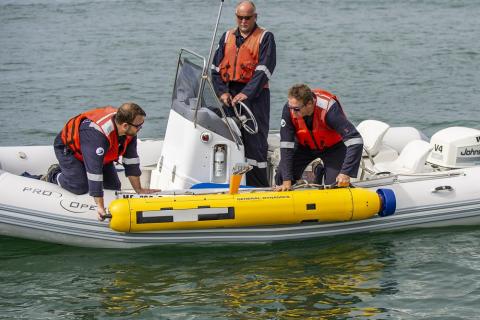
During Oceans 2018 in Charleston, South Carolina on Tuesday, Oct. 23, General Dynamics Mission Systems released the new Bluefin-9 autonomous UUV.
Completely reengineered, the vehicle provides defense, commercial and academic customers with highly-detailed subsurface data in just minutes thanks to the combination of high navigational accuracy, outstanding sonar resolution, and precision manufacturing.
Capable of providing the same data collection capabilities of larger UUVs, the two-man portable Bluefin-9 autonomous UUV can be deployed and recovered from piers, a rigid-hulled inflatable boat (RHIB) or other vessels of opportunity.
UAVOS and Stratodynamics Aviation finalizing balloon-launched unmanned glider
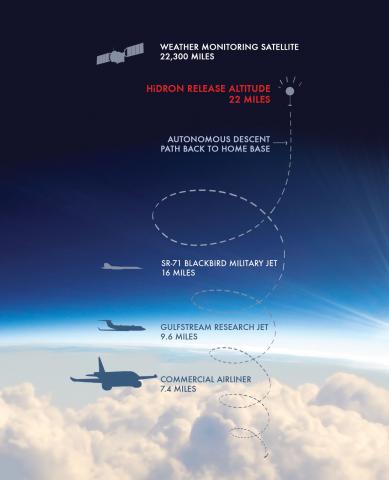
UAVOS Inc., along with Stratodynamics Aviation Inc., is finalizing manufacturing of HiDRON, a stratospheric aircraft that is built to provide a “new dynamic method for measuring and evaluating atmospheric phenomena at various altitudes in a variety of geographical locations.”
Designed to collect high-altitude atmospheric data, the balloon-launched unmanned glider is capable of autonomous and soaring flight modes.
During a campaign next month, the HiDRON will reach altitudes up to 82,000 feet, the companies say.
Honeywell and Fetch Robotics collaborating to deliver autonomous mobile robots to distribution centers
Honeywell and Fetch Robotics are partnering to deliver autonomous mobile robots (AMRs) to distribution centers, in an effort to help them “more effectively fulfill growing volumes of e-commerce orders.”
The collaboration between the two entities enables Honeywell Intelligrated's customers to increase productivity and boost labor efficiency by deploying Fetch Robotics' AMRs, which transport items through distribution centers without human guidance or fixed paths, all while operating safely alongside people.
With Fetch Robotics’ AMRs a part of its smart robotics portfolio, Honeywell Intelligrated can provide customers with a range of flexible automation technology that can be adjusted to address current and future operational needs.
NASA and MTSI to develop framework for autonomous aircraft that can be used to achieve FAA certification
Over the next 24 months, NASA and Modern Technology Solutions Inc. (MTSI) will collaborate to develop a framework for autonomous aircraft that can be used to achieve FAA certification.
Known as Resilient Autonomy, the NASA-led project’s goal is to develop a “robust architecture and methodology” for certifying fully autonomous systems by using a technique known as multi-mode run-time assurance (MM-RTA). MM-RTA places a deterministic "wrapper" around the autonomous system's non-deterministic software to safely bind the untrusted system's behavior.
Bell and Yamato seek to transform on-demand delivery service by integrating autonomous UAS and package handling systems
Textron Inc. company Bell and Yamato Holdings Co., Ltd. have announced a strategic collaboration for the “future of civilian aerial logistics.”
With aspirations of being a global leader in electric vertical take-off and landing (eVTOL) logistics, Bell and Yamato plan to achieve this by working together to integrate innovative autonomous UAS and package handling systems in an effort to create an exceptional customer experience for on-demand logistics services.
The companies expect to introduce their initial product into service by mid-2020s.
Global UAV's Procyon 800E UAS successfully takes off and lands from a moving off-road vehicle
Using one of its research and development UAS from NOVAerial Robotics Inc., Global UAV Technologies Ltd., along with Planck Aerosystems Inc., successfully performed a fully autonomous landing and takeoff from a moving off-road vehicle.
The companies were able to accomplish the precision landing and takeoffs thanks to Planck integrating its precision flight control software technology into the Procyon 800E UAS. The software enables the UAS to autonomously take off and land from moving vehicles and marine vessels of various sizes.