Exyn Technologies has announced that Velodyne LiDAR’s VLP-16 Puck LITE LiDAR sensors are now integrated into Exyn Technologies’ Advanced Autonomous Aerial Robots (A3R).
The primary sensor for simultaneous localization and mapping, the Velodyne VLP-16 is also part of the sense-and-avoid capabilities and state estimation.
“Using Velodyne’s VLP-16, Exyn’s A3Rs do not need GPS, beacons or markers,” explains Nader Elm, chief executive officer of Exyn Technologies.
Autonomy
Autonomy
Oil & Gas Technology Centre and others developing autonomous offshore robot
The Oil & Gas Technology Centre, Total E&P (Total), taurob and the Technische Universitaet Darmstadt (TU Darmstadt) are all working together to develop a robot that could work autonomously alongside humans on a North Sea platform.
Through an 18-month project, which is being described as a “world-first,” the entities will develop and trial a mobile robot for “autonomous operational inspection” of facilities on Total’s onshore Shetland Gas Plant and offshore Alwyn platform.
According to the entities, the trial is the first time that an autonomous ground robot will be used on an operational oil and gas installation, and they believe that the project “could start a revolution in robotics offshore that improves safety, enhances productivity and reduces costs.”

AI Incorporated releases design for autonomous refuse robot
AI Incorporated, which is a Canadian robotics and artificial intelligence research company, has released a design for an autonomous refuse robot, which is considered a new application for mobile robotics, the company says.
The new AI enhanced robotics system introduces a device that can autonomously travel to the curbside and wait for the pickup truck at pre-scheduled times. Scheduling is completed using an app, and a user can also use the app to control the robot in the event that it needs help with navigation, or if it gets stuck.
According to AI Incorporated, this invention will render humans emptying trash cans “a thing of the past,” as the bins will simply leave their post to be emptied when it is time for pickup.

DJI and Skycatch developing Skycatch Explore1 UAS for Komatsu Smart Construction
DJI and Skycatch have announced that they have extended their partnership to manufacture and deliver a fleet of high-precision UAS for Komatsu Smart Construction.
Known as the Skycatch Explore1 drone, the UAS will be deployed on Komatsu job sites.
The UAS are manufactured by DJI, and outfitted with specialized Skycatch technology. According to DJI, this is the first time that it has manufactured a custom UAS for a partner.
Southwest Research Institute-led team developing UAS to use in Japan's Fukushima Daiichi Nuclear Power Plant
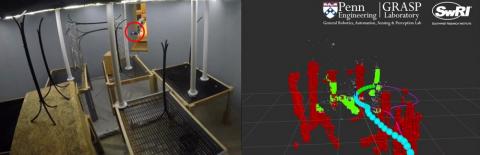
Southwest Research Institute (SwRI) is leading a team that is developing UAS technology to fly into the containment vessels of the damaged units at Japan’s Fukushima Daiichi nuclear power station and assess conditions.
SwRI was contracted by Tokyo Electric Power Company Holdings, Incorporated (TEPCO Holdings) to explore the use of UAS within the containment.
SwRI engineers are working with the General Robotics, Automation, Sensing and Perception (GRASP) Lab at the University of Pennsylvania (Penn) School of Engineering and Applied Science, to help “adapt small drones to autonomously operate within the containment.”
WPI students building autonomous security robot for U.S. Air Force
A team of undergraduate students at Worcester Polytechnic Institute (WPI) in Worcester, Massachusetts is attempting to turn a wheelchair into an autonomous security robot that could help protect unmanned installations for the U.S. Air Force.
The students are building this proof-of-concept robot using a tracked all-terrain wheelchair (trackchair)— provided by a company called Action Trackchair Inc.—and about $8,000 for supplies.
According to WPI, the military wants to have robots at unmanned bases that can respond to and investigate intrusion alarms and other warnings within two minutes. The robots would be used to safeguard thousands of unmanned bases, such as missile silos, around the world.
Boeing partners with Queensland Government to establish autonomous systems development program in Australia
Boeing has announced a new partnership agreement with the Queensland Government in Australia, which will result in Australia being home to Boeing’s largest autonomous systems development program outside of the U.S.
Over the next three years, Boeing will use the rapid innovation program to develop “next-generation autonomous systems capability” in Australia, in an effort to increase the independent operation of air and sea vehicles.
According to Chris Raymond, Boeing vice president and general manager, Autonomous Systems, the Queensland program formed part of Boeing’s global growth strategy to “accelerate game-changing autonomous technology for commercial and defence systems.”
AeroLabs and BGE autonomously inspect distribution assets in Maryland using UAS
In early February, AeroLabs and Baltimore Gas and Electric (BGE) successfully completed a test on the use of a DJI Matrice 210 UAS to perform autonomous inspections of distribution assets in a rural area of northern Maryland.
AeroLabs says that the Matrice “held its own and flew quite well on its programmed flight path” despite flying in adverse conditions, which included strong 15+ mph winds.
The test consisted of a 10-12 pole segment of a circuit that presented various hardware configurations, and tree encroachments that allowed AeroLabs to showcase the UAS' ability to safely maneuver around the assets, and avoid environmental hazards.
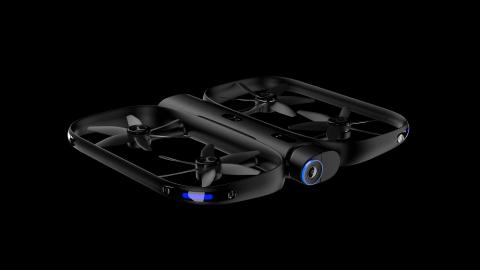
Skydio introduces R1, the 'world's first fully autonomous flying camera'
A California-based company called Skydio has announced the availability of its first product, R1, which is a fully autonomous flying camera. Skydio says that with the introduction of R1, it is “taking a step toward the future of autonomous drones and enabling a new type of visual storytelling.”
According to Skydio, a team of world-class researchers and engineers built R1 from the ground up for autonomous flight. The fully autonomous flying camera is powered by the Skydio Autonomy Engine, which allows it to “see and understand” the world around it, so that it can fly safely at high speeds while avoiding obstacles, even in dense and challenging environments.
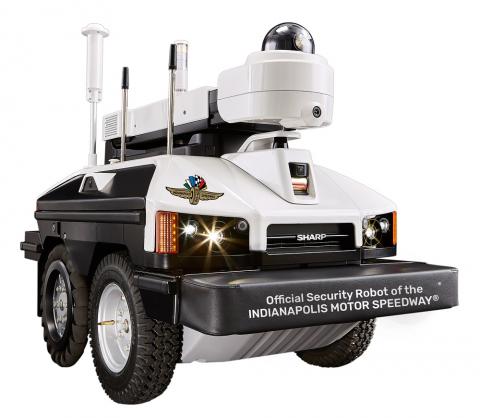
Indianapolis Motor Speedway set to begin using Sharp INTELLOS A-UGV for security purposes
The Sharp INTELLOS Automated Unmanned Ground Vehicle (A-UGV) has been named the “Official Security Robot of the Indianapolis Motor Speedway.”
The automated, driverless security robot is expected to provide an extra layer of safety and security protection for the Indianapolis Motor Speedway (IMS), which is the world's largest spectator sporting facility.
“Sharp Electronics' outdoor security robot is ideally suited to help safeguard the Indianapolis Motor Speedway's expansive, fenced property,” says Cliff Quiroga, Vice President for Sharp Robotics Business Development.