Sea Machines Robotics has partnered with workboats manufacturer Hike Metal to integrate its SM300 autonomous vessel control system aboard commercial vessels used for search-and-rescue (SAR) missions.
According to Sea Machines, the collaboration will “help develop and demonstrate the capabilities of autonomous marine technology for the purposes of increasing the productivity and safety of SAR operations.”
Autonomy
Autonomy

Charles River Analytics receives funding to enhance its MANTA system
Through the US Army’s Combat Vehicle Robotics (CoVeR) program, Charles River Analytics Inc. has received funding to enhance its Modular Appliqué Enabling Natural Teaming with Autonomy (MANTA) system.
The goal of the CoVeR program is to develop technologies that support scalable integration of multi-domain robotic and autonomous systems. Along those lines, MANTA, described as a “platform-independent, natural control and autonomy robot appliqué,” allows a user to easily direct or more host platforms to perform various autonomous behaviors.

U-M's Automotive Research Center shifting focus to autonomous technologies for military ground vehicles
The University of Michigan has announced that its Automotive Research Center (ARC) has been awarded a $50 million contract from the U.S. Army, extending the ARC’s 25-year partnership with the Army through 2024.
With the funding, the ARC will shift its focus to autonomous technologies for military ground vehicles.
Launched in 1994, the ARC has served as a source of technology, modeling and simulation for the Army’s fleet of vehicles, which is the largest in the world.
Amazon acquires warehouse robotics startup Canvas Technology
According to TechCrunch, Amazon has acquired Canvas Technology, a warehouse robotics startup based in Boulder, Colorado.
“We are inspired by Canvas Technology’s innovations, and share a common vision for a future where people work alongside robotics to further improve safety and the workplace experience,” an Amazon spokesperson says in a statement, via TechCrunch.
“We look forward to working with Canvas Technology’s fantastic team to keep inventing for customers.”

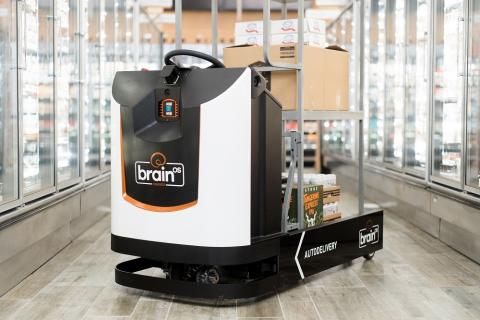
Brain Corp introduces AutoDelivery robot for retail facilities, warehouses and factories
Brain Corp has introduced a new proof-of-concept robot called AutoDelivery, which is powered by the company’s commercial operating system, BrainOS.
Described as an “autonomous tug” powered by BrainOS, AutoDelivery can operate across a number of different public environments, enabling the seamless transportation and delivery of goods from point A to B, Brain Corp says.
The robot can tow several common cart types, providing “easily customized, automated delivery solutions” for commercial and retail facilities, as well as warehouses and factories. According to Brain Corp, the robot will allow users to improve workflows, boost productivity, increase efficiency, and reduce interruptions.
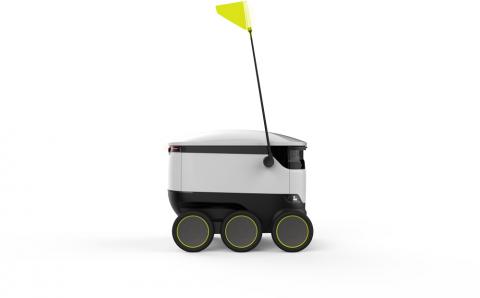
Starship's delivery robots now operating on campus of Northern Arizona University
Just a few months after launching a robot food delivery service at George Mason University’s campus in Fairfax, Virginia, Starship Technologies and Sodexo Inc. have launched their robot food delivery service at Northern Arizona University’s (NAU) Flagstaff campus.
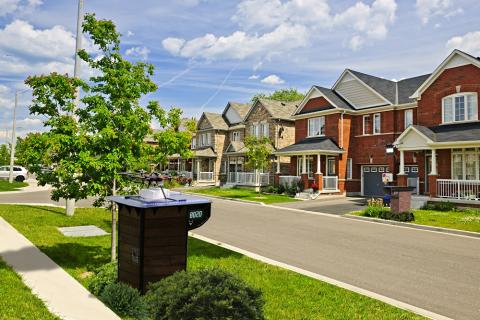
Valqari introduces Smart Drone Delivery Mailbox
A Chicago-based start-up called Valqari says that its patented Smart Drone Delivery Mailbox solves the last inch logistic problems associated with drone delivery.
Described as a “universal drone receptacle for package delivery and pick-up,” the smart mailbox is equipped with agnostic capabilities to ensure seamless integration and communication with any UAS manufacturer during a fully-automated delivery process.
Valqari says that with its smart mailbox, it can “revolutionize drone deliveries” for a variety of industries, including pharmaceuticals, meal delivery and grocery services, governments and residential e-commerce.
Gatwick Airport partners with Stanley Robotics to test robotic valet parking service
Stanley Robotics has signed a framework contract with Gatwick Airport that will result in Gatwick becoming the first airport in the United Kingdom to test robots that valet park passengers’ cars.
During the trial, which is expected to run from the second half of 2019 to early 2020, passengers will leave their cars in a ‘parking station’ close to the South Terminal entrance. A driverless robot will gently lift up the car and store it in a secure car park, all without passengers having to hand over their keys.
The system will be connected to real-time flight information so the robot simply returns the vehicle to the parking station. The user will receive a message that the vehicle is ready and waiting for their arrival.
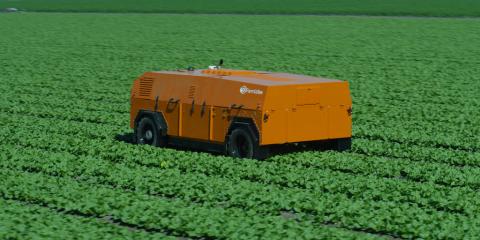
FarmWise, Roush collaborating to develop autonomous vegetable weeders
FarmWise, a developer of adaptive robots for agriculture, has announced a collaboration with Roush, a full-service product development supplier, to develop and test autonomous vegetable weeders in Michigan.
As part of the initial contract between the two, FarmWise and Roush will develop a dozen prototypes of the self-driving robots this year, with plans to scale to additional units in 2020.
“These are many of the key ingredients we need to manufacture and test our machines,” says Thomas Palomares, co-founder and chief technology officer of FarmWise.