Collins Aerospace, L3Harris Technologies, and Thales USA have all been selected to provide systems engineering and integration services to build, implement, and operate North Dakota’s first-of-its-kind, aviation-grade, statewide network for flying UAS beyond visual line of sight (BVLOS).
The companies have been contracted to work with the Northern Plains UAS Test Site (NPUASTS) to enable real-world, scalable, commercial and public BVLOS UAS operations in North Dakota.
BVLOS
BVLOS
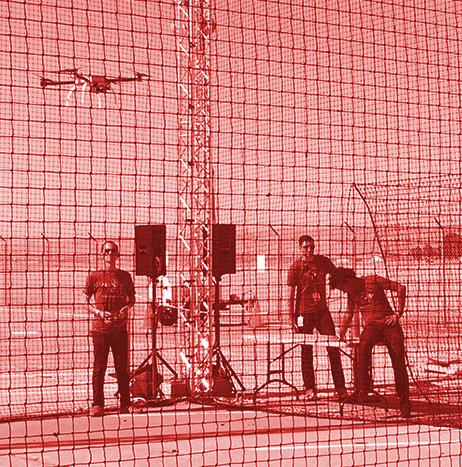
Kongsberg Geospatial, partners to use AI and UAS to improve search and rescue ops in Canada
Public Safety Canada has selected Kongsberg Geospatial, Larus Technologies, and the Civil Air Search and Rescue Association of Canada (CASARA) to help develop new methods for using drones in search and rescue operations in remote communities in Canada using geospatial software, artificial intelligence, and machine vision software.
Dubbed OVERSEE—an acronym for Optical Vision Enhancement and Refinement of Sensor Exploitation Effectiveness—the project will seek to address the unique challenges of conducting search and rescue operations using UAS platforms in remote areas such as indigenous communities in the Arctic and their immediate surrounding area.

F-drones completes first commercial BVLOS drone delivery in Singapore
On April 19, F-drones completed the first commercial beyond visual line of sight (BVLOS) drone delivery in Singapore.
The drone delivered two kilograms of vitamins over 2.7 kilometers in seven minutes to a ship managed by Eastern Pacific Shipping (EPS), which is one of the world’s largest privately-owned ship managers. EPS is F-drones’ first paying customer.
“EPS has been part of F-drones' test deliveries since November 2019, when they joined the Eastern Pacific Accelerator powered by Techstars,” says Gil Ofer, the head of Open Innovation at Eastern Pacific Shipping.

From Unmanned Systems magazine: The power, promise and potential pitfalls of 5G for unmanned systems
Check out just a few wow-worthy examples of the vision that the fifth generation of wireless technology is inspiring for the use of connected drones:
• It could bring data-throughput speeds of up to 10 gigabytes per second, enabling real-time sharing of aerial video and other sensor data.
• It could enable devices to stay connected while traveling hundreds of miles per hour, allowing for remote deployment of AI-enabled, ultra-responsive autonomous fleets.
• It could support up to a million connected devices per square kilometer — enough capacity to absorb an explosion in the Internet of Things alongside increasingly sophisticated mobile applications, on the ground and aloft.
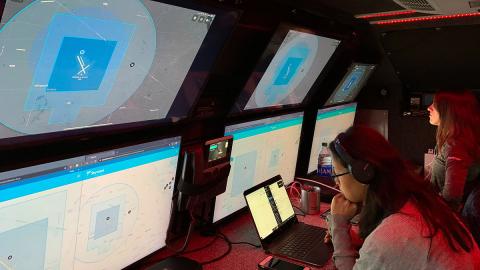
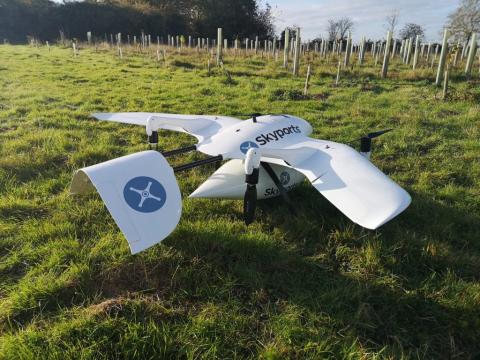
Skyports to trial BVLOS flights in non-segregated airspace after joining UK CAA Regulatory Sandbox
After being accepted into the UK Civil Aviation Authority’s (CAA) Regulatory Sandbox, drone delivery service provider Skyports will begin testing beyond visual line of sight (BVLOS) flights in non-segregated airspace.
Specializing in operating end-to-end drone deliveries within the medical, e-commerce and logistics sectors, Skyports, along with the UK CAA, will explore how drones controlled out-of-sight of the remote pilot can be granted regulatory approvals to fly safely within airspace that is shared with other aircraft, which will be crucial for permanent drone deliveries to become a reality.
Iris Automation launches first onboard DAA system with 360-degree radial field of view for UAS
Iris Automation has launched Casia 360, the first onboard detect-and-avoid (DAA) system with a 360-degree radial field of view to enable commercial beyond visual line of sight (BVLOS) operations for UAS.
When equipped with Casia 360, a UAS can see and react to the aviation environment around the aircraft, as the DAA system detects other aircraft in all directions. Using computer-vision algorithms, Casia 360 classifies the aircraft and makes intelligent decisions about the threat they may pose to the UAS, before triggering an alert to the pilot in command and automating maneuvers to safely avoid collisions.
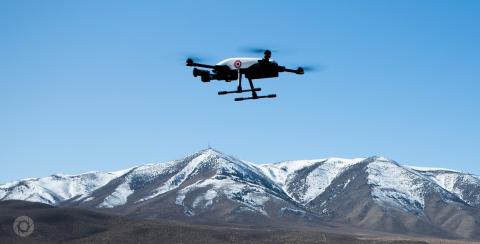
Iris Automation, MVT Geo-solutions to conduct BVLOS flights using only onboard Detect-and-Avoid in Canada
Transport Canada has granted Iris Automation and MVT Geo-solutions the first beyond visual line of sight (BVLOS) Special Flight Operations Certificate (SFOC) using only onboard Detect-and-Avoid (DAA).
The approval was granted based on the use of Casia, which is Iris Automation’s DAA system that provides commercial drones with automated collision avoidance maneuvers.
“Achieving the first BVLOS approval in Canada further validates our technology alongside multiple permissions we have already received from regulators in the U.S. and South Africa,” says Iris Automation CEO Alexander Harmsen.
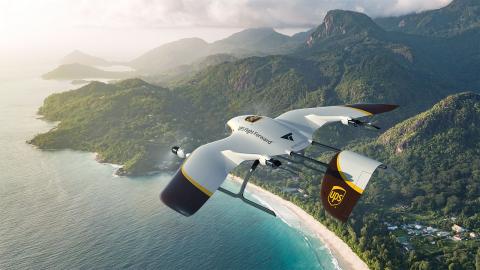
UPS Flight Forward, Wingcopter partner to develop next-gen package delivery drones
UPS Flight Forward (UPSFF) and German drone-maker Wingcopter are partnering to develop the next generation of package delivery drones for various use cases in the United States and internationally.
Wingcopter says that UPS chose it for this collaboration for two reasons: for its UAS technology, and for its track record in delivering a variety of goods over long distances in multiple international settings.
“Drone delivery is not a one-size-fits-all operation,” says Bala Ganesh, vice president of the UPS Advanced Technology Group.
Drone Delivery Canada to begin commercialization of Condor UAS
Drone Delivery Canada (DDC) has announced that it will begin the commercialization of its cargo delivery drone, the Condor.
According to DDC, this phase of Beyond Visual Line of Sight (BVLOS) flight testing will take place at the Foremost UAS Test Range in Alberta, Canada this summer under a Special Flight Operations Certificate (SFOC), which is anticipated in Q2 2020.
Iris Automation customer granted first BVLOS waiver in South Africa
Iris Automation has announced that its customer, United Drone Holdings (UDH), has been granted the first beyond visual line of sight (BVLOS) drone waiver in South Africa, which allows UDH to conduct long-range commercial flights with vertical take-off and landing (VTOL) aircraft.
The BVLOS flight approval was granted by the South African Civil Aviation Authority (SACAA), thanks to the utilization of the Iris Automation Casia onboard detect-and-avoid system. During live flight operations, Casia showcased its ability to make automated maneuvers to avoid collisions with manned aircraft.
Thanks to this approval, UDH will not need visual observers or ground-based radars when conducting BVLOS flights, so only two crew members are needed to perform these flights.