
Earlier this summer, AirMap participated in the FAA’s UTM Pilot Program (UPP) under Virginia Tech’s Mid-Atlantic Aviation Partnership (MAAP), which was designated as one of three UAS Test Sites for the UPP in January.
Designed to advance the findings made during NASA Technical Capability Level (TCL) drone trials and transition them to the FAA for future implementation and rulemaking, the UPP is one of the pilot programs that U.S. government agencies have been conducting over the years to demonstrate beyond visual line of sight (BVLOS) flights and other advanced operations under real-world conditions.
BVLOS
BVLOS

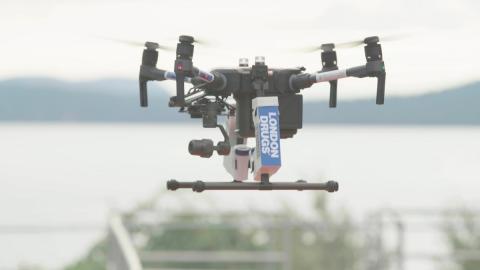
London Drugs, partners complete Canada's first BVLOS UAS flight carrying pharmaceuticals
London Drugs, Canada Post and InDro Robotics recently collaborated to successfully complete Canada’s first ever beyond visual line of sight (BVLOS) flight carrying pharmaceuticals using a UAS.
During the flight, which was conducted on Aug 19., the UAS carried pharmaceuticals from a London Drugs pharmacy to remote Salt Spring Island in British Columbia.
“We are proud to have been selected to participate in the first trial of a Drone delivery of this kind in Canada,” says Chris Chiew, general manager of Pharmacy, London Drugs.
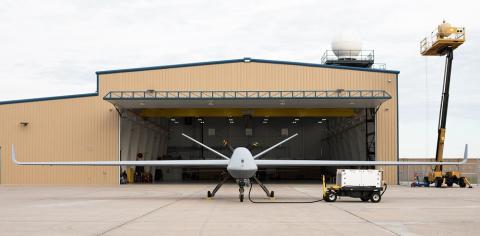
GA-ASI receives COA to conduct BVLOS flights using Ground-based Sense and Avoid system
The FAA has granted General Atomics Aeronautical Systems Inc.
Airbus Aerial granted waiver to conduct BVLOS ops without visual observer in Grand Forks
The FAA has granted Airbus Aerial a waiver to conduct beyond visual line of sight (BVLOS) UAS operations without the need for a visual observer in Grand Forks, North Dakota.
Airbus Aerial will perform these flights under the North Dakota Department of Transportation’s UAS Integration Pilot Program (IPP).
“UAS are a critical aspect of the future of aviation in America – and, in fact, globally. We are honored to be a part of such an important, historic effort,” says Jesse Kallman, head of Airbus Defense and Space’s Intelligence business activities in North America.

North Dakota UAS IPP, Xcel Energy receive waivers to conduct wider range of UAS flights without visual observers
On Friday, Aug. 16, Sen. John Hoeven of North Dakota announced that the FAA has issued waivers for North Dakota’s UAS Integration Pilot Program (IPP) and electric services company Xcel Energy, which will allow each entity to conduct a wider range of UAS flights without a chase plane or other visual observers.
“These updated waivers for the North Dakota IPP and Xcel Energy are a big win, and with them in place, companies across the country should recognize that our state is the location of choice for advanced UAS operations,” Senator Hoeven says.
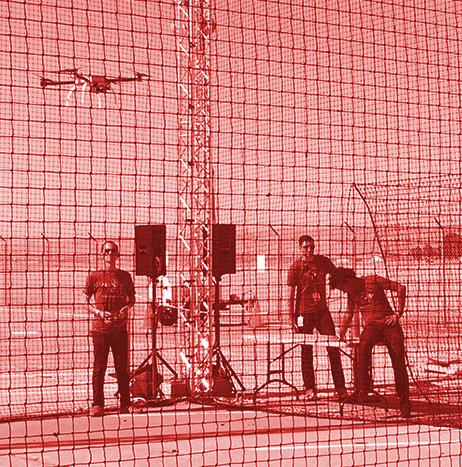
KDOT IPP team to conduct landmark BVLOS UAS flight leveraging only onboard detect-and-avoid systems
The Kansas Department of Transportation (KDOT) UAS Integration Pilot Program (IPP) team has been granted permission to conduct the first ever beyond visual line of sight (BVLOS) UAS flight that utilizes only onboard detect-and-avoid systems.
According to the KDOT team, this is the first-ever FAA authorized Part 107 operation to fly without visual observers or ground-based radar in place, as the flight will leverage Iris Automation’s onboard collision avoidance system, Casia.
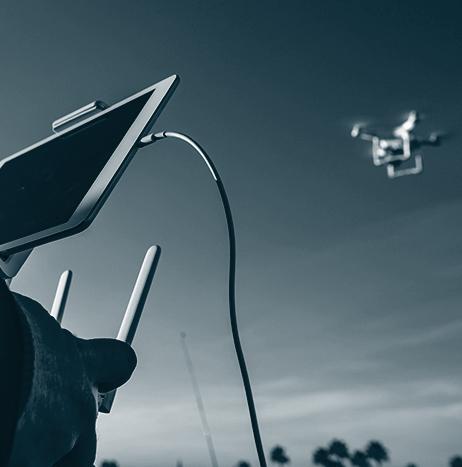
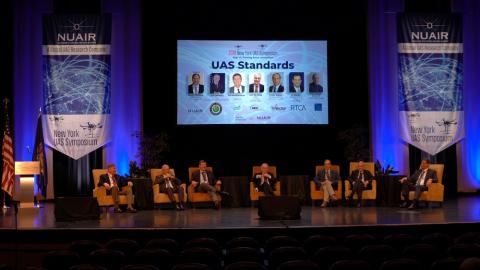
2nd annual NY UAS Symposium to highlight issues facing industry, importance of UTM
The second annual New York UAS Symposium, hosted by Northeast UAS Airspace Integration Research (NUAIR), will look to build off of a successful 2018 symposium that brought in more than 300 participants.
This year’s symposium will give attendees a chance to talk with fellow UAS industry leaders representing all sides of the industry — including from the FAA, NASA, and the New York City Fire Department (FDNY), to name a few — make new connections, and discuss key issues that the industry is facing.
According to Michael Hertzendorf, interim CEO for NUAIR Alliance, the number one challenge that the industry faces is public adoption.
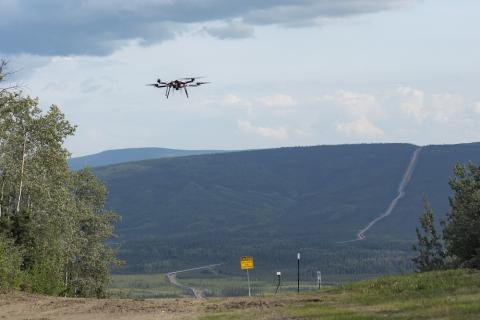
University of Alaska Fairbanks team completes first FAA-approved BVLOS mission in U.S.
A University of Alaska Fairbanks (UAF)-led team recently completed the first FAA-approved true beyond visual line of sight (BVLOS) domestic flight of a UAS in the United States under the small UAS rule.
A Skyfront Perimeter long range hybrid-electric UAS flew 3.87 miles as it inspected a portion of the Trans-Alaska Pipeline. Operators flew the UAS from the university’s Alaska Center for Unmanned Aircraft Systems Integration.
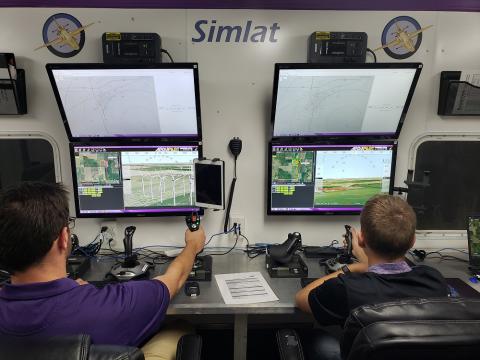
K-State Polytechnic, Simlat partner to provide BVLOS simulator training
The Kansas State University Polytechnic Campus Applied Aviation Research Center has partnered with UAS simulation company Simlat to provide beyond visual line of sight (BVLOS) simulator training.
The simulators will be part of a partnership with the Kansas Department of Transportation (KDOT), and initially will be used to train partners involved in the FAA’s UAS Integration Pilot Program. Course participants will receive a comprehensive training experience on simulation, as well as live flight events.
Soaring Eagle Imaging, Censys Technologies perform BVLOS utility inspection following Hurricane Barry
Soaring Eagle Imaging (SEI), a professional aviation organization, recently performed a 51-mile beyond visual line of sight (BVLOS) utility inspection in just six hours using Censys Technologies Sentaero v2VTOL following Hurricane Barry, which made landfall in Louisiana on July 13.
Over the course of three missions, a single crew captured 51 miles worth of detailed information, which allowed the scope of damage and corresponding locations to be identified, which helped facilitate quick repairs.