
On Friday, Dec. 21, the University of North Dakota (UND), along with research partners from Harris Corporation and the Northern Plains UAS Test Site (NPUASTS), completed what they are calling the first-ever test flights over a “specially developed UAS network of technologies” that opens the skies for broad commercial use of UAS.
Known as the Harris UAS Network, the North Dakota-based network combines detect-and-avoid capabilities developed at UND with UAS technology and services from Harris. The network is described as a “system of integrated ground infrastructure” that enables commercial UAS to fly much farther and safer beyond the visual line of sight (BVLOS) in national airspace.
Components
Components
Rite-Solutions selected to help US Navy develop future generations of UUV Family of Systems
A software development, systems engineering, information technology and learning development firm called Rite-Solutions has been selected to participate in a 5-year, $561.2 million contract to help the U.S. Navy develop future generations of its UUV Family of Systems (FoS).
Announced by the Naval Undersea Warfare Center (NUWC) in Newport, Rhode Island, the contract will develop core technologies in 12 functional areas including payloads, vehicle control, and command and control. Rite-Solutions was one of 23 companies selected to participate in the contract.

Mobile Recon Systems' Dauntless UAS designed to lift more than twice its weight
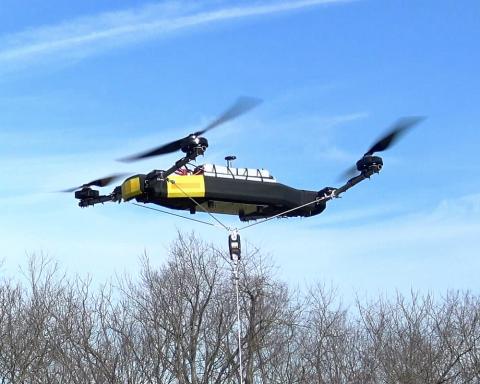
Mobile Recon Systems has introduced the Dauntless UAS, which is designed to lift more than its own weight.
According to Mobile Recon Systems, the UAS is designed to set new records for what multi-rotor UAS can carry. Weighing in at 78 pounds, the Dauntless UAS has showcased an ability to lift an additional payload of 100 pounds as a tethered quadcopter.
As an octocopter, with a generator-powered flight time of several hours, the UAS is designed to lift more than 200 pounds.
AUTOSAR's latest version of Adaptive Platform can be used in highly autonomous systems
Real-Time Innovations (RTI) has announced that AUTomotive Open Systems ARchitecture (AUTOSAR) has released the latest version of the Adaptive Platform, Release 18-10, which features a full network binding of the Data Distribution Service (DDS) standard.
The release of the Adaptive Platform allows automotive manufacturers to now implement an AUTOSAR Adaptive framework with DDS and develop highly autonomous systems, such as Level 4 and Level 5 autonomous vehicles.

Insitu equipping its line of UAS with Persistent Systems' Wave Relay MANET technology
Persistent Systems has entered into a five-year agreement with Insitu that will result in Insitu equipping its line of UAS with Persistent’s Wave Relay mobile ad hoc network (MANET) technology.
By incorporating Persistent’s MANET radios on its line of UAS, Insitu will now be a member of the Wave Relay Ecosystem, which is an “alliance of industry-leading companies using Wave Relay MANET radios in their products,” Persistent says.
As a member of the Wave Relay Ecosystem, Insitu’s platforms will work seamlessly with all other Wave Relay MANET-enabled products.
Persistent Systems' Embedded Module receives new security validation from NIST
Persistent Systems’ Embedded Module, which is a low-size, -weight and -power mobile ad hoc networking (MANET) unit for sensors and unmanned vehicles, has received a Federal Information Processing Standards (FIPS) 140-2 Level 2 security validation from the National Institute of Standards and Technology.
Persistent says that the achievement confirms that all of its main products have achieved this level of validation, which in turn increases usability for users with nonnegotiable requirements for FIPS 140-2 Level 2.
With this new FIPS 140-2 Level 2 validation, the Embedded Module meets its Level 1 cryptographic data security requirement. It also has in place physical security mechanisms—such as tamper-evidence—that allow it to handle sensitive data transmission.
WiBotic announces new wireless power system for DJI Matrice 200 and 210 drones
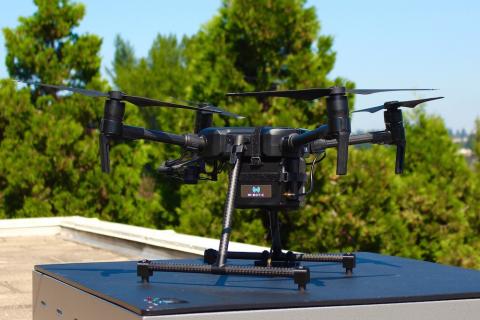
WiBotic, which provides wireless charging and power optimization platforms for the robotics industry, has announced a new wireless power system for the DJI Matrice 200 (M200) and DJI Matrice 210 (M210) drones.
The WiBotic wireless power system enables fully autonomous charging of UAS, allowing UAS to be on constant standby, or fly repeatedly without the need for human or mechanical battery swapping.
The WiBotic wireless power system for the DJI M200 and M210 includes both ground-based transmitter components and onboard charging components. For companies that want a “completely turnkey solution,” the system is also compatible with the (additional) WiBotic PowerPad.
DJI's new customizable drone protection service plan meets needs of commercial UAS operators
DJI has introduced its new customizable drone protection service plan called DJI Enterprise Shield.
Designed to “meet the diverse needs of today’s commercial drone operators,” DJI Enterprise Shield is the first comprehensive coverage plan of its kind that covers the company’s line of enterprise products, providing broad accident coverage, repair and replacement services, free shipping and rapid delivery, and the option to share coverage across a fleet of enterprise products.
Persistent Systems introduces Auto-Tracking Antenna System
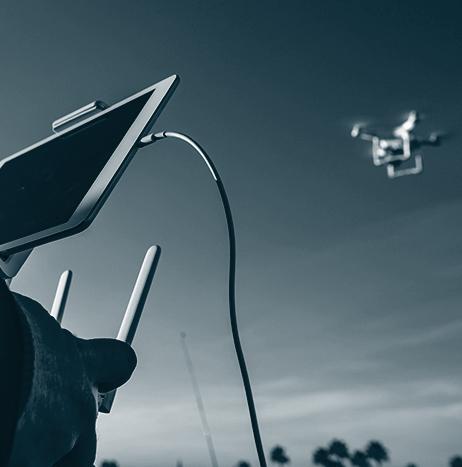
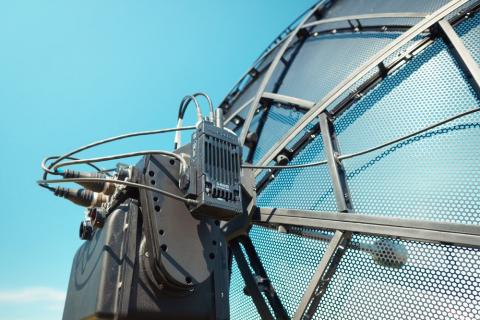
Persistent Systems has introduced a new portable ground-to-air antenna called the Auto-Tracking Antenna System, which operates on the Wave Relay mobile ad hoc network (MANET).
Considered a “complete, easy-to-assemble system,” the Auto-Tracking Antenna System is designed to incorporate aircraft into the MANET.
“The Auto-Tracking Antenna System represents a major step towards achieving the vision of a truly networked battlefield,” says Herb Rubens, CEO of Persistent Systems.
Kratos' Unmanned Systems Division's Autonomous Impact Protection Vehicle approved to deploy on public roadways
Kratos Defense & Security Solutions’ Unmanned Systems Division (USD) has received confirmation that its Autonomous Impact Protection Vehicle (AIPV) has officially been approved for “autonomous operation on public roadways in the first of many planned states in the USA for roadway line painting operations.”
This approval transitions the AIPV, also known as the Autonomous Truck Mounted Attenuator (ATMA), from the validation phase of deployment to “standard safety critical equipment ready for operational use with trained roadside construction crews.”