
Parrot has announced that it will participate in an operational assessment to support an Army production award decision, as part of the final steps of the selection process for the United States Army’s Short Range Reconnaissance drone program.
The company will now begin manufacturing prototypes of its dedicated drone in the U.S. Designed with carefully selected components, Parrot’s mature prototype has been approved for initial manufacturing.
“Parrot is honored to work with the DoD on this highly strategic project,” says Laurent Rouchon, VP Security & Defense at Parrot.
Defense
Defense
AeroVironment to provide Raven small UAS and training to allied nation
AeroVironment has announced that on March 3, it received a $2,424,595 firm-fixed-price contract to provide an allied nation with its Raven small UAS and training.
Delivery is anticipated by August of this year.
“With its rugged design, small footprint and high resolution sensor capabilities, the combat-proven Raven offers allied forces the actionable intelligence they need at a moment’s notice in the most extreme environments,” says Rick Pedigo, vice president of sales and business development for AeroVironment.
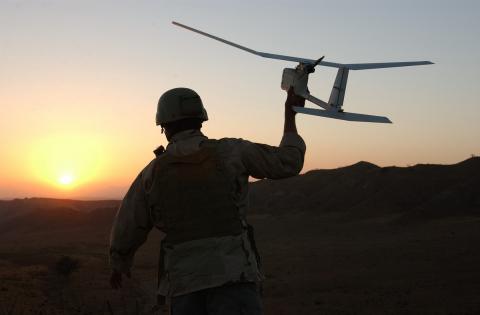
Asylon, Ghost Robotics to develop robotic platform under new contract
The United States Air Force Research Lab has awarded Asylon Inc. a contract to provide the future of persistent ISR, inspection and perimeter security.
According to Asylon, this includes the exploration of the ability to use available water-based resources in the mission operating environment to generate power and recharge air and ground autonomous platforms, which will allow them to operate longer at the point of need.
Under this contract, Asylon has partnered with Ghost Robotics. The companies will develop a combined, autonomous, and self-powering air and ground robotic platform by integrating their respective robotic systems. The platform will use DroneHome, which is Asylon’s patented automated battery SWAP base station.
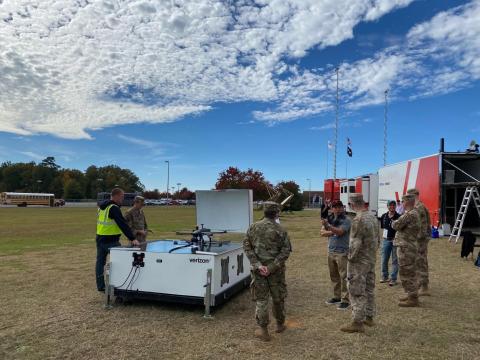
Army unit begins testing Arcturus UAS as service ponders Shadow replacement
The U.S. Army has begun evaluating tactical unmanned aircraft systems intended to replace the venerable RQ-7 Shadow drone, which has been in service since the early 2000s.
The 1st Armored Brigade Combat Team, 1st Infantry Division conducted the first soldier-operated flight on April 7, flying an Arcturus Jump 20, a 210-pound aircraft with an 18-foot wingspan that is capable of vertical takeoff and landing (VTOL).
It's also quieter than the Shadow.
"We’re used to screaming at each other and having to use radios in order to communicate,” Spc. Christopher McCoy, a crew chief, said in an Army press release. “You can stand right next to this aircraft and not even raise your voice."
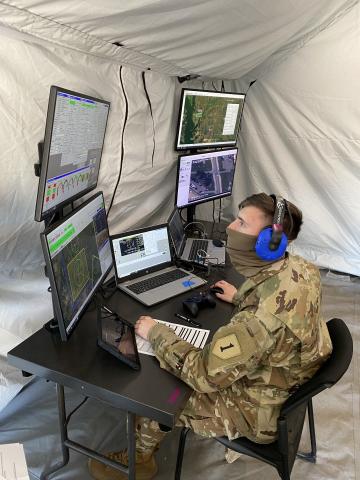
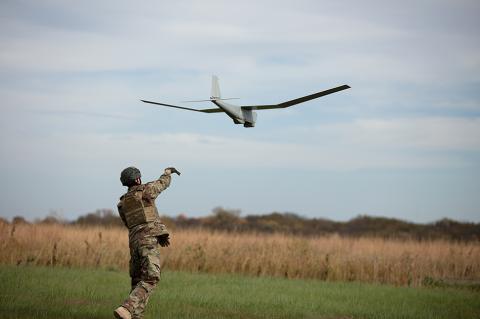
AeroVironment receives contract award for Puma 3 AE UAS for U.S. Navy and Marine Corps SUAS program
AeroVironment Inc. has announced that on Feb. 18, it received a $10,677,987 firm-fixed-price contract award for its Puma 3 AE systems and spares for the U.S. Navy and Marine Corps Small Tactical Unmanned Aircraft Systems (SUAS) Program.
Delivery of the technology is anticipated by this month.
“Puma 3 AE is a combat-proven enabler of U.S. Navy and Marine Corps tactical operations, providing persistent situational awareness, expeditionary reconnaissance, surveillance, and target acquisition, force protection and overwatch – anywhere and at any time,” explains Rick Pedigo, AeroVironment vice president of business development.
U.S. Marine Corps orders more than 140 of FLIR Systems' Centaur UGVs
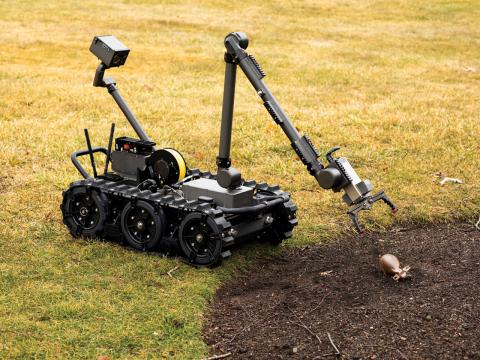
Through an $18.6 million contract sourced through the Dept. of Defense Man Transportable Robotic System Increment II (MTRS Inc II) program, the U.S. Marine Corps has ordered more than 140 of FLIR Systems’ Centaur UGVs, plus spares.
Marine Corps Explosive Ordnance Disposal (EOD) teams will use the UGVs to help with various hazardous tasks such as disarming improvised explosive devices (IEDs) and unexploded ordnance. Different sensors and payloads can be added to support several different mission types.
Deliveries of the UGVs are expected to begin in the third quarter of 2020.
Weekend Roundup: April 3, 2020
This Week in the Unmanned Systems and Robotics World
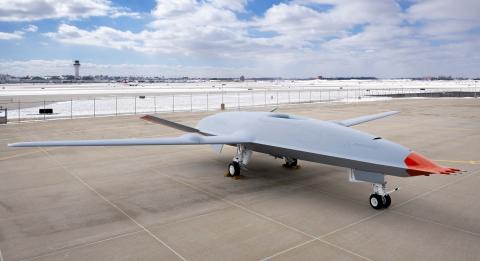
As part of a modification to a previously awarded contract, the Navy has exercised contract options with Boeing worth $84.7 million to buy three MQ-25A Stingray unmanned aerial refueling tankers. According to the contract announcement released by the Pentagon on Thursday, April 2, the three MQ-25s covered by the contract options are to be completed by August 2024. (USNI News)
Milrem Robotics to deliver two UGVs to UK's Defense Science and Technology Laboratory
Milrem Robotics has announced that it will deliver two UGVs to the United Kingdom’s Defense Science and Technology Laboratory (DSTL).
With a goal of maximizing the impact of science and technology for the defense and security of the UK, DSTL is acquiring the UGVs to explore the capabilities and limitations of this technology in a variety of areas such as mobility, vulnerabilities and safety.
“The United Kingdom has a clear view on the importance of robotics on the battlefield and its impact on defense capabilities,” says Kuldar Väärsi, CEO of Milrem Robotics.

Milrem Robotics' UGVs to be equipped with IrvinGQ's airdrop system
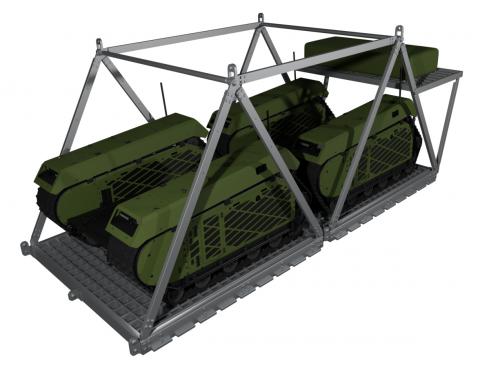
Aerial delivery technologies provider IrvinGQ has developed and tested an airdrop system that can be used to rapidly deploy Milrem Robotics’ UGV into warzones or large-scale terrain fires.
Expected to be used for defense or firefighting missions, respectively, Milrem Robotics’ THeMIS or the Multscope Rescue UGV will be equipped with IrvinGQ’s ATAX airdrop system.
Other aerial deployment possibilities of Milrem Robotics’ UGVs include helicopter underslung or in the cargo area of a helicopter such as the Chinook CH-47.
From Unmanned Systems magazine: From hobby to business: Creating a business map for new drone companies
The drone market of today is well over 40-years old, and yet it still feels a little like the wild, wild west in 2020. Why? What is collectively missing? What will get the drone market to the next level?
The answer: Stop acting like a bunch of technicians in love with products and start acting like business owners in love with customers. How do we correct this misguidance? By creating a business map; one for our business; and one for our overarching drone market with the help of AUVSI.
Mapping the business