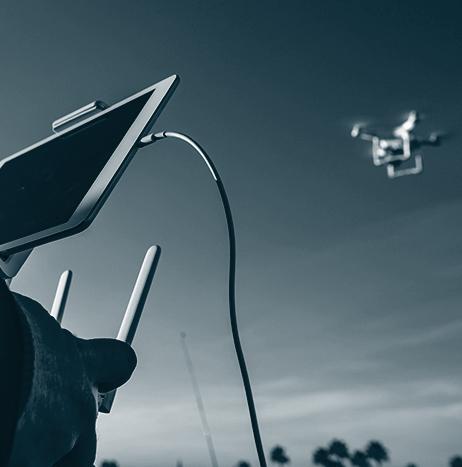
In support of the Oklahoma Emergency Management and Dept. of Wildlife Conservation’s efforts to survey the aftermath of large rangeland fires that spread across hundreds of thousands of acres in Oklahoma back in April, Embry-Riddle Aeronautical University, Daytona Beach students embarked on a UAS Disaster Study Away trip in May.
Led by Embry-Riddle Professors Dan Macchiarella and John Robbins, the Embry–Riddle UAS Disaster Response Team started their trip in Arlington, Texas, where they underwent Predator/Reaper UAS orientation flight training.
Following that, they went to the State Emergency Operation Center in Oklahoma City, where they received an initial briefing, and prepared to help with response and recovery efforts resulting from various severe weather events.
Education
Education
School district in Texas holds "Tech Wars" robotic competition for students
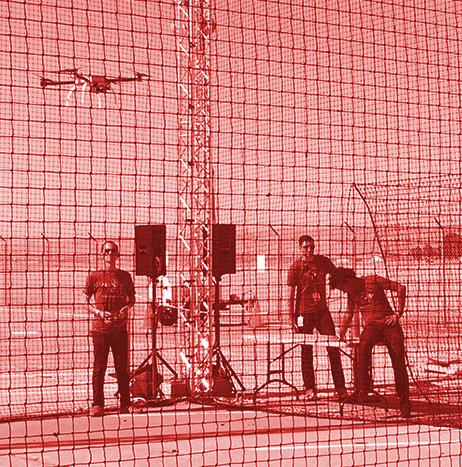
In McAllen, Texas, the McAllen school district recently held its inaugural “Tech Wars” robotic competition, which gave students the opportunity to compete against in each other in drone racing, a Battle Bot competition, and an unmanned vehicle competition.
Tech Wars took place on a football field, and according the Monitor, which is McAllen's newspaper, the idea behind creating Tech Wars came from McAllen ISD Superintendent J.A. Gonzalez.
“We wanted to give kids with these technology talents the opportunity to shine, so it’s not about the star quarterback or star pitcher or great swimmer or great volleyball, but now it’s about the great drone racer,” Gonzalez says.

Mohawk Valley Community College receives grant that will help prepare students for UAS industry
The National Science Foundation has awarded Mohawk Valley Community College (MVCC) a $557,487 grant to support a project in which MVCC will develop a series of “microcredentials” to increase the number of skilled technicians in the UAS industry, and ultimately address local workforce needs.
Over the next three years, MVCC will develop and implement five microcredentials made up of four courses each, which will provide students with “highly specialized, specific skills” without requiring completion of a full degree. The microcredentials are UAS Components, UAS Fabrication, UAS Operations, UAS Electronics, and UAS Data Analysis.
UND to utilize Insitu's recently launched ScanEagle3 UAS
Insitu Inc. and the University of North Dakota at Grand Forks (UND) have announced additions to UND’s UAS degree program and research enterprise.
In conjunction with its 50th Anniversary of Aviation Education and Research, UND will integrate Insitu’s INEXA Control, TacitView and Catalina UAS software into its Aviation UAS curriculum in the fall of 2019.
UND, which currently uses Insitu’s ScanEagle UAS, will also make additions to its UAS fleet, adding Insitu’s ScanEagle3 UAS, which was launched on May 1 during Xponential 2018.
Kansas State Polytechnic offering UAS training to Kansas Department of Wildlife, Parks and Tourism employees
Thanks to a partnership with Kansas State University Polytechnic Campus, 30 Kansas Department of Wildlife, Parks and Tourism employees will receive UAS training from May through June.
The employees will attend small UAS (sUAS) Commercial Remote Pilot Training and then be eligible to sit for the FAA exam to become certified as remote pilots in command. 18 Department of Wildlife, Parks and Tourism staff members will complete Basic Multirotor Training, allowing them to become proficient in basic aircraft maneuvers and safety procedures.
Bow Valley College to offer UAS certification courses starting in May
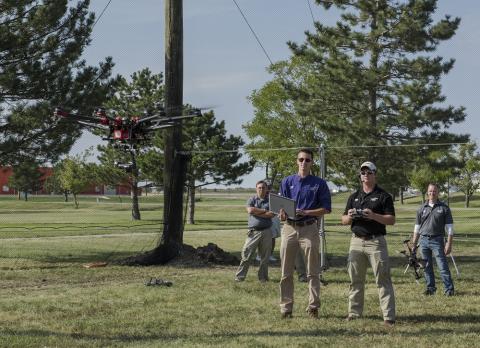
Through its School of Continuing Learning, Bow Valley College helps UAS enthusiasts and professional UAS operators alike prepare for new and updated aviation laws that will limit where and how UAS can be flown. So with this in mind, two comprehensive certification courses will be offered at Bow Valley College’s Okotoks and High River campuses in Alberta, Canada starting May 4.
The courses will provide theory and practical knowledge through a variety of measurers including in-class instruction, labs, seminars, two tests, and a certificate that requires renewal every five years.
University of Hawai'i hosts first-ever drone boot camp
The University of Hawaiʻi Applied Research Laboratory (ARL) and the Office of the Vice President of Research and Innovation hosted their first-ever drone boot camp at Les Murakami Stadium in Honolulu, Hawaii on March 30.
Approximately 100 people attended the boot camp.
Many of the people who attended the event were UAS owners, but realized that they were afraid to fly—and crash—their aircraft. So they went to the boot camp to receive expert instruction about piloting a UAS. Margo Edwards, director of ARL, says that many of the attendees told her that the boot camp was exactly what they needed.
Oceans Unmanned's freeFLY program uses UAS for large whale entanglement response efforts
In partnership with NOAA Hawaiian Islands Humpback Whale National Marine Sanctuary (HIHWNMS), Oceans Unmanned, Inc. has launched the freeFLY Program, which is a new initiative that uses small UAS to provide aerial support for large whale entanglement response efforts off of Maui, Hawaii.
The freeFLY Program provides training, equipment, and management oversight to a network of local, Maui-based volunteer UAS operators that are available to support the Hawaiian Islands Entanglement Response Network, led by HIHWNMS.
The goals of the Network are to safely free endangered humpback whales and other marine animals from life threatening entanglements, while also collecting crucial information that will lower entanglement threats in the future.
Kansas State Polytechnic offering Part 107 prep course in Denver area just ahead of XPONENTIAL 2018
Right before the start of AUVSI’s XPONENTIAL conference, which will be held in Denver, Colorado from April 30 to May 3, Kansas State University's Polytechnic Campus will offer its Part 107 preparation course in the Denver area from April 27 to 29.
Designed to prepare professionals for the FAA’s written exam—which is required for anyone who wants to operate a commercial small UAS, who does not already hold a manned pilot certificate—the course will focus on areas covered in the FAA written exam, including “adherence to FAA rules and regulations pertinent to small unmanned aircraft operations, how to set up sUAS within FAA regulations and the application of safety practices in flight.”
Minnesota firefighters learn how UAS can assist their operations
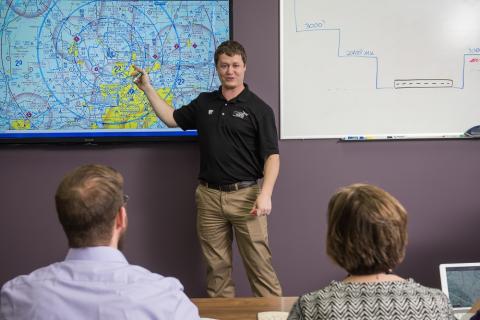
During the finale of the 2018 Minnesota State Fire School & Expo, a few dozen area firefighters learned about UAS and how the technology can be used in emergency situations.
As a part of their class, firefighters received a lecture about UAS, which was followed by a live demonstration of the technology in action. During that demonstration, firefighters got to see the different maneuvers and functions of the UAS in the sky, and they could also view what the camera was capturing on a TV.
The class, which was taught by Al Ebbinga, was meant to not only show how UAS can benefit first responders on scene, but it was also meant to “clarify the perception of the name "drone" and how it's been used.”