
The Army Research Laboratory has awarded Blake Stringer, Ph.D., assistant professor of aerospace engineering in Kent State’s College of Aeronautics and Engineering, a grant worth more than $130,000 to study propulsion systems for a new generation of intermediate-sized UAS.
Currently, the military is limited to airplanes and helicopters when it needs to move people and supplies through the air.
With this in mind, Dr. Stringer, who retired after 20 years in the Army, will work with Army Research Laboratory consultants and researchers at the University of Tennessee to see how plausible it is to create a UAS that is somewhere in between the size of the military's current aviation options.
IHP
IHP
Kansas Department of Transportation and Iris Automation begin UAS test flights under UAS IPP this week
This week, the Kansas Department of Transportation (KDOT) is starting the testing phase of the UAS Integration Pilot Program (IPP).
One of KDOT’s partners for the program, Iris Automation, will focus on enabling new detect and avoid capabilities for UAS.
The winner of AUVSI’s 2018 Startup Showdown during XPONENTIAL 2018, Iris Automation will test its collision avoidance technology in the airspace above Gypsum’s farmlands. Using computer vision and artificial intelligence, the technology allows UAS to see the world the way a pilot does, which ultimately facilitates beyond visual line of sight (BVLOS) flights.
Test flights will take place throughout the week, and the technology will be evaluated through controlled UAS flights against a manned aircraft.
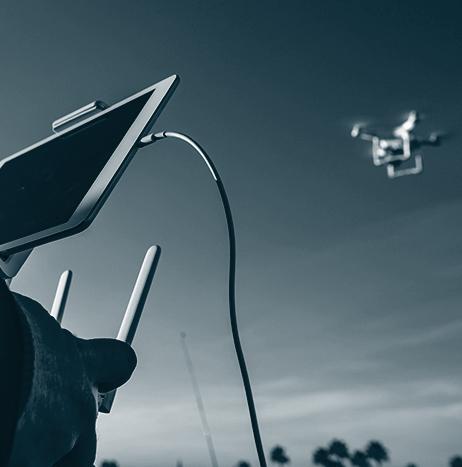
Textron Systems plans to acquire robotics developer Howe & Howe Technologies
Textron Systems is positioning itself as a global leader in autonomy across the air, land and sea domains, after entering into a letter of intent to purchase Howe & Howe Technologies Inc., a developer of advanced robotic land vehicles.
Built and proven for the most extreme conditions in the world, Howe & Howe’s vehicles have earned the trust of customers in the U.S, as U.S. government customers have selected Howe & Howe’s small, highly mobile Ripsaw Super Tank for its speed, mobility and off-road performance, while Howe & Howe’s RS2-H1 SMET was down-selected to compete to be the U.S. Army’s first platoon load-carrying robot, after completing a 60-mile test through swamp and jungle terrains.

MBARI engineers demonstrate using long-range AUV for detecting and tracking oil spills
Late last month, Monterey Bay Aquarium Research Institute (MBARI) engineers demonstrated using MBARI’s long-range AUV (LRAUV) for detecting and tracking oil spills.
The engineers, who worked with the US Coast Guard and collaborators at Woods Hole Oceanographic Institution (WHOI), equipped an LRAUV with special instruments (fluorometers) that can detect oil in water. During the recent test in Monterey Bay, the MBARI team simulated an oil spill using non-toxic, biodegradable dye.
According to MBARI, the Coast Guard is very interested in testing robots that can find and track oil spills under ice; a capability that will be crucial as ship traffic and oil exploration expands in the Arctic Ocean, MBARI says.
SenseFly and IN-FLIGHT Data complete historic urban BVLOS UAS project
SenseFly and IN-FLIGHT Data recently completed what they are calling North America’s first urban beyond visual line of sight (BVLOS) UAS project in a major city.
Conducted in Calgary, Alberta, Canada, the project’s goal was to collect mapping data to support the development of a new graveyard site, which will be the first new cemetery in the city since 1940.
Using a senseFly eBee Plus fixed-wing UAS, the IN-FLIGHT Data team mapped the area by conducting a total of 257 miles’ worth of BVLOS operations at an average distance of 1.46 miles from the pilot.
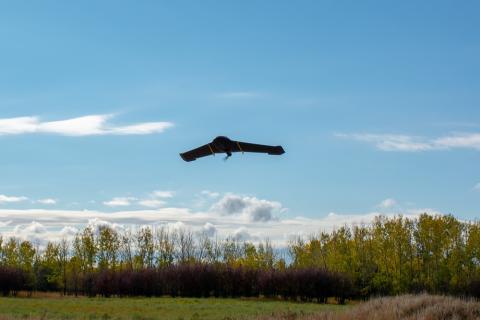
Meet the IPP Sites: Memphis airport authority looks to show how UAS can benefit airports, manned aircraft
The Memphis-Shelby County Airport Authority (MSCAA) will spend the next three years conducting a variety of UAS operations across Memphis under the UAS Integration Pilot Program.
The only lead applicant selected for the program that is an airport, MSCAA is especially interested in the benefits that drones can offer airports, and ironically enough, manned aircraft.
Airports are increasingly looking to integrate UAS into their operations, which is something that MSCAA’s President and CEO, Scott Brockman, is also looking to do.
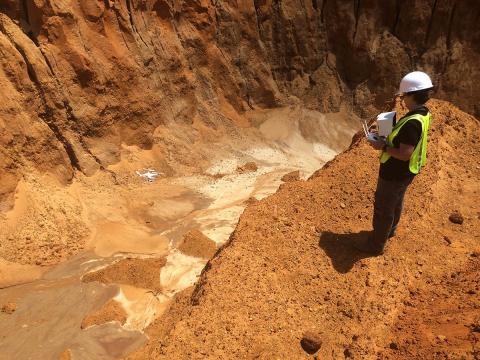
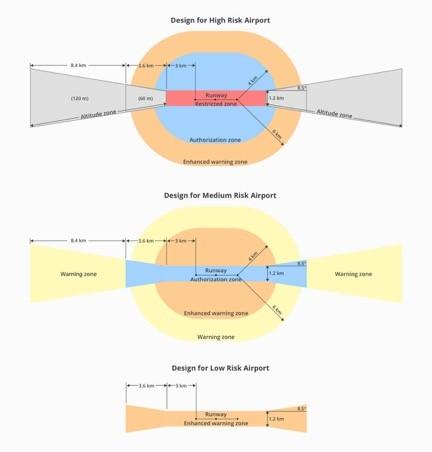
DJI improving its geofencing technology to refine airspace limitations for UAS flights near airports
In an effort to provide smarter protection for airplanes in critical areas, DJI has announced that it is improving its geofencing technology to refine the airspace limitations for UAS flights near airports.
The updated Geospatial Environment Online (GEO) Version 2.0 will be phased in starting in November once the revised zones take effect for airspace around airports in the United States. DJI says that upgrades in other regions will follow in “due course.”
“DJI is proud to once again lead the industry in developing proactive solutions for safety and security concerns,” says Brendan Schulman, DJI Vice President of Policy & Legal Affairs.
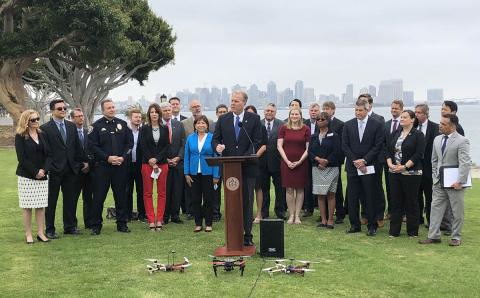
Meet the IPP Sites: City of San Diego pursues several diverse UAS applications
The city of San Diego is one of 10 jurisdictions selected to participate in the U.S. Department of Transportation’s UAS Integration Pilot Program, and one of two municipalities selected in the final group of 10.
The city’s Office of Homeland Security was the lead program applicant, with support from the San Diego Regional Economic Development Corporation (EDC) and approximately 20 partner organizations representing business and government throughout the region.
Meet the IPP sites: Choctaw Nation to use partners, diverse landscape to push for UAS integration
When Secretary of Transportation Elaine Chao announced the winners of the DOT’s UAS Integration Pilot Program in May, the first team announced was the Choctaw Nation of Oklahoma.
That effort involves a technology-minded Native American tribe, a multi-billion business incubator, a demonstration farm and a 45,000-acre ranch, as well as nearly a dozen partners interested in pushing the envelope for drone flights at night, package delivery and flights over people.
James Grimsley, founder of DII LLC, a family of technology companies (and a former AUVSI Member of the Year), says the Choctaw Nation contacted him about two years ago to discuss a strategy of getting into aviation, which is a strong point for Oklahoma.
Media Advisory: Webinar on Drones for Geospatial Technology, Dec. 6
FOR IMMEDIATE RELEASE: Dec. 5, 2017
Contact: Tom McMahon, tmcmahon@auvsi.org, (571) 255-7786