A company called Ouster that is developing LiDAR sensors for autonomous vehicles has announced a $27 million series A fundraise led by Cox Enterprises.
Ouster would like to provide an affordable alternative to more expensive LiDAR sensors, so the company has developed its first product, a 64-channel LiDAR sensor called OS1, which will be priced at $12,000.
Ouster says that besides being a more affordable option in comparison to its competition, OS1 is also “dramatically lighter, smaller, and uses less power than other competitors.”
Sensors
Sensors
Velodyne LiDAR and UMS partner to test autonomous vehicles in South Korea
Through a recently announced partnership with Unmanned Solution (UMS) of South Korea, Velodyne LiDAR Inc. will integrate its advanced LiDAR sensors into UMS’ extensive autonomous technology development program.
UMS’ autonomous program represents a wide range of activities, including on-road vehicles, agricultural equipment, robots, and autonomous systems integration. In addition to those activities, an “instructional platform for educational programs serving students studying autonomous and robotics technology” is also being developed.
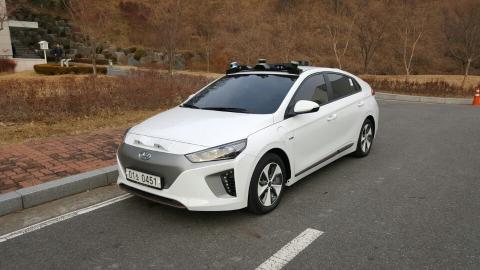
NAVYA unveils AUTONOM CAB, the company's fully autonomous taxi
Navya has unveiled its AUTONOM CAB, which is an autonomous, personalized and shared vehicle designed to address the “major challenges urban populations face traveling in and around cities.”
The AUTONOM CAB is equipped with extremely sophisticated multi-sensor technology, with no fewer than 10 Lidar sensors, six cameras, four radars, two GNSS antennae and one inertial measurement unit (IMU). Navya says that these sensors provide “at least a triple redundancy across all functions,” which guarantees exceptional reliability.
Bye Aerospace successfully installs and ground tests SolAero solar cells on its UAV
Bye Aerospace has announced that solar cells from a company called SolAero were successfully installed and ground tested on both wings of Bye Aerospace's initial prototype of the StratoAirNet UAV, which is an advanced, medium-altitude, long-endurance solar-electric aircraft being developed by the company.
In a statement, Bye Aerospace's CEO George Bye expressed appreciation to SolAero for the company’s active participation in developing the StratoAirNet UAV.
“SolAero is a business and engineering partner in every sense of the word,” Bye says. “With the completion of ground tests for the solar cells on the wings, we can advance to the next stage of assembly and testing.”

Vanilla Aircraft's Heely says more to come from long-duration VA001 aircraft
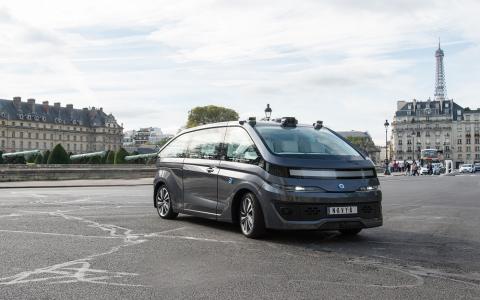
Vanilla Aircraft's VA001 UAS recently completed a historic flight, as it flew for a little over five days for a total of 121.4 hours.
After executing a pilot-controlled takeoff on Oct. 18 from the NASA Wallops Flight Facility, the UAS switched to autopilot control and quietly orbited above Wallops Island's Virginia Space UAS Runway at 5,000 feet in a two-mile orbit.
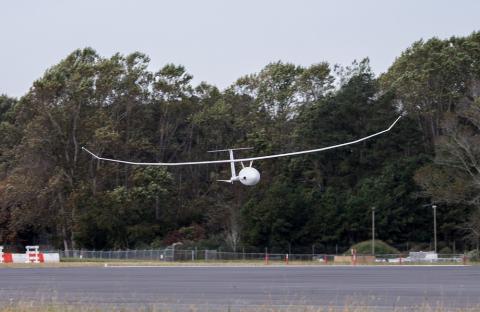
EasyMile's EZ10 shuttle bus becomes first autonomous vehicle operating in Germany
A German railway company called Deutsche Bahn has welcomed the first autonomous vehicle to the roads of Germany, in the form of EasyMile’s EZ10 shuttle bus.
The EZ10 shuttle bus is currently operating in Bad Birnbach, which is a municipality in the district of Rottal-Inn in Bavaria, Germany.
The vehicle, which has one staff member onboard to take over operation of the vehicle if necessary, will be used on a route that is approximately 700 meters long, from the town center to the thermal baths. Next year, the route will be extended to connect the town center and rail station.

Velodyne LiDAR Inc. to integrate its LiDAR sensors into BoE Systems' UAV fleet
Through a new partnership with Kansas City, Missouri-based BoE Systems, Velodyne LiDAR Inc. will integrate its VLP-16 Puck and Puck LITE 3D LiDAR sensors into BoE Systems’ UAV fleet for geospatial data collection and analysis.
The companies say that through this integration, BoE Systems can provide full 360-degree imaging of geography and equipment for industries that need quick, safe, and accurate aerial inspections, such as transportation, construction and agriculture, to name a few.
After collecting imaging data, BoE Systems processes that data, and works with customers for “tailored analysis and inspection reports,” which allows them to address immediate and future needs and compliance issues.

LiquidPiston wins NOVUS Unmanned startup pitch competition
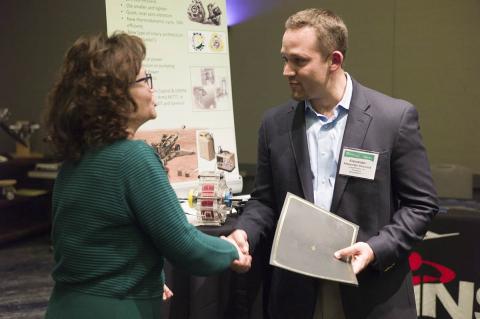
LiquidPiston, a company that has designed a revolutionary new rotary engine, took home the top prize at AUVSI’s NOVUS Unmanned conference and competition in San Francisco.
Ten companies vied for the top spot and seed funding at the conference, which was cosponsored by Investorfest, a company that coaches startups to help them get funding. They outlined their business plans and early successes before the judges picked a winner.
LiquidPiston will go home with $50,000 worth of prizes, including a presence at upcoming AUVSI shows and conferences and coaching from Investorfest.
University of Mississippi and General Atomics collaborating on UUV technology
The University of Mississippi (UM) and General Atomics are starting an “on-campus collaborative effort” that will focus on acoustic sensing and navigation technologies for UUVs, in an effort to help Department of Defense operations in deep-sea areas.
Starting on Nov. 1, GA Electromagnetic Systems Group (GA-EMS) will work out of UM’s research facility, Insight Park, and GA-EMS will look to fortify the relationship established with UM and its National Center for Physical Acoustics, so that it can advance the investigation of “acoustic-based techniques for navigation and control of unmanned underwater systems.”
Research team from Hong Kong University of Science and Technology develops unmanned car
A research team from the Hong Kong University of Science and Technology (HKUST) has developed the first unmanned car in Hong Kong.
The research team from the Robotics Institute at the HKUST developed an “advanced unmanned passenger vehicle system” made up of several subsystems, ranging from the sensor systems to the dynamic modelling.
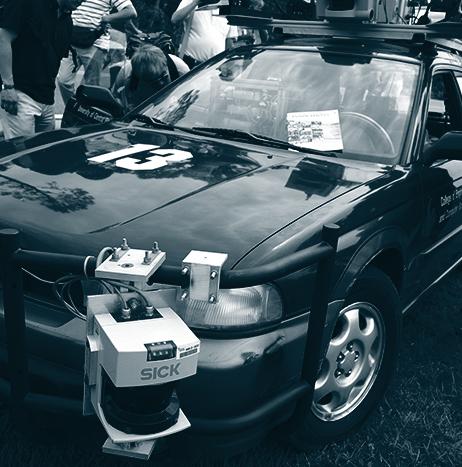
Among its many capabilities, the unmanned car can avoid obstacles as it travels using LiDAR (laser range finders), which achieves the perception of the obstacles, and can measure the surroundings 100 times per second.
The perception system, which is three-dimensional, generates more than 100,000 points per second, “indicating the pose of the vehicle to the surroundings.”