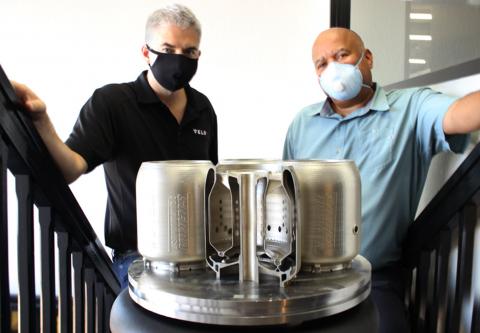
A new microturbine venture called Sierra Turbines is seeking to revolutionize UAV engines with 3D printing. Using the metal additive manufacturing (AM) technology from manufacturer VELO3D, Sierra Turbines reduced part count in a critical component from 61 to 1 and saw a variety of important performance gains as well.
Sierra Turbines has published a case study on its work with VELO3D. Sierra Turbines CEO Roger Smith also took some time to speak with AUVSI about the case study and the benefits of its microturbine, Aurelius Mk1.
Can you start off by providing our audience with some background information on Sierra Turbines and what you all are seeking to achieve within the UAV industry?
Software
Software
Weekend Roundup: August 14, 2020
This Week in the Unmanned Systems and Robotics World
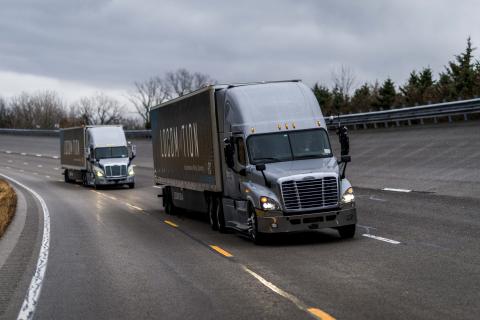
Autonomous trucking startup Locomation announced this week that it has successfully completed its first on-road pilot transporting commercial freight. In partnership with Aon, a risk management consultancy, and Wilson Logistics, a transportation logistics company, Locomation deployed two trucks hauling trailers in a driverless convoy on a 420-mile-long route stretching from Portland to Nampa, Idaho along I-84. (VentureBeat)
PrecisionHawk awarded two patents for its UTM technologies
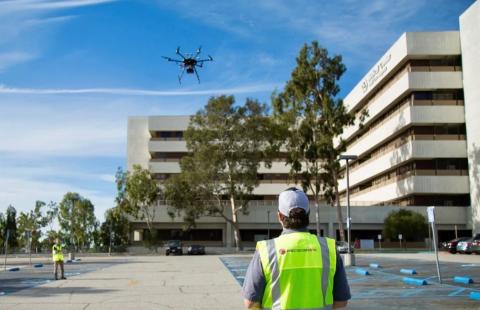
PrecisionHawk has been awarded two patents for technologies it has developed for UAS traffic management (UTM).
Known as the ‘Automated Unmanned Air Traffic Control System,’ the patents are designed to enable collision avoidance between drones and manned aircraft, which is achieved by transmitting real-time flight data from drones to a UTM server prior to and while in-flight.
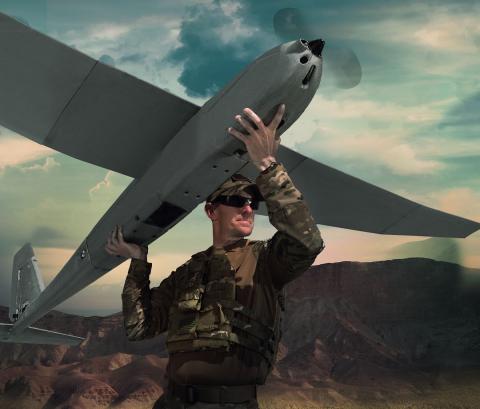
AeroVironment introduces enhancement options for its Puma UAS product line
AeroVironment has launched two new Puma product line enhancement options that improve and expand the operational capabilities of its family of tactical UAS.
AeroVironment worked with front-line users to develop the product enhancement options, which the company says “enable customers to proceed with certainty in ever-changing operational environments.”
“AeroVironment is committed to anticipating and delivering innovative solutions that are critical to tactical UAS operators downrange,” says Rick Pedigo, vice president of sales and business development for AeroVironment.
Weekend Roundup: August 7, 2020
This Week in the Unmanned Systems and Robotics World
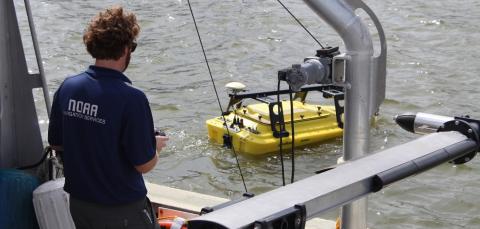
The National Oceanic and Atmospheric Administration (NOAA) and the U.S. Navy have signed a new agreement to jointly expand the development and operations of unmanned maritime systems in the nation’s coastal and world’s ocean waters. Through the agreement, NOAA will accelerate its science, service and stewardship mission by leveraging the Navy’s expertise, infrastructure, best practices and training. (NOAA)
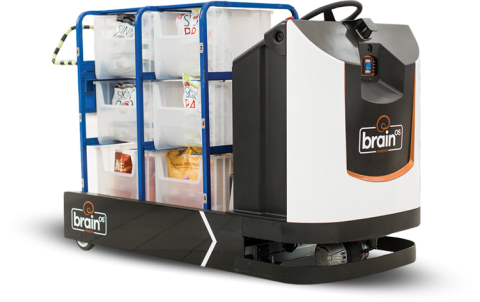
Brain Corp's manufacturing partners deploy autonomous delivery tugs across the U.S.
Artificial intelligence software technology company Brain Corp has announced that its manufacturing partners are involved in several pilots and initial deployments of autonomous delivery tugs powered by BrainOS, which is Brain Corp’s cloud-connected operating system for commercial autonomous robots.
According to Brain Corp, these commercial rollouts mark the industry debut of a “new robotic application that helps retailers bridge the automation gap in moving inventory from the stockroom out to store shelves.”
AVS speakers emphasize importance of uniform legislation, safety for autonomous vehicles
From helping address the driver shortage currently plaguing the trucking industry to transporting passengers to and from their destinations, autonomous vehicles (AV) have no shortage of potential use cases for the present and beyond.
“As autonomous technology comes to market, it’ll have a broad and positive impact on the overall industry,” said Shawn Kerrigan, co-founder and chief operating officer of self-driving truck technology company Plus.ai, during the Automated Vehicle Symposium (AVS).
Before these vehicles can hit the roads at scale, though, there first needs to be some sort of uniform legislation to guide this technology, many speakers noted during AVS, which took place as a fully virtual show this year.

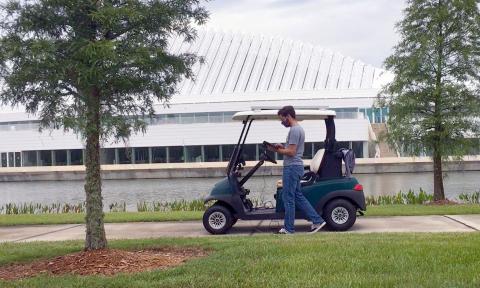
Florida Poly researchers turning disused golf cart into solar-powered autonomous vehicle
In an effort to “advance cutting-edge research for years to come,” a team of researchers at Florida Polytechnic University (Florida Poly) is turning a disused golf cart into a solar-powered autonomous vehicle.
Funded by the University’s Advanced Mobility Institute, the project will support a $350,000 National Science Foundation award to develop a large-scale Hardware-in-the-Loop simulation facility for connected and autonomous vehicles (CAV).
Oscilla Power to further develop tech that enables AUVs to recharge themselves using ocean waves
The US Department of Energy (DOE) has awarded Oscilla Power Inc., a company focused on developing advanced technology to extract energy from ocean waves, a $200,000 grant to further develop technology that enables AUVs to recharge themselves using ocean waves.
Through their Rotary and Mission Systems group, Oscilla Power will work with Lockheed Martin during this Small Business Innovation and Research (SBIR) project to explore how they can equip their AUV and UUV systems with this capability.

Weekend Roundup: July 31, 2020
This Week in the Unmanned Systems and Robotics World
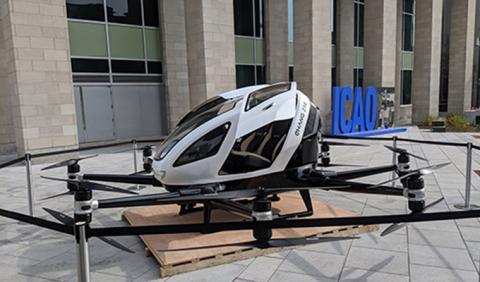
Canada’s civil aviation authority, Transport Canada Civil Aviation (TCCA), has issues a Special Flight Operations Certificate (SFOC) to EHang for its EHang 216 autonomous aerial vehicle (AAV). In addition to this announcement, EHang has also announced plans to build a new AAV production facility in Yunfu city in Guangdong, China.