
FLIR Systems Inc. will deliver dozens of its SkyRaider UAS to the United States Marine Corps after being awarded a $10 million contract.
The FLIR R80D SkyRaider is FLIR’s most advanced military UAS. Developed for U.S. defense and federal government customers, the UAS is equipped with long-range, high-resolution EO/IR imaging sensors that provide day and night situational awareness.
For forward resupply, asset extraction, and other specialized missions, SkyRaider can carry and deliver external loads up to 4.4 pounds. The UAS also features “some of the most powerful” embedded AI processing available on a small UAS, according to FLIR.
Software
Software
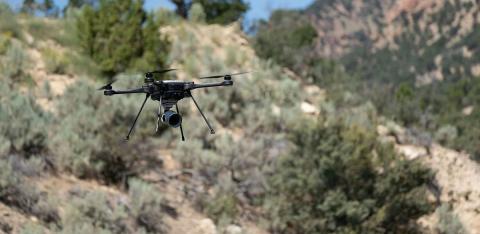
UAVOS' UVH-170 unmanned helicopter successfully completes first high altitude flight
UAVOS’ UVH-170 unmanned helicopter recently showcased its value to mountainous areas operations by successfully conducting its first high altitude flight and reaching a height of 16,400 feet. During its flight, the UAS performed surveillance missions.
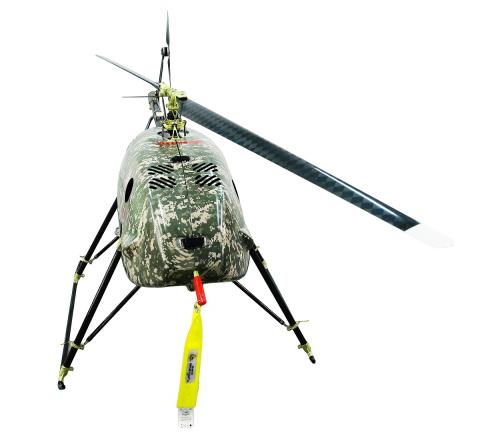
GA-ASI completes month-long demonstration of GE-ER UAS
General Atomics Aeronautical Systems Inc. (GA-ASI) has announced the completion of a month-long demo event that showcased its Gray Eagle Extended Range (GE-ER) UAS equipped with a suite of long-range sensors, Air Launched Effects (ALE) and Scalable Command and Control (SC2).
GA-ASI collaborated with industry to equip the UAS with best-of-breed long-range intelligence, surveillance, and reconnaissance (ISR) payloads and ALEs. During the demo, the UAS showed a persistent stand-off survivability with stand-in capabilities with up to 40 hours of endurance that Army Commanders can use to orchestrate forces in the Multi-Domain Operations (MDO) environment.
UC Riverside engineers awarded grant to develop new generation of GPUs for autonomous systems
The National Science Foundation has awarded three University of California, Riverside (UC Riverside) engineers a $1.2 million grant to develop a new generation of energy-efficient, energy-elastic, and real-time-aware Graphics processing units (GPUs) that can be used in resource-constrained environments such as emerging embedded and autonomous systems, including UAS and autonomous vehicles.
Daniel Wong, Hyoseung Kim, and Nael Abu-Ghazaleh are the recipients of the grant. All three are Marlan and Rosemary Bourns College of Engineering faculty members, and are professors of electrical and computer engineering.

Weekend Roundup: June 26, 2020
This Week in the Unmanned Systems and Robotics World
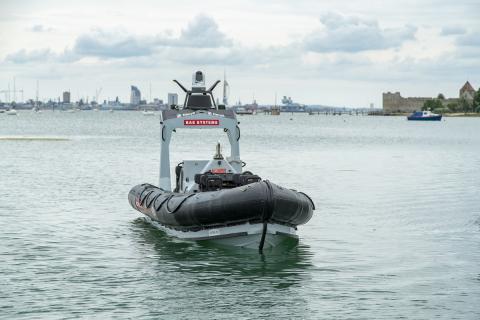
The Royal Navy has launched its first crewless boat for general duties. The autonomous Pacific 24 is ready for testing to see how it and similar vehicles might fit into the ‘fleet of tomorrow.’ (The Royal Navy)
Mercedes-Benz, NVIDIA to create new software-defined architecture to enable autonomous driving
Mercedes-Benz and NVIDIA have announced that they will work together to create a 'revolutionary' in-vehicle computing system and artificial intelligence (AI) computing infrastructure.
Expected to be rolled out across the fleet of next-generation Mercedes-Benz vehicles starting in 2024, the technology will equip the vehicles with upgradable automated driving functions.
The new software-defined architecture will be built on the NVIDIA DRIVE platform. It will be standard in Mercedes-Benz’s next-generation fleet, enabling state-of-the-art automated driving functionalities.

Breezy One disinfecting robot deployed at Albuquerque International Sunport airport
Fetch Robotics, Build with Robots and the City of Albuquerque, New Mexico have launched the Breezy One disinfecting autonomous mobile robot (AMR), which is designed to protect employees and passengers from both harmful pathogens and cleaning agents.
Described as the first platform to offer efficient, hands-free, and safe sanitization specifically designed for large scale facilities, Breezy One uses a patented, environmentally safe disinfectant to quickly, safely and effectively decontaminate spaces over 100,000 square feet in just 90 minutes. The disinfected space can be re-entered in as little as two hours with no harmful residue or risk to employees or passengers.

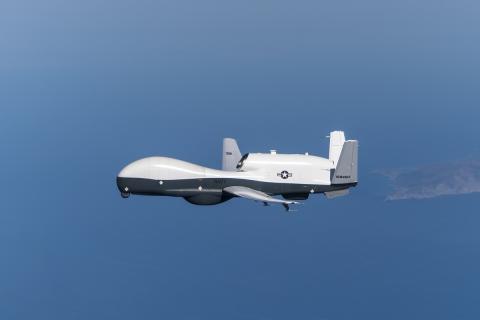
Australian government to provide funding for additional MQ-4C Triton
The Australian government will provide funding for an additional MQ-4C Triton aircraft
Weekend Roundup: June 19, 2020
This Week in the Unmanned Systems and Robotics World
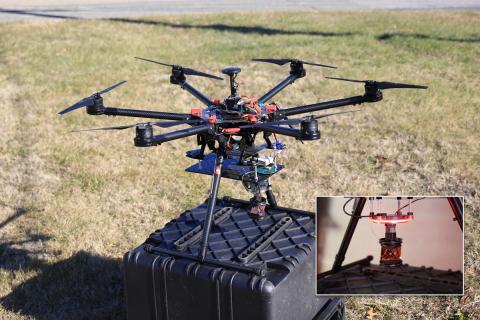
A proof of concept experiment by a multi-institutional research team shows that deploying sterile mosquitoes via drones could accelerate efforts to control their populations and reduce insect-borne disease. The project is a collaborative effort between French, Swiss, British, Brazilian, Senegalese and other researchers, and seems to be the most effective and practical approach to releasing sterilized male mosquitoes into the wild, where they compete with the other males for food and mates but produce no offspring. (TechCrunch)
Milrem Robotics, John Cockerill Defense showcase Type-X Robotic Combat Vehicle
In front of select military forces from across the globe, Milrem Robotics and John Cockerill Defense showcased the Type-X Robotic Combat Vehicle with the Cockerill Protected Weapons Station Gen. II (CPWS II).
The Type-X chassis features what the companies describe as a “revolutionary design” for a mobile modular multi-mission vehicle that provides a platform for a family of unmanned armored vehicles. According to the companies, the Type-X is the “first combat vehicle that is purposefully designed to be unmanned intended to be an integral part of mechanized units.”
