A company that develops self-driving industrial vehicles for material handling called Seegrid has closed a $25 million growth equity investment from venture capital firm G2VP.
According to Seegrid, the investment, which reflects a multi-hundred million dollar valuation, will help the company further capitalize on its position as a market leader in the automated guided vehicle (AGV) and autonomous mobile robots (AMRs) industry.
Software
Software
Kongsberg Maritime develops new Launch and Recovery System for HUGIN AUVs
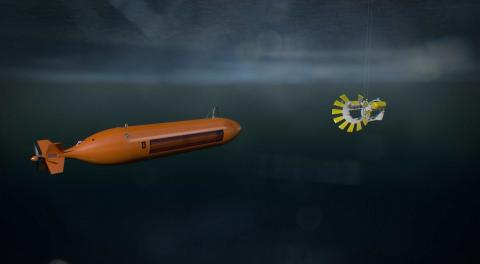
To facilitate a series of “far-reaching operational improvements,” Kongsberg Maritime has developed a new Launch and Recovery System (LARS) for its HUGIN range of AUVs.
According to Kongsberg, LARS is a result of a “uniquely integrated combination of advanced in-house technologies” that the Kongsberg Group offers, which have been reinforced with years of accumulated expertise. LARS is expected to operate from midships, with the release and capture of HUGIN marine robots occurring beneath the sea surface.
“There is limitless scope in this new LARS design,” says Bjørn Gjelstad, Marine Robotics R&D manager, Kongsberg Maritime.
UAVOS, KACST successfully demonstrate flight control system capability for Saker MALE UAS family
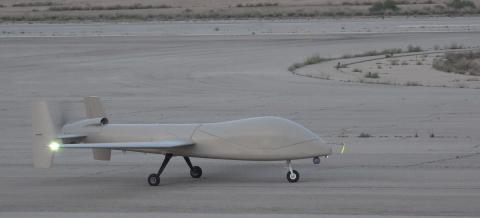
In collaboration with King Abdulaziz City for Science and Technology (KACST), Saudi Arabia, UAVOS has developed and demonstrated a progressive flight control system capability for the Saker MALE UAS family.
The Saker-1B UAS has been flown under remote control with no need for a ground control station at the takeoff or landing site. When equipped with the flight control system capability, the UAS can automatically land in remote runways located thousands of kilometers away where a crew services it before it takes off for another mission.
Milrem Robotics' UGVs to be equipped with IrvinGQ's airdrop system
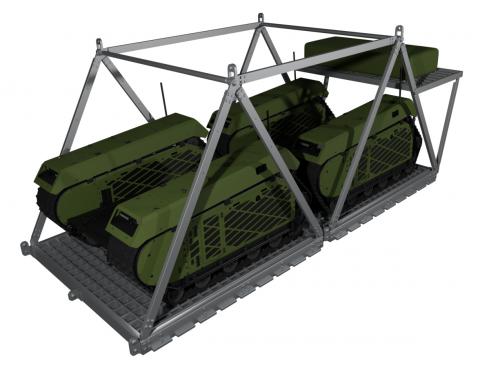
Aerial delivery technologies provider IrvinGQ has developed and tested an airdrop system that can be used to rapidly deploy Milrem Robotics’ UGV into warzones or large-scale terrain fires.
Expected to be used for defense or firefighting missions, respectively, Milrem Robotics’ THeMIS or the Multscope Rescue UGV will be equipped with IrvinGQ’s ATAX airdrop system.
Other aerial deployment possibilities of Milrem Robotics’ UGVs include helicopter underslung or in the cargo area of a helicopter such as the Chinook CH-47.
Iris Automation, MVT Geo-solutions to conduct BVLOS flights using only onboard Detect-and-Avoid in Canada
Transport Canada has granted Iris Automation and MVT Geo-solutions the first beyond visual line of sight (BVLOS) Special Flight Operations Certificate (SFOC) using only onboard Detect-and-Avoid (DAA).
The approval was granted based on the use of Casia, which is Iris Automation’s DAA system that provides commercial drones with automated collision avoidance maneuvers.
“Achieving the first BVLOS approval in Canada further validates our technology alongside multiple permissions we have already received from regulators in the U.S. and South Africa,” says Iris Automation CEO Alexander Harmsen.
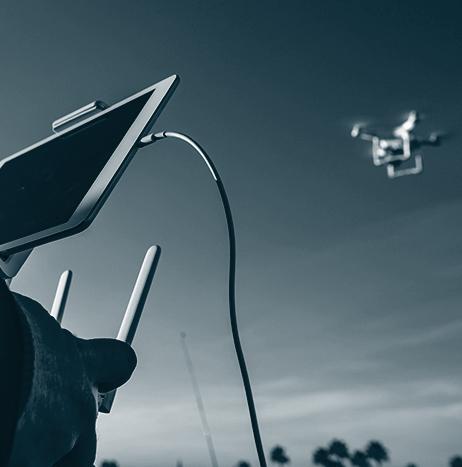
Telstra picks TEOCO to help with the development of its UAS strategy
To help with development of its UAS strategy, telecommunications company Telstra is partnering with analytics, assurance and optimization technologies provider TEOCO.
Telstra will use TEOCO’s AirborneRF technology to assess the readiness of its radio access network for future UAS applications, including communications, navigation, surveillance, safety, and identity.
According to TEOCO, AirborneRF, which is already being used by several tier-one operators across the world, ensures “effective, mission-critical” connectivity to enable effective traffic management and control for UAS in the lower airspace.

Parrot, DroneLogbook partner to provide enhanced flight data tracking to Parrot's UAS
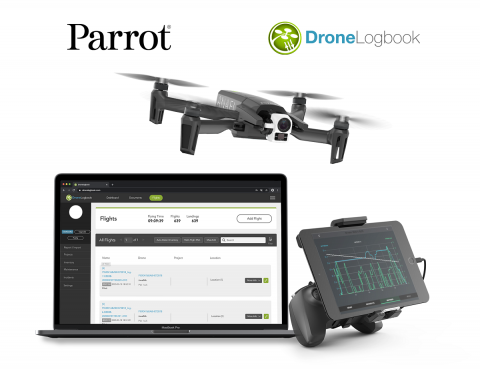
Parrot has partnered with DroneLogbook, a flight logging service that provides secure data storage, which will result in the addition of enhanced flight data tracking to Parrot's ANAFI drone.
With this enhanced flight data tracking, pilots will be able to keep track of their equipment’s performance, schedule necessary maintenance, and record and report all pertinent information to comply with FAA regulation.
Using the aerial insights provided by Parrot’s ANAFI and ANAFI Thermal drones, professionals gain “new vantage points” to make informed decisions with higher precision and efficiency, Parrot notes.
MIT researchers invent simulation system to train driverless cars to navigate worse-case scenarios
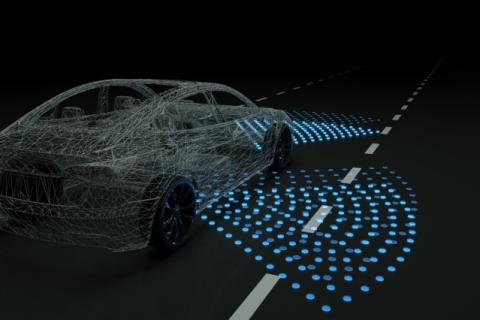
To help driverless cars learn to navigate a variety of worse-case scenarios before they begin operating on real roads, researchers at MIT have invented a simulation system to train driverless cars that creates a photorealistic world with “infinite” steering possibilities.
According to the researchers, control systems—also known as “controllers” —for autonomous vehicles largely rely on real-world datasets of driving trajectories from human drivers. The vehicles use this data to learn how to emulate safe steering controls in different situations. Researchers note, though, that real-world data from hazardous “edge cases,” such as nearly crashing or being forced off the road or into other lanes, are rare.
Drone equipped with special cameras can dodge fast-moving objects
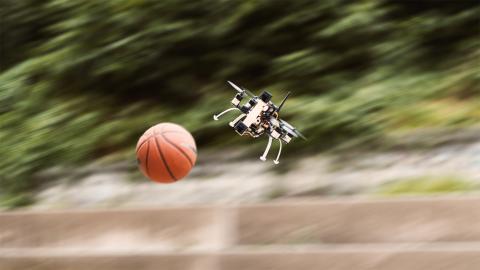
Researchers from the University of Zurich have equipped a drone with a novel type of camera to give it the ability to detect and avoid fast-moving objects.
According to the researchers, drones that are equipped with cameras typically take 20 to 40 milliseconds to process an image and react in order to detect obstacles, which is not quick enough to avoid a bird or another drone. It also isn't quick enough to avoid a static obstacle when the drone itself is flying at high speed.
Stanford University researchers develop soft robot that can move and change shape
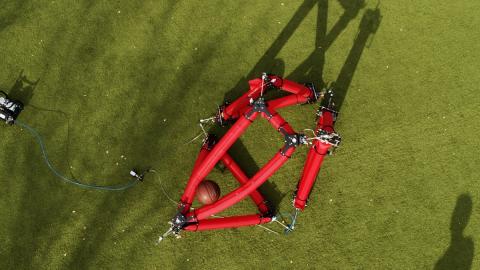
Stanford University researchers have developed a soft robot that borrows features from traditional robotics to stay safe while still retaining the ability to move and change shape.
“A significant limitation of most soft robots is that they have to be attached to a bulky air compressor or plugged into a wall, which prevents them from moving,” explains Nathan Usevitch, a graduate student in mechanical engineering at Stanford.
“So, we wondered: What if we kept the same amount of air within the robot all the time?”