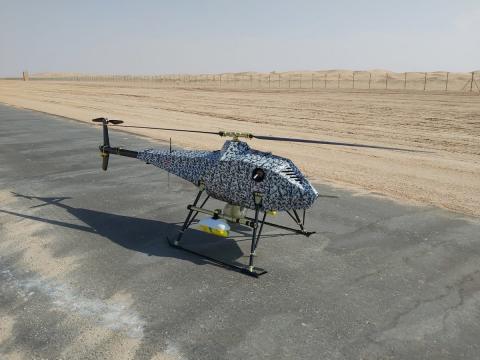
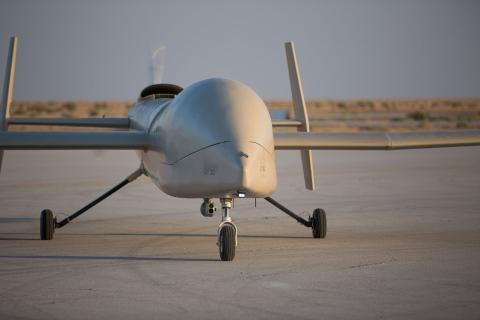
UAVOS and King Abdulaziz City for Science and Technology (KACST) in Saudi Arabia are collaborating on the scientific research and development of the Flight Control System (FCS), which is designed to fit and leverage multi-mission, multi-domain UAS platforms.
As a result of their shared experience and first-class knowledge, UAVOS and KACST have created a Saker-1B Medium Altitude Long Endurance (MALE) UAS. More than 500 hours of day and night test missions under various weather conditions have confirmed the drone’s specifications. In total, 1,000 hours of take-off and landing test missions have been successfully performed, with the long endurance flights lasting up to 19 hours.
Software
Software
GreenPower Motor Company, Perrone Robotics partner to build fully autonomous electric transit vehicles
GreenPower Motor Company Inc. is partnering with Perrone Robotics Inc. (PRI) to build fully autonomous electric transit vehicles based on GreenPower’s EV Star shuttle platform.
A designer, manufacturer and distributor of a diverse line of electric powered buses for the transit, shuttle, tourist and school sectors, Greenpower was founded a decade ago with the intent to bring the “most compelling” zero-emissions buses to the market.

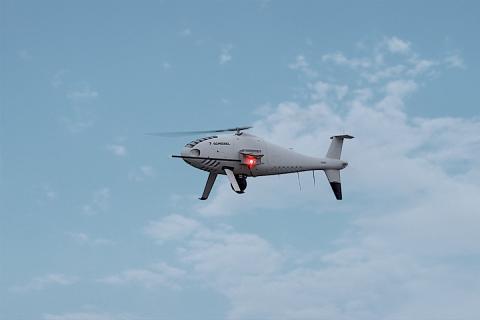
Schiebel, Nordic Unmanned successfully test Camcopter S-100 equipped with sniffer capability
Schiebel and its partner Nordic Unmanned have successfully completed a two-day test of the sniffer capability onboard the Camcopter S-100 UAS in the shipping lane outside Gniben, Denmark.
The entities note that ships operating in Europe’s busiest sea routes are allowed to emit exhaust fumes with a Sulphur oxide content limited to no more than 0.1 percent. One potential option to enforce this International Maritime Organization (IMO) 2020 regulation is using UAS such as the Camcopter S-100 equipped with a Sulphur sniffer. The UAS measures the Sulphur emissions by flying through the ship’s exhaust plume, and identifies the ships using its Automatic Identification System (AIS).
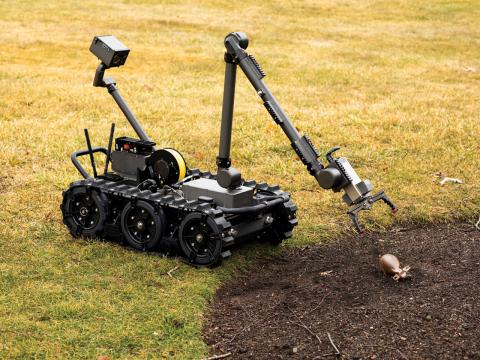
U.S. Air Force orders 180-plus FLIR Systems Centaur UGVs
Through a $23 million contract sourced through the Dept. of Defense Man Transportable Robotic System Increment II (MTRS Inc II) program, the United States Air Force has ordered more than 180 of FLIR Systems’ Centaur UGVs, plus spares.
A remotely operated, medium-sized UGV system, Centaur provides a standoff capability to detect, confirm, identify, and dispose of hazards. The open-architected robot, which weighs approximately 160 pounds, is equipped with an advanced EO/IR camera suite, a manipulator arm that reaches more than six feet, and the ability to climb stairs. The robot's modular payloads can be used for CBRNE detection and other missions.
Shipments of the UGVs are expected to begin in the second quarter of 2020.
NAV CANADA, Unifly partner to deploy national system to ensure safe UAS ops in Canada
Canada’s air navigation service provider NAV CANADA has entered into an agreement with Unifly to deploy a national system that provides digital services for the safe operations and management of drones in Canadian airspace.
Equipped with an intuitive user interface, the system, which is designed to support current regulations for drone flights within visual line of sight, will allow Canadian drone pilots to access web and mobile applications to perform various functions, including identifying safe and legal airspace, planning flights, and managing operations, pilots and fleet of drones.
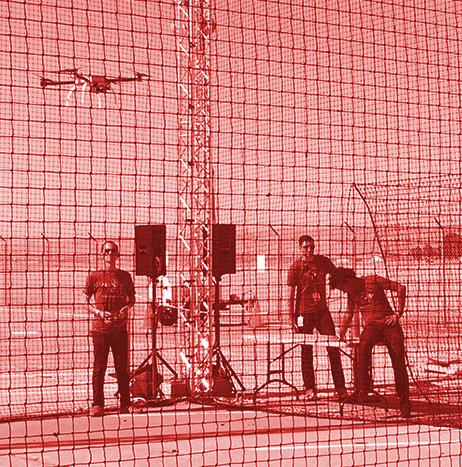
Swarming robots avoid crashes, jams using algorithm developed by Northwestern University researchers
Northwestern University researchers have developed what they are calling the “first decentralized algorithm with a collision-free, deadlock-free guarantee.”
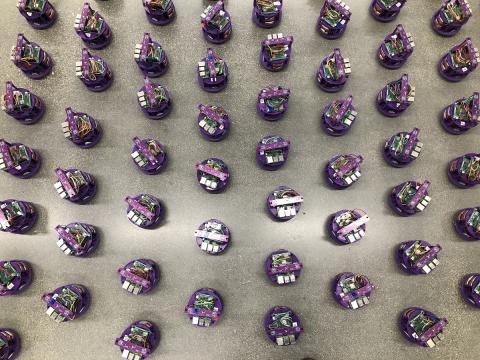
The algorithm could potentially one day help self-driving vehicles navigate one another safely and flawlessly without crashing or causing unnecessary traffic jams, but for now, it is helping robots avoid crashes and jams. The algorithm was tested in a simulation of 1,024 robots and on a swarm of 100 real robots in the laboratory. In less than a minute, the robots reliably, safely and efficiently converged to form a pre-determined shape, as you can see below:
Spatial Integrated Systems to demonstrate autonomous USV to examine feasibility of improving Maritime Domain Awareness
After being awarded a contract with the US Coast Guard (USCG), Spatial Integrated Systems Inc. (SIS) will demonstrate an autonomous USV to examine the feasibility of improving Maritime Domain Awareness (MDA) in the remote Pacific Ocean.
Based in Virginia Beach, Virginia, SIS has partnered with MetalCraft Marine U.S. and Honolulu, Hawaii’s Navatek, resulting in the combination of the SIS Multi-Agent Robotic Teams (SMART) Autonomy System and the MetalCraft 7m Interceptor Boat for commercial sale as an “intelligent, goal-oriented” autonomous USV.
Raven Industries to showcase autonomous agriculture tech during DOT demo days
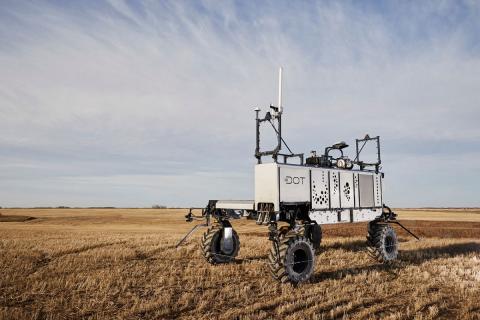
During DOT demo days this spring in Maricopa, Arizona, Raven Industries Inc., as majority owner of Dot Technology Corp. (DOT), will showcase the latest advancements in autonomous agriculture.
The Dot Power Platform (Dot) is powered by Raven’s suite of machine control technology, which includes the RS1 for steering and guidance, Slingshot for remote support and connectivity, and Raven’s object detection and avoidance technology. With its ability to complete tasks autonomously, Dot allows framers to spend more time focusing on the overall operation of their farms.
Raven and DOT are preparing for the commercialization of this technology this spring.
Robotic Research to begin testing fully autonomous shuttles without onboard attendants
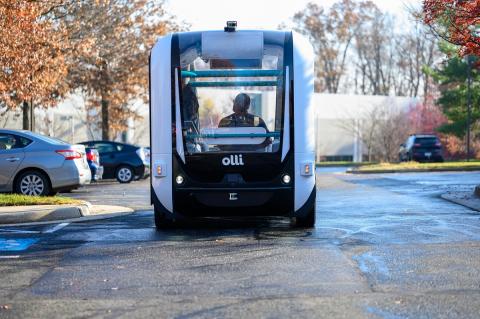
Starting in the second quarter of 2020, Robotic Research LLC will begin testing fully autonomous low-speed shuttles that are totally unmanned.
UAVOS to demonstrate unmanned helicopter for search and rescue maritime missions
During UMEX 2020, UAVOS and its partner ISR Unmanned Technology will conduct search and rescue maritime missions using their joint ISR350-5 unmanned helicopter.
Designed for civilian and security missions, the ISR350-5 UAS will perform rescue tasks, including dropping a life jacket into the water. In preparation for these exercises, UAVOS has modified the lifejacket by fitting it with a water anchor.
The demonstration flights will seek to prove the advantages of using an unmanned helicopter for maritime patrolling, especially when the aircraft is equipped with multiple sensors.