A new group in Utah called Deseret Unmanned Aerial Systems is hoping to make the state a leader in the “wave of drone innovations.”
“The biggest untapped resource in the U.S. and the world is our airspace,” says Tulinda Larsen, executive director of Deseret UAS, via Deseret News. “And that's where Deseret UAS is stepping up.”
The result of a joint effort by Tooele and Box Elder counties in partnership with Ogden city, Deseret UAS is looking to advance the work of Utah businesses working in the UAS arena, and ultimately attract new endeavors to the state.
UAS
UAS
Delta Regional Authority awards ULM professor $90,000 grant to teach people how to operate UAS
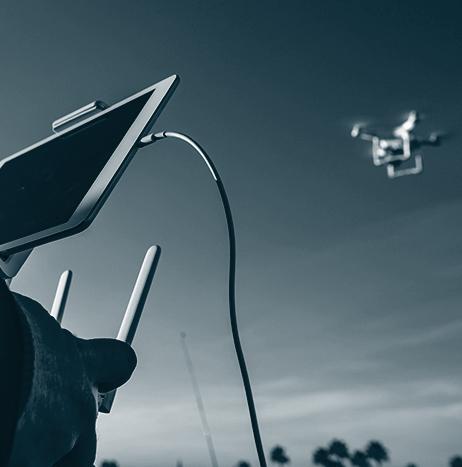
In an effort to meet the growing demand of using UAS for commercial and practical applications, the Delta Regional Authority (DRA) has created the program, “Workforce Development: Training the Trainer Using Unmanned Aerial Systems.”
Through the program, DRA recently awarded a $90,000 grant to Sean Chenoweth, associate professor of geosciences at the University of Louisiana Monroe (ULM), to teach people in northeast Louisiana how to operate a UAS. Once those people are trained UAS operators, they can go out and train others.
U.S. Navy commissions first UAS test and evaluation squadron
During a ceremony at Naval Air Station Patuxent River’s Webster Outlying Field on Oct. 18, the U.S. Navy commissioned its first UAS test and evaluation squadron.
Known as Air Test and Evaluation Squadron (UX) 24, the new unit flies over 23 fixed and rotary wing UAS, including the MQ-8 Fire Scout, RQ-20 Puma, RQ-21 Blackjack and RQ-26 Aerostar.
The ceremony marked UX-24’s official transition from what was formerly known as NAWCAD’s UAS Test Directorate, which was previously overseen by Commander Matthew Densing. Under Densing’s leadership, the directorate executed more than 2,200 flight hours and 2,000 ground test hours in support of UAS developmental test.
During the ceremony, Cdr. Densing officially assumed leadership of UX-24.

FLIR announces UAS flight management software platform designed for public safety applications
FLIR Systems Inc. has announced a UAS flight management software platform designed for public safety applications called DroneSense–FLIR Edition.
According to FLIR, DroneSense-FLIR Edition is the only software platform that combines thermal and visual imaging processing with flight data planning and management capabilities across public safety organizations to help improve incident response.
This is the first product under a collaboration between FLIR and DroneSense. DroneSense is a UAS software platform maker based in Austin, Texas that FLIR announced a strategic investment in earlier this year.
UAVOS and Stratodynamics Aviation finalizing balloon-launched unmanned glider
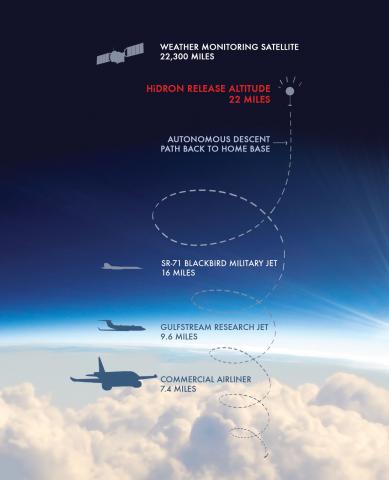
UAVOS Inc., along with Stratodynamics Aviation Inc., is finalizing manufacturing of HiDRON, a stratospheric aircraft that is built to provide a “new dynamic method for measuring and evaluating atmospheric phenomena at various altitudes in a variety of geographical locations.”
Designed to collect high-altitude atmospheric data, the balloon-launched unmanned glider is capable of autonomous and soaring flight modes.
During a campaign next month, the HiDRON will reach altitudes up to 82,000 feet, the companies say.
UAVOS completes first stage of flight tests of HAPS ApusDuo UAS
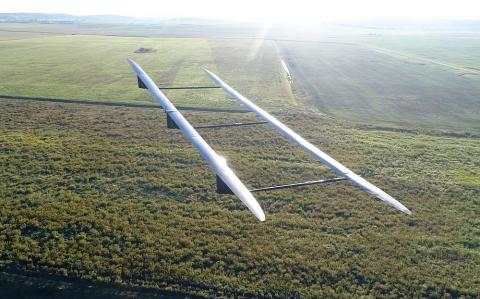
UAVOS Inc. recently completed the first stage of flight tests of the 10-meter prototype of the High Altitude Pseudo Satellite (HAPS) ApusDuo UAS.
HAPS ApusDuo was manufactured as part of the development program of the ApusDuo solar aircraft.
The prototype was made for testing control algorithms such as take-off and landing and full-scale verification of HAPS aerodynamics.
UAVOS says that test flights “fully confirmed” the flight characteristics of the UAS.
Video footage of the flight tests can be seen below:
NASA and MTSI to develop framework for autonomous aircraft that can be used to achieve FAA certification
Over the next 24 months, NASA and Modern Technology Solutions Inc. (MTSI) will collaborate to develop a framework for autonomous aircraft that can be used to achieve FAA certification.
Known as Resilient Autonomy, the NASA-led project’s goal is to develop a “robust architecture and methodology” for certifying fully autonomous systems by using a technique known as multi-mode run-time assurance (MM-RTA). MM-RTA places a deterministic "wrapper" around the autonomous system's non-deterministic software to safely bind the untrusted system's behavior.
From Unmanned Systems Magazine: Good teams, good strategies, compelling tales: Successful startups describe their strategies
With technological advances emerging nearly every day, companies in the unmanned systems industry are competing to build better, stronger, faster, more agile machines for every type of customer, from governments to businesses to consumers. The technology is becoming more affordable and accessible, making the UAS industry one of the most dynamic, unpredictable and exciting marketplaces on earth.
Now more than ever, the path to competing in the market is paved with opportunity. As more countries have developed regulations allowing drone operations, and as more industries have created standards for the use and incorporation of unmanned systems into business functions, widespread adoption is racing ahead.
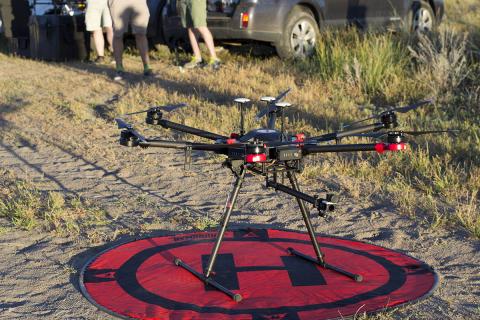
PAE ISR and NASA to conduct UAS demo in National Airspace System in 2020
PAE ISR has signed a cooperative agreement with NASA to conduct a UAS demonstration in the National Airspace System (NAS) in 2020, and work toward the full integration of this technology into the NAS.
“NASA's Systems Integration and Operationalization Demo program is a great opportunity to validate integration of larger UAS in the NAS,” says Beth Beach, vice president of business development.
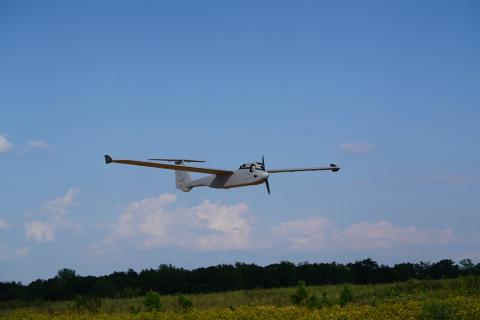
NATE hosts UAS showcase event to highlight wireless industry use
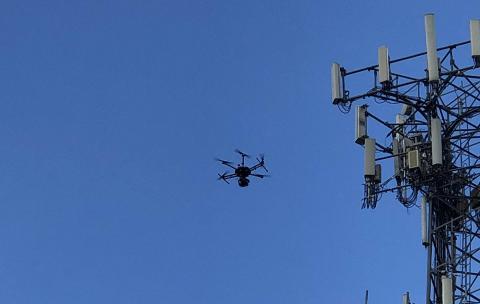
The National Association of Tower Erectors hosted key stakeholders from federal government agencies, industry and media at the inaugural NATE UAS Operations “Field Day Showcase” on Tuesday, Oct. 9 in Gainesville, Virginia, near the Washington, D.C. Beltway.
The event was held at a Crown Castle tower site. Crown Castle operates and leases more than 40,000 cell towers across the United States. At the event, attendees watched live flight demonstrations conducted by ETAK Systems; Talon Aerolytics; Ehresmann Engineering; and B+T Group.
Attendees were also able visit with drone and aviation subject matter experts about the transformative impact this technology is having on the wireless industry.