
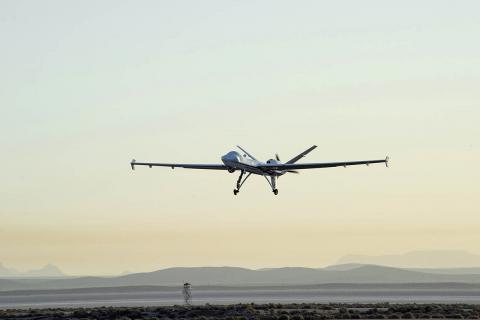
The June flight of a large unmanned aircraft in the National Airspace System without the use of a chase plane took “thousands of hours” and a tightly integrated detect and avoid system, NASA and industry officials said on Thursday.
“This historic flight moves the United States one step closer to normalizing unmanned aircraft operations across the U.S.,” NASA said in a press release announcing a press teleconference held Thursday afternoon to discuss the historic flight.
On June 12, NASA and partners General Atomics Aeronautical Systems (GA-ASI), Honeywell and the Federal Aviation Administration conducted the demonstration, a 2.5-hour flight not far from Los Angeles.
UAS
UAS
Vanilla Aircraft is now Vanilla Unmanned, a joint venture
Platform Aerospace, which provides rapid aircraft and drone prototyping, modification, and systems integration, has established a joint venture with an unnamed partner to acquire substantially all the assets of Vanilla Aircraft, which designed and built the VA001 ultra-endurance UAS.
The joint venture, named Vanilla Unmanned, will leverage Platform Aerospace’s prototyping and integration experience and the partner’s experience with aerospace and defense electronics to further develop the record-setting VA001, “creating a disruptive persistent aerial solution for both military and commercial applications,” the new company says.

GA-ASI to fly first trans-Atlantic flight of a MALE RPA in July
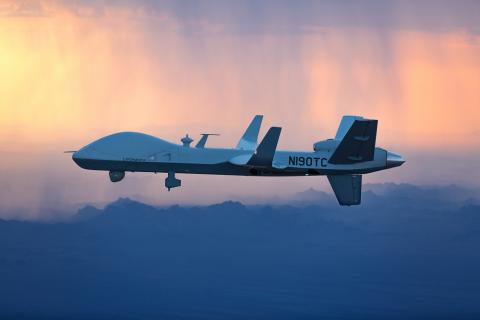
General Atomics Aeronautical Systems Inc. (GA-ASI) plans to make the first-ever trans-Atlantic flight of a Medium-altitude, Long-endurance (MALE) Remotely Piloted Aircraft (RPA) on July 10-11.
GA-ASI’s company-owned MQ-9B SkyGuardian RPA is scheduled to fly from GA-ASI’s Flight Test and Training Center in Grand Forks, North Dakota to Royal Air Force (RAF) Fairford in Gloucestershire, UK.
GA-ASI has partnered with Inmarsat—the leading provider of global mobile satellite communications (SATCOM) services—for the trans-Atlantic flight. The MQ-9B’s ground control station will use Inmarsat’s SwiftBroadband SATCOM to communicate and control the aircraft.
KT Corp.'s emergency network service platform features UAS for search and rescue operations
South Korea's second-largest mobile carrier, KT Corp., has unveiled an emergency network service platform that features UAS for search and rescue operations.
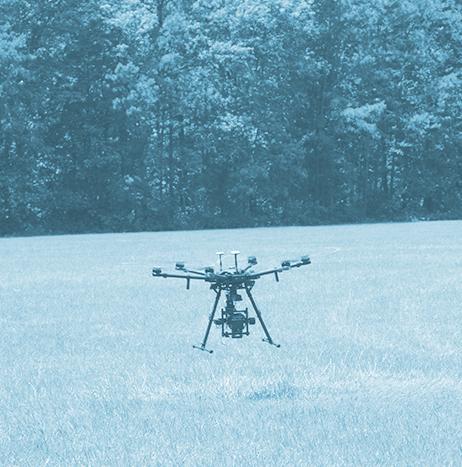
Co-developed by a local UAS maker named Metismake Inc., the Skyship platform features a helium-powered airship and a high-resolution camera that can scan for mobile signals of people who need to be rescued.
Capable of scanning for LTE or high-end fifth-generation (5G) signals, the airship can determine a person's position “to within 50 meters” before sending UAS to find their exact location.
Once the signal of a survivor is picked up by the airship, the platform will deploy smaller UAS that will deliver emergency kits and supplies before actual rescue personnel arrive at the site.
Kansas State Polytechnic becomes first university to receive waiver to fly UAS BLOS
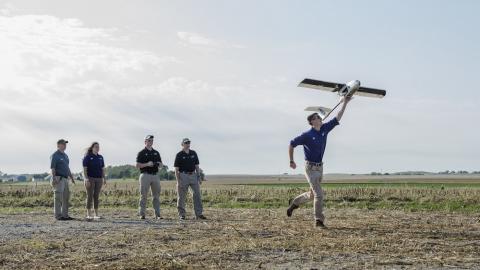
Kansas State University Polytechnic Campus has become the first university to receive a waiver from the FAA to fly UAS beyond the line of sight (BLOS).
The FAA certificate to Kansas State Polytechnic's Applied Aviation Research Center waives the rules regarding visual sight of aircraft operations by the pilot and visual observers, which will allow K-State Polytechnic to conduct research and operations where pilots and observers can no longer see their UAS.
“These operations and research will provide valuable insight into regulation and safety measures for UAS in the national airspace,” says Travis Balthazor, Kansas State Polytechnic's UAS flight operations manager.
Weekend Roundup
This Week in the Unmanned Systems and Robotics World
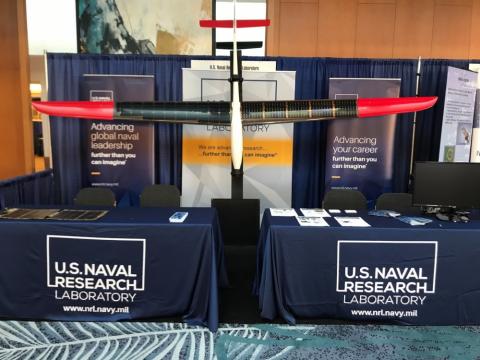
Researchers at the U.S. Naval Research Laboratory (NRL) have developed Solar Soaring technology that gives UAS the ability to fly for more than 12 hours. Solar-Soaring, which is a “pair of endurance-enhancing technologies,” enables a UAS to fly longer without carrying extra weight in batteries, ultimately helping the warfighter. (United States Navy)
CNC Technologies selected to deploy state-of-the-art mobile video network to support advanced UAS program
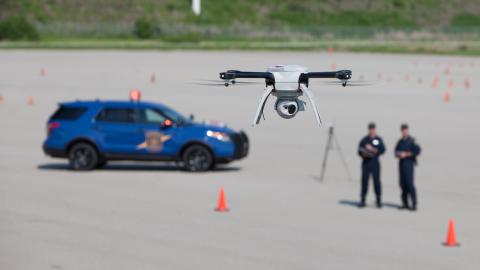
The Michigan State Police (MSP) has selected CNC Technologies—an aviation technology and wireless communications company that serves the law enforcement, military and government markets—to deploy a state-of-the-art mobile video network to support the department’s advanced UAS program.
The new technology is meant to speed and improve the ability of MSP to share actionable aerial intelligence. It is also meant to “secure transmission of real-time video and data from the department’s airborne assets to officers and partner agencies across the region.”
SenseFly moves its North American operations to Raleigh, North Carolina
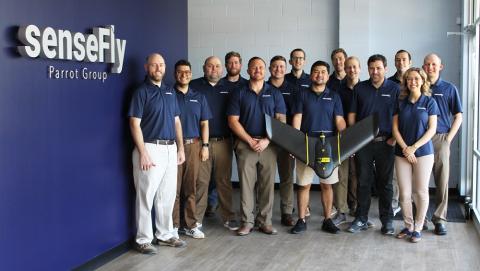
SenseFly has announced that it is moving its North American operations to Raleigh, North Carolina.
SenseFly says that its new office will “accommodate its rapid growth.” Additionally, the new office will host senseFly's North American shipping & logistics operation, its customer service & satisfaction function, and its sales and marketing teams.
“Our move to Raleigh reflects our dedication to meeting our customers’ needs through innovation,” says senseFly CEO Gilles Labossière.
Insitu's ScanEagle UAS selected to provide fire suppression services across U.S.
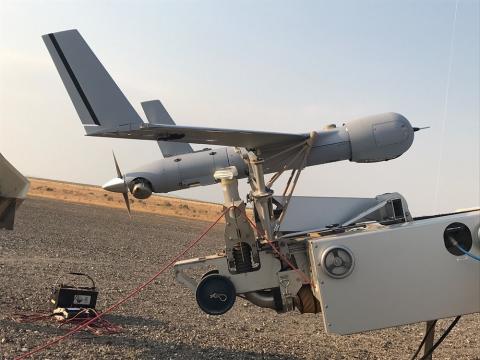
The U.S. Department of the Interior (DOI) has awarded a “first-of-its kind” contract to Insitu, so that the company can provide fire suppression services within the contiguous 48 states and Alaska using its ScanEagle UAS.
The UAS will help battle wildfires using geospatial mapping and full motion video.
Through the contract, Insitu will support manned aerial operations for a variety of scenarios, including fire suppression, search and rescue, and emergency management, as needed on a “call when needed” basis.
Deveron UAS Corp launches its drone data services in the U.S. market
Deveron UAS Corp. has launched its drone data services in the U.S. market.
Deveron will now offer its UAS data services to its partners across the Midwestern United States, where there are some 127 million acres of farmland, according to the company.
“We are excited to be launching our drone data services network to US customers,” says Deveron’s President & CEO, David MacMillan.