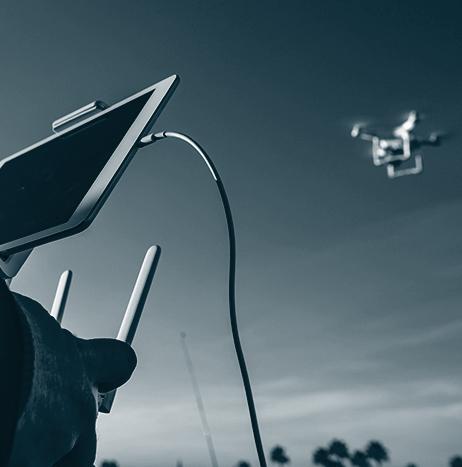
Since June, the Madison Police Department in Wisconsin has deployed its new UAS team five times.
One of the times, the policed launched a UAS to help officers locate a suicidal man who was on the loose, and another time, a UAS was used to help officers map out the scene at a restaurant where a homicide and armed robbery had occurred.
These are just a few examples of how the department plans on using its UAS, and according to Madison Police Lt. Mike Hanson, who commands the 11-member team, this is just the beginning for this technology.
“They’re here to stay,” Hanson says via the Wisconsin State Journal.
UAS
UAS
NOAA partners with UMD UAS Test Site to investigate UAS in Satellite Data Validation
In an effort to determine whether or not UAS can be used to validate satellite data more efficiently, the National Oceanic and Atmospheric Administration (NOAA) has partnered with the University of Maryland Unmanned Aircraft Systems (UAS) Test Site.
NOAA regularly measures temperatures and light wavelengths from earth, and compares those results with results sent down from space.
While this process helps make sure that weather forecasts aren’t manipulated by inaccurate data, it is labor intensive and hard to conduct over large regions, which limits how directly the two data sets can be compared.
Through this partnership, NOAA and the UAS Test Site will investigate the potential of UAS saving time and money while collecting more data over a wider region.

North Carolina State University to research tracking UAS thanks to NASA grant
Thanks to support in the form of a three-year, $1.33 million grant from NASA’s University Leadership Initiative, researchers at North Carolina State University will launch a project that seeks to research and develop high-performance communications, networking and air traffic management (ATM) systems, which includes navigation and surveillance for UAS, as well as manned aircraft.
The NC State Group will work with David Matolak from the University of South Carolina (USC), Hani Mehrpouyan from Boise State University, and Benjamin Boisvert from Architecture Technology Corporation (ATCorp) to develop “multi-band radio designs, “millimeter wave” (mmWave) propagation measurements/modeling, navigation and surveillance techniques for manned/unmanned aircraft, and ATM simulations.”
AUVSI’s Brian Wynne to Deliver Keynote Address at ACT-IAC Internet of Things and Drones Forum
FOR IMMEDIATE RELEASE: July 24, 2017
Contact: Tom McMahon, tmcmahon@auvsi.org, (571) 255-7786
Cloud County Community College to adopt Unmanned Safety Institute’s drone curriculum
Cloud County Community College will become the first college in Kansas to adopt the Unmanned Safety Institute’s (USI) drone curriculum, as the school will reportedly use the curriculum as a “precursor to drone operations involving renewable energy assets.”
The UAS courses are also a part of the school’s Precision Ag program, and could be used to support other careers, such as those in mass communications, or that of a substation technician.

50 airports to provide Automated Airspace Authorization for UAS starting this fall
This fall, 50 airports will begin providing Low Altitude Authorization and Notification Capability (LAANC), which will give UAS operators the ability to “apply for instant, digital approval to fly in U.S. controlled airspace using the same applications they use for flight planning and in-flight situational awareness.”
Currently, FAA authorization is required for flights in controlled airspace, at certain times of day, or near sensitive locations. Authorization requests are subject to long waiting periods and labor-intensive manual approvals, which can add more time to, or entirely halt, the process of trying to fly UAS commercially.
NIAS and SkyOp partner to provide West Coast with UAS training programs and courseware
The Nevada UAS Test Site and the Nevada Institute for Autonomous Systems (NIAS) are partnering with a New York based training and education provider called SkyOp LLC, to offer UAS training programs and courseware to the West Coast.
Las Vegas will serve as the West Coast affiliate training center, where the next generation of the workforce will be prepared and trained so that it can answer “future demand for highly specialized drone-enabled employment opportunities.”
“UAS workforce development is the engine that will grow the Nevada UAS Industry,” says Dr. Chris Walach, Director of the FAA-designated Nevada UAS Test Site.
Harvey County Sheriff’s Office uses UAS to locate missing elderly man
On Wednesday, July 19, the Harvey County Sheriff’s Office in Kansas used a UAS to locate a missing elderly man who had been reported missing by his family.
The UAS located the 91-year-old man approximately 12 hours after he had been reported missing. The man was found dehydrated with possible injuries, but he was alive and is receiving treatment at a local medical facility.
According to Harvey County Sheriff Chad Gay, the UAS was integral to saving this man’s life.
“It was critical to saving that guy’s life last night. No doubt about it,” Gay says via the Hutchinson News.