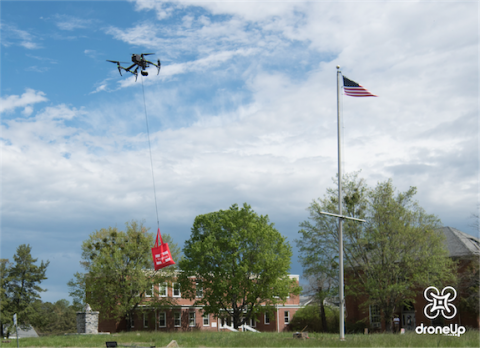
To determine how UAS could help medical professionals in their fight to stop the spread of the Coronavirus, DroneUp, UPS and its subsidiary UPS Flight Forward (UPSFF), Virginia’s Center for Innovative Technology (CIT), and Workhorse Group recently came together to test the technology in Lawrenceville, Virginia.
The entities say that experts in the healthcare industry and in government are looking for technology that could speed the pace of testing and treatment for infected patients, making autonomous drones a potentially valuable tool. The tests evaluated the commercial drone industry’s ability to provide and scale small UAS to support a variety of use cases to speed and assist the U.S. healthcare system during the pandemic.
UAS
UAS
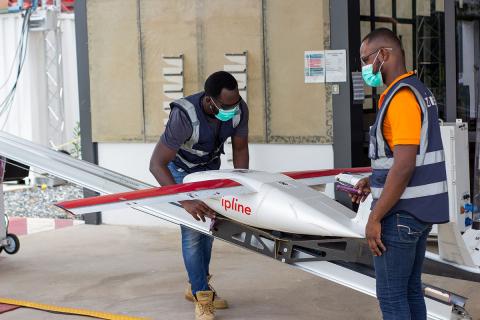
Drone delivery company Zipline tapped for Ghana COVID-19 sample flights
On-demand drone delivery specialist Zipline has been contracted by Ghana’s Ministry of Health to return COVID-19 test samples from health centers in the most remote areas of the country.
According to an official statement published on April 20, the U.S.-based company has already started to fly missions from four launch sites across the West African country to laboratory sites in Ghana’s Capital, Accra and second city Kumasi.
The "contactless" service will allow Ghana’s government to respond to the pandemic and help save lives "more quickly," according to a statement released by Zipline CEO Keller Rinaudo.
Black Swift Technologies to develop UAS for Air Force, Army and Special Operations Forces ops
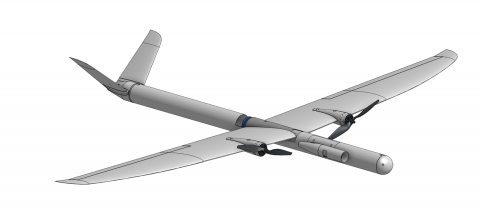
Black Swift Technologies (BST) has been awarded a USAF SBIR Phase II contract to develop a UAS that can autonomously conduct atmospheric profiling to support more accurate cargo drops and improved localized weather forecasts in support of Air Force, Army and Special Operations Forces (SOF) operations.
Known as the Black Swift SØ (S-zero), the compact, rugged aerial platform is designed to be hand-launched with the ability to quickly climb up to 15,000 feet. It is capable of a deep-stall landing with near vertical descent and 10-foot accuracy thanks to its unique tail design. Its rapid ascent and descent capabilities allow the UAS to quickly and accurately capture 3-dimensional (3D) wind profiles at a variety of levels, which is crucial for precision cargo drops.
OSU's new drone designed to keep rescuers out of harm's way following disasters
The aftermath of the Oklahoma City bombing in 1995 that left 168 people dead sparked the work being done today by Oklahoma State University’s (OSU) Unmanned Systems Research Institute to help first responders.
25 years ago, there was no technology available that could help rescuers locate victims without risking their own lives to climb throughout what was left of the Murrah Building.
With this in mind, the now deceased Jon Hansen of the Oklahoma City Fire Department said that first responders needed a better way to conduct searches of rooms and communicate with the injured without having rescuers climbing through an unstable structure.
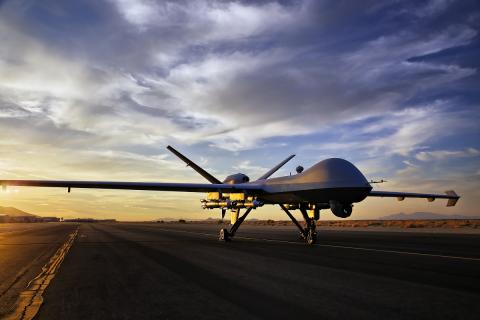
USMC conducts first operational flight of MQ-9A Reaper UAS in the Middle East
U.S. Marine Corps (USMC) pilots and sensor operators from Marine Unmanned Aerial Vehicle Squadron 1 (VMU-1) conducted their first operational flight of GA-ASI's MQ-9A Reaper UAS in the Middle East on March 20.
The VMU-1 “Watchdog” crews took control of a Company Owned/Company Operated (COCO) MQ-9A supporting forward deployed Marines, while the GA-ASI team provided oversight.
This achievement by the USMC comes shortly after 7,000 hours of COCO flight operations since Sept. 2018 was surpassed.
“This achievement represents a unique milestone and example of the Marine Corps’ legacy of innovation,” says David R. Alexander, president, GA-ASI.
Weekend Roundup: April 17, 2020
This Week in the Unmanned Systems and Robotics World
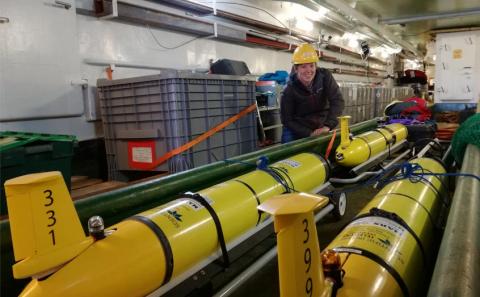
Oceanographers from the Scottish Association for Marine Science (SAMS) recently uncovered a hidden Arctic eddy using an autonomous glider. Eddies are circular movements of water that have broken off from an ocean current. (Scottish Association for Marine Science)
Workhorse Group expands patented portfolio for HorseFly UAS and key components
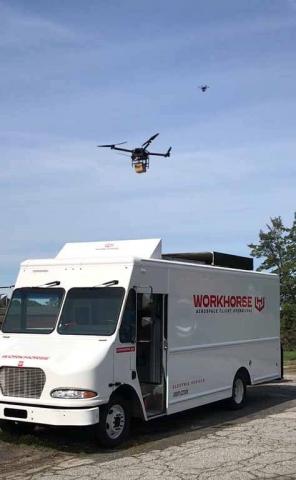
Through a recently filed provisional application, Workhorse Group Inc. has expanded its patent portfolio, which further protects its HorseFly UAS, as well as several of the system's key components and capabilities including the ground control station, winch deliveries and aircraft structure.
Built to operate autonomously with a high degree of precision, the HorseFly UAS includes a safe, reliable, multi-use aircraft that can deliver parcels and carry sensors and cameras.
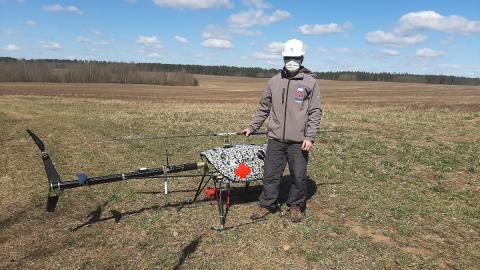
UAVOS successfully tests cargo delivery UVH-170 unmanned helicopter
During a trial designed to validate a highly automated delivery flight from a vendor to a destination and back, across precisely pre-selected pathways, UAVOS successfully tested its cargo delivery UVH-170 unmanned helicopter.
During the 1.7-hour flight that covered a standoff distance of 62 miles, critical humanitarian aid that weighed 17.6 pounds was delivered without the UAS having to land, and without the need for a ground control station on the receiving side.
Swift Tactical Systems, Silvus Technologies partner to produce robust UAS
Swift Engineering subsidiary Swift Tactical Systems has entered into a strategic alliance with Silvus Technologies that will result in the companies combining Swift’s UAS with Silvus' advanced MIMO communication systems for tactical applications.
Through the commercial agreement, Swift will equip its family of American made UAS with the locally manufactured radios, which will allow the company to accelerate its product roadmap and the delivery of its government contracts.
The companies say that the combined systems will not only bolster commercial and advanced military missions, but also research and development for future applications.
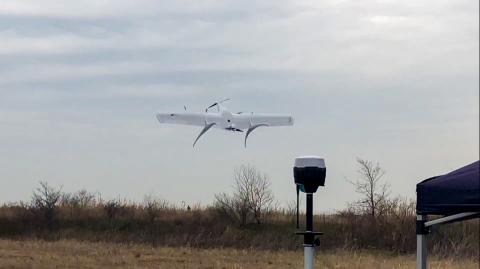
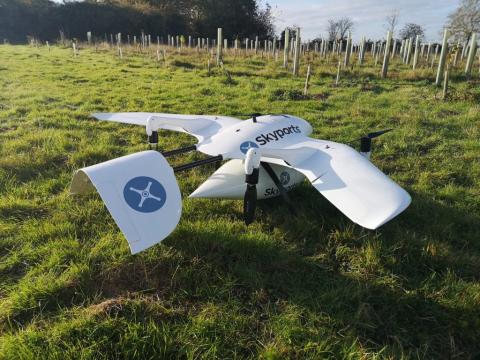
Skyports to trial BVLOS flights in non-segregated airspace after joining UK CAA Regulatory Sandbox
After being accepted into the UK Civil Aviation Authority’s (CAA) Regulatory Sandbox, drone delivery service provider Skyports will begin testing beyond visual line of sight (BVLOS) flights in non-segregated airspace.
Specializing in operating end-to-end drone deliveries within the medical, e-commerce and logistics sectors, Skyports, along with the UK CAA, will explore how drones controlled out-of-sight of the remote pilot can be granted regulatory approvals to fly safely within airspace that is shared with other aircraft, which will be crucial for permanent drone deliveries to become a reality.