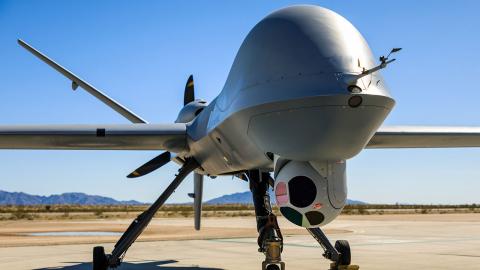
General Atomics Aeronautical Systems Inc. (GA-ASI) and L3Harris Technologies have successfully completed equipping a GA-ASI MQ-9 Remotely Piloted Aircraft System (RPAS) with the WESCAM MX-20 Electro-optical/Infrared (EO/IR) system, resulting in an advanced targeting platform.
Beginning Feb. 18, a series of test flights were conducted to demonstrate the MQ-9’s ability to locate and track targets at long stand-off ranges thanks to the integration of the MX-20.
“The GA-ASI and L3Harris teams have worked closely over the past year to ensure the successful integration of this sophisticated system,” says Linden Blue, CEO, GA-ASI.
UAS
UAS
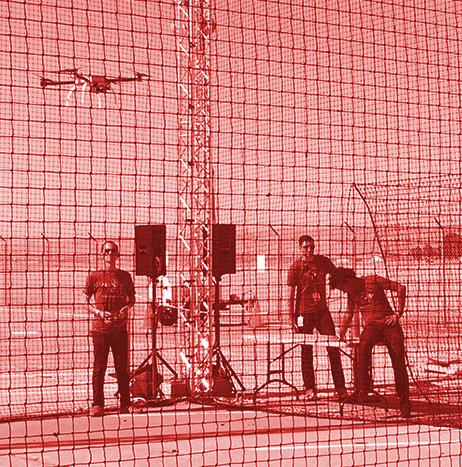
AIRT, Public Safety Unmanned Response Team North Texas support using UAS for public safety missions
The Public Safety Unmanned Response Team North Texas (PSURTNTX) and Airborne International Response Team (AIRT) have signed an agreement of cooperation to support using UAS for public safety and emergency management missions.
Through the agreement, PSURTNTX—a Texas-based non-profit organization made up of UAS remote pilots from regional public safety entities—and AIRT will collaborate to develop emergency preparedness, response, and resilience capabilities between one another, as well as among select partner organizations.
The goal is to develop a “robust network” of UAS responders and geographic information systems (GIS) experts that can provide direct assistance and location intelligence during complex emergencies, rapidly expanding incidents, and major disasters.

Union Robotics offering factory training certification program for UAS pilots
Robotics company Union Robotics is now offering a factory training certification program called R.A.F.T (Remote Aircraft Factory Training) to accompany its UAS. According to Union Robotics, the new program is the “most comprehensive training and certification instruction offered by a manufacturer in the industry.”
Through the program, industrial drone pilots will be prepared on how to be compliant with upcoming governmental mandates for UAS operations. The program will also offer skill development with drones created for the energy industry.
UAVOS, KACST developing Flight Control System for multi-mission, multi-domain UAS
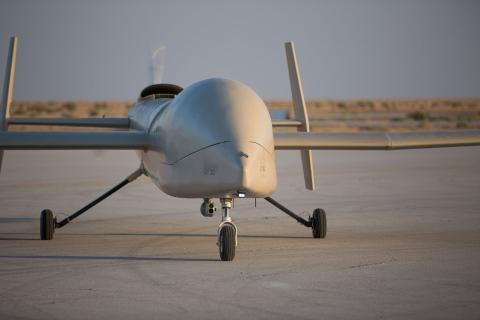
UAVOS and King Abdulaziz City for Science and Technology (KACST) in Saudi Arabia are collaborating on the scientific research and development of the Flight Control System (FCS), which is designed to fit and leverage multi-mission, multi-domain UAS platforms.
As a result of their shared experience and first-class knowledge, UAVOS and KACST have created a Saker-1B Medium Altitude Long Endurance (MALE) UAS. More than 500 hours of day and night test missions under various weather conditions have confirmed the drone’s specifications. In total, 1,000 hours of take-off and landing test missions have been successfully performed, with the long endurance flights lasting up to 19 hours.
AIRT to produce DroneResponders Emergency Management and Disaster Forum through new partnership with EDRC
The Energy Drone & Robotics Coalition (EDRC) is partnering with Airborne International Response Team (AIRT), which will result in AIRT producing the DroneResponders Emergency Management and Disaster Forum.
AUVSI releases response to FAA's proposed remote ID rule
AUVSI has published a 27-page set of comments on the Federal Aviation Administration's Notice of Proposed Rulemaking for remote identification, which would require drones to be able to report their positions, allowing police or other officials to determine who is flying a particular unmanned aircraft.
The issue is seen as enabling the wider use of drones for a variety of services such as package delivery, but the proposed rule has received significant complaints from the hobbyist drone flyers, who say it is too restrictive and would end their hobby. As of the afternoon of March 2, the last day to submit responses, the proposed rule had racked up more than 34,000 comments.

Schiebel, Nordic Unmanned successfully test Camcopter S-100 equipped with sniffer capability
Schiebel and its partner Nordic Unmanned have successfully completed a two-day test of the sniffer capability onboard the Camcopter S-100 UAS in the shipping lane outside Gniben, Denmark.
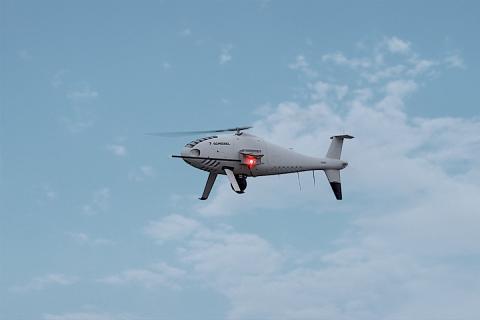
The entities note that ships operating in Europe’s busiest sea routes are allowed to emit exhaust fumes with a Sulphur oxide content limited to no more than 0.1 percent. One potential option to enforce this International Maritime Organization (IMO) 2020 regulation is using UAS such as the Camcopter S-100 equipped with a Sulphur sniffer. The UAS measures the Sulphur emissions by flying through the ship’s exhaust plume, and identifies the ships using its Automatic Identification System (AIS).
Quaternium sets world record of endurance with eight-hour hybrid-drone flight
Six years after developing the first hybrid fuel-electric drone, Quaternium has announced that it has set the New World Record of Endurance with the longest hybrid-drone flight.
The eight-hour, 10-minute non-stop flight was completed using Quaternium’s new drone, HYBRiX 2.1, of 25 kilograms maximum takeoff weight (MTOW), in Valencia, Spain.
According to Quaternium, HYBRiX is ideal for aerial missions such as surveillance or first response thanks to the advantage it offers in flight time.


NAV CANADA, Unifly partner to deploy national system to ensure safe UAS ops in Canada
Canada’s air navigation service provider NAV CANADA has entered into an agreement with Unifly to deploy a national system that provides digital services for the safe operations and management of drones in Canadian airspace.
Equipped with an intuitive user interface, the system, which is designed to support current regulations for drone flights within visual line of sight, will allow Canadian drone pilots to access web and mobile applications to perform various functions, including identifying safe and legal airspace, planning flights, and managing operations, pilots and fleet of drones.