
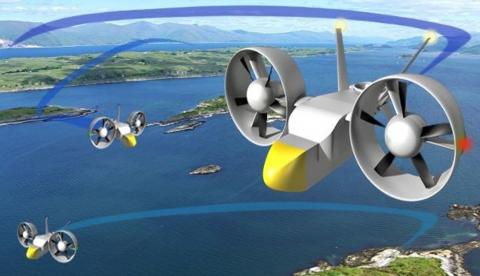
A group of engineers in the United Kingdom is planning to build a “mid-mass logistics drone” for global markets called the Sky Hopper.
Initially, the system will be aimed at remote and isolated communities, but the plan is for it to be “fully capable of near urban operations in due course.”
UAV
UAV
Primoco UAV SE announces new engine for unmanned aircraft
Primoco UAV SE, which is a Czech company that develops, manufactures and sells the Primoco UAV One 100/150, has announced its new “self-designed” Primoco 500 piston engine, which is designed for the company's unmanned aircraft, but can also be used by other aircraft manufacturers as well.
Developed by the company in nine months, the Primoco 500 is made of light aluminium alloy, and is an “air-cooled four-cylinder engine with a power output of 50 HP and a weight of 15 kg.”
According to Primoco UAV SE CEO Ladislav Semetkovský, the idea behind the development of the engine was largely born out of necessity, as the company’s newest aircraft, the Primoco UAV One 150, required a more powerful engine than the one that the Primoco UAV One 100 uses, which is a 20 HP engine.

From Unmanned Systems Magazine: UNMANNED SYSTEMS GO OVER, ON AND UNDER BRIDGES TO MAKE INSPECTIONS CHEAPER AND FASTER
America has a lot of bridges, more than 600,000. Many of them are in disrepair or are reaching the end of their planned lives.
According to the 2017 Infrastructure Report Card from the American Society of Civil Engineers, 9.1 percent of the country’s bridges were structurally deficient in 2016, meaning that drivers made an average of 188 million trips across a deficient bridge every day.
Inspecting bridges, then, is a critical activity for many states. Several states are looking at bolstering that activity by using drones, including Minnesota, which has been studying their use for years and is planning to make them a standard part of its bridge inspection toolkit.

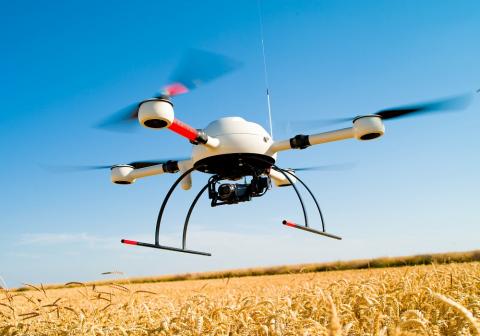
Microdrones conducts BVLOS test flights in Quebec
Via Unmanned Aerial, it has been announced that Microdrones completed a series of beyond visual line of sight (BVLOS) test flights on July 13 and 14 in Alma, Quebec, using the company’s md4-1000 UAV.
Using the md4-1000 UAV with a variety of payloads attached to it, Microdrones conducted a total of 10 flights, which were flown by Microdrones’ Jocelyne Bois, flight operations manager; Jeremy Jung, research and development engineer; and Yannick Savey, UAS pilot.
“We are very excited about the results,” Bois says.
Pioneer Aerial Surveys signs UAV-MAG contract to perform survey for Quantum Pacific Exploration
Starting in August, Pioneer Aerial Surveys, which is the wholly owned subsidiary of Global UAV Technologies, will conduct a survey for Quantum Pacific Exploration (QPX), after signing a UAV-MAG contract in Chile.
For Pioneer Aerial, this will be its third international survey, and its first contract for a UAV-MAG survey in South America.
“The QPX contract marks a significant step in Pioneer Aerial’s acceptance as the leader in UAV-MAG surveys worldwide,” says Michael Burns, President of Pioneer Aerial Surveys.
Cell phone network takes Delair-Tech beyond line of sight
Delair-Tech, based in both France and California, announced it has used 3G cell phone connectivity to allow its DT18 drone to fly beyond line of sight to inspect power lines in France.
In early June, the company flew the aircraft for more than 50 kilometers (31 miles) for the company RTE, inspecting power lines between the towns of Samur and Poitiers, using only 3G connections to navigate.
“That’s a major step forward for beyond line of sight flight,” says Benjamin Benharrosh, the company’s cofounder.
French airspace regulators were present for the flight, and Benharrosh said the company would like to present the results to the U.S. Federal Aviation Administration as well.
AERTEC Solutions to Present TARSIS UAS at ‘HOMSEC’ International Security Technologies Trade Fair
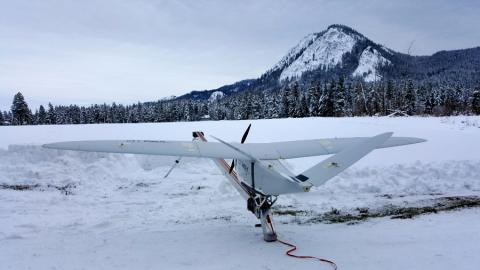
AERTEC Solutions plans on showcasing its ‘TARSIS’ fixed-wing UAS at the sixth edition of HOMSEC, which is an International Security Technologies Trade Fair that began on March 15 in Spain.
Specifically, AERTEC Solutions will showcase its TARSIS 75 and TARSIS 25 versions, which are built to conduct observation and surveillance missions for the military, as well as civilly.
A real version of the TARSIS 75 light tactical UAS will be displayed on its corporate stand (G01). This UAS has a wingspan of 75 meters, can fly at a maximum speed of 110 km/h, and has a maximum takeoff weight of 12 kg.
With the ability to operate autonomously for 110 hours, the UAS can conduct its missions from both the runway and a catapult, and can land with assistance from a parachute.
Redkite wide-area sensor completes successful advanced flight testing aboard Integrator UAS
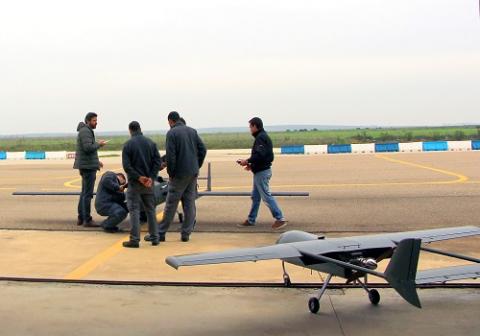
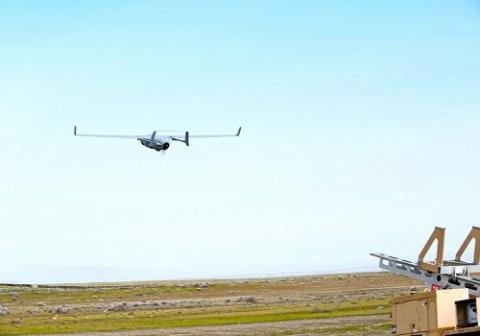
Logos Technologies has announced that it has successfully conducted advanced flight testing of its Redkite wide-area sensor aboard the Insitu Integrator UAS.
Testing confirmed that the Redkite was capable of capturing stabilized, wide-area motion imagery (WAMI), and could successfully stream it to multiple handheld devices on the ground from the payload bay of the UAS.
This latest demonstration, which was the second successful airborne test with the Integrator, took place in Boardman, Oregon.
WhiteFox Defense Technologies demonstrates Its DroneFox technology during Xponential
During Xponential 2017, San Luis Obispo, CA-based WhiteFox Defense Technologies, Inc. demonstrated its flagship technology, the DroneFox, which is built to respond to dangerous small UAS.
Designed to detect, identify, and mitigate UAS with a multi-mile range, the DroneFox is a SWaP-C optimized, portable technology, which uses a “master signal” to track and temporarily take control of UAS.
Using the “master signal,” the operator of the DroneFox can choose a course of action from a variety of responses, including land, return to launch, confiscate, and reroute.
The DroneFox is different from jammers and other non-kinetic products because it can select the exact signal it wants to manipulate without interfering with any others signals, even other UAS.
Microdrones’ md4-1000 UAV added to Transport Canada's list of Compliant Unmanned Air Systems
Transport Canada (TC) has added Microdrones’ md4-1000 UAV to its exclusive list of Compliant Unmanned Air Systems, making Microdrones one of just eight companies in the world to earn such a distinction.
In order to earn compliance, Microdrones had to submit an assortment of application materials, including flight, maintenance, and systems design manuals.
“This compliance means that our platform meets a certain level of safety and will provide users with the opportunity to become a TC-compliant organization, gaining access to all the related advantages," says Sebastien Long, Microdrones' Sales Manager for Canada.