
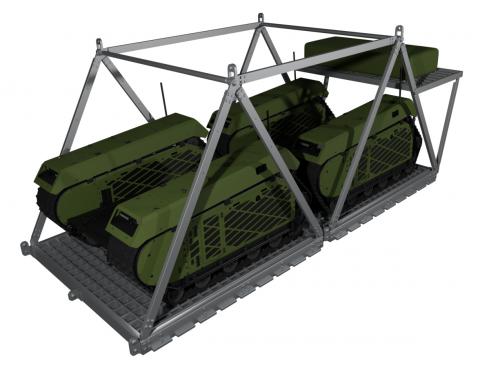
Aerial delivery technologies provider IrvinGQ has developed and tested an airdrop system that can be used to rapidly deploy Milrem Robotics’ UGV into warzones or large-scale terrain fires.
Expected to be used for defense or firefighting missions, respectively, Milrem Robotics’ THeMIS or the Multscope Rescue UGV will be equipped with IrvinGQ’s ATAX airdrop system.
Other aerial deployment possibilities of Milrem Robotics’ UGVs include helicopter underslung or in the cargo area of a helicopter such as the Chinook CH-47.
UGV
UGV
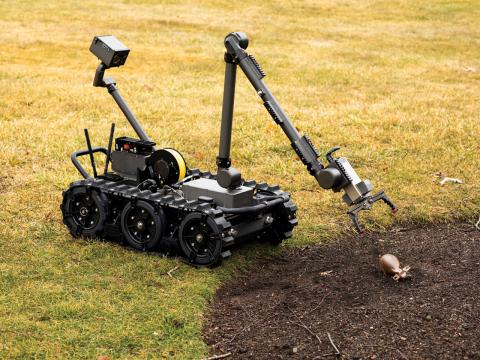
U.S. Air Force orders 180-plus FLIR Systems Centaur UGVs
Through a $23 million contract sourced through the Dept. of Defense Man Transportable Robotic System Increment II (MTRS Inc II) program, the United States Air Force has ordered more than 180 of FLIR Systems’ Centaur UGVs, plus spares.
A remotely operated, medium-sized UGV system, Centaur provides a standoff capability to detect, confirm, identify, and dispose of hazards. The open-architected robot, which weighs approximately 160 pounds, is equipped with an advanced EO/IR camera suite, a manipulator arm that reaches more than six feet, and the ability to climb stairs. The robot's modular payloads can be used for CBRNE detection and other missions.
Shipments of the UGVs are expected to begin in the second quarter of 2020.

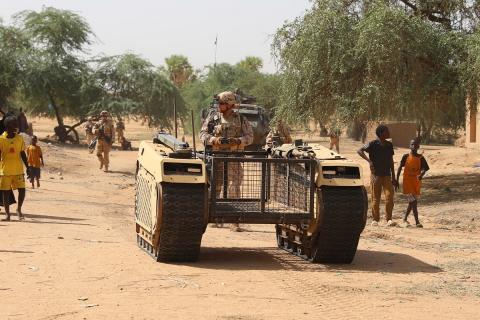
Milrem Robotics THeMIS UGV deployed for first time in Mali by Estonian Infantry Platoon
For the first time, the Estpla-32 infantry platoon, which is currently serving in Mali, deployed the Milrem Robotics THeMIS UGV during a military operation.
During the deployment, the UGV’s implementation in support of infantry in the conflict area was tested from both a tactical and a technical viewpoint.
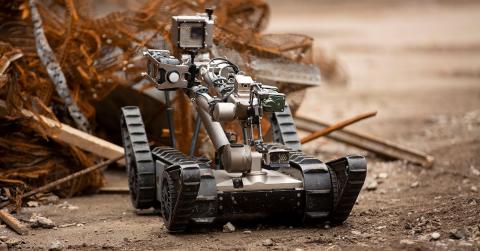
FLIR Systems to provide Norwegian Ministry of Defense and Oslo Police with its PackBot UGVs
FLIR Systems has announced that it has won contracts to provide more than 20 of its PackBot UGVs, as well as spare parts and training, to Norwegian Ministry of Defense and Oslo Police, which will upgrade and expand their ground robot inventory.
FLIR’s PackBot UGV supports various operations that would normally put humans at risk, including bomb disposal, close-in surveillance, and situations involving hostages or hazardous materials.
The UGV can be equipped with a range of payloads that deliver real-time intelligence, allowing it to perform sensing of chemical, biological, and nerve agents, radiation levels, explosive traces, and toxic industrial gases.
Lockheed Martin, Raytheon successfully fire Javelin missiles from remote launcher mounted on UGV
The Javelin Joint Venture team, which is a partnership between Lockheed Martin and Raytheon, has announced that it successfully fired Javelin missiles from a Kongsberg remote launcher mounted on a Titan UGV during demonstrations at the U.S. Army Redstone Test Center, Alabama.
The Javelin Joint Venture team describes Javelin as a “versatile one-man-portable and platform-employed anti-tank and multi-target precision weapon system.”
“Javelin is ready to support emerging military robotic vehicle requirements,” says Sam Deneke, Raytheon Land Warfare Systems vice president. “Remotely operated technology like this protects soldiers in battle.”

Milrem Robotics unveils fifth generation THeMIS UGV
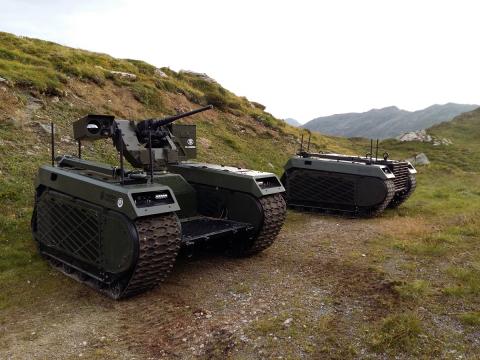
During DSEI 2019 in London, Milrem Robotics unveiled its fifth generation THeMIS UGV, which is designed to help warfighters and enhance combat effectiveness.
The vehicle leverages the knowledge obtained during tests conducted in the US, Europe, and the Middle East, as well as a deployment in Mali in the French lead Operation Barkhane. Its architecture, safety, air transportability, power offload and other aspects all follow NATO STANAG standards.
U.S. Navy and Marine Corps successfully test Remote Control Assault Amphibious Vehicle
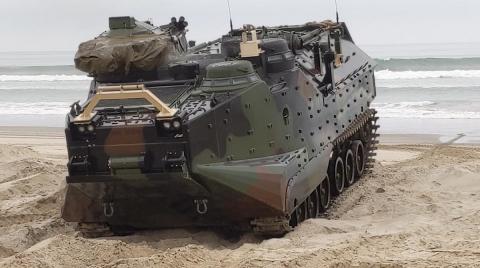
The U.S. Navy and the Marine Corps Systems Command (MCSC) recently successfully tested the Remote Control Assault Amphibious Vehicle (RC AAV).
For two weeks, the Naval Surface Warfare Center Panama City Division (NSWC PCD) team conducted tests in the Open Ocean and surf zone at the United States Marine Corps’ (USMC) Amphibious Vehicle Test Branch (AVTB) at Camp Pendleton, California.
“Assault Amphibious Vehicles were structured to carry troops in water operations from ship-to-shore, through rough water and the surf zone,” says Dustin Bride, RC AAV system engineer at the (NSWC PCD).
Unmanned vehicles to change the way we fight our wars
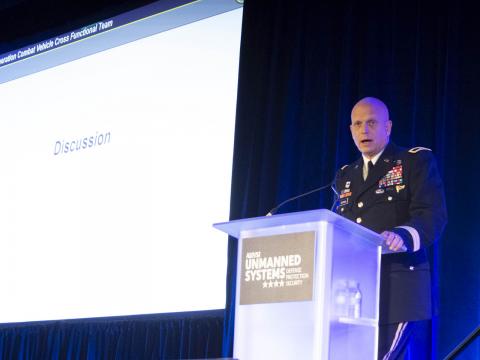
Unmanned vehicles “are going to change the way we fight our wars,” according to Brig. Gen. Ross Coffman, Director of the Next Generation Combat Vehicle (NGCV) – Cross Functional Team (CFT), U.S. Army Futures Command.
Among the many ways this technology could help soldiers on the battlefield is by taking them out of precarious situations and conducting dangerous operations.
While robots will not save the number of people needed, they “will save the people you have by managing risks,” Coffman said during his keynote address on the final day of AUVSI Unmanned Systems Defense. Protection. Security in Washington.
UTA researchers, Lockheed Martin collaborating on project surrounding sensors on unmanned vehicles
Two University of Texas at Arlington researchers are working with Lockheed Martin to “optimize how unmanned vehicles use sensors to gather information.”
Frank Lewis, the Moncrief-O’Donnell Chair and professor of electrical engineering, and Yan Wan, an associate professor of electrical engineering, are helping Lockheed figure out how to use sensors on vehicles underwater, on the ground and in the air, to measure and predict the activities of a target.