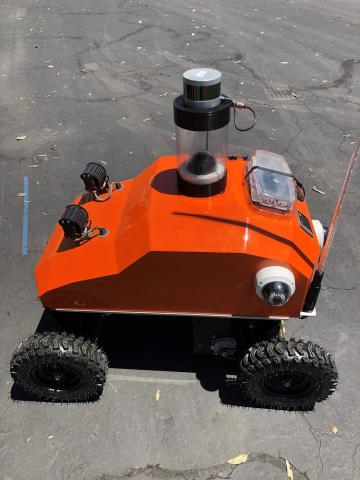
NXT Robotics Corp. recently launched “Maverick,” its Generation 5 autonomous vehicle and cognitive software platform.
The baseline model of Maverick is equipped with four high resolution PTX security cameras that can be used to conduct artificial intelligence (AI) based analysis of a physical environment, along with license plate detection and facial and object recognition.
Maverick can also open a two-way audio stream, allowing the robot to communicate with people it encounters along its patrol routes, which are largely autonomous. The audio system can also stream pre-recorded messages and noises in response to particular situations it encounters.
UGV
UGV
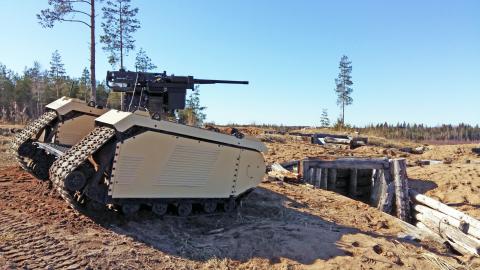
Milrem Robotics, ST Engineering demonstrate BVLOS combat UGV during live fire exercise
During a live fire exercise in April held in Tapa, Estonia, Milrem Robotics and ST Engineering demonstrated a beyond visual line of sight (BVLOS) combat UGV armed with a 40-millimeter AGL and a 12.7-millimeter HMG.
Made up of Milrem Robotics' THeMIS UGV and ST Engineering's ADDER DM Remote Weapon Station, the joint warfare system is meant to be a force multiplier for dismounted troops that can be used in urban areas, as well as rural areas.
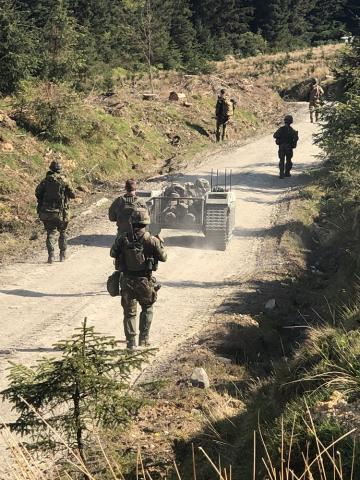
Milrem Robotics delivers THeMIS UGVs to Royal Netherlands Army
Milrem Robotics recently delivered two of its THeMIS UGVs to the Robot and Autonomous Systems (RAS) Unit of the 13th Light Brigade of the Royal Netherlands Army.
The robots were delivered for the Army's Concept Development and Experimentation Project, which examines how to take advantage of the possibilities new unmanned platforms provide for increasing combat power and decreasing risk to soldiers.
The THeMIS UGVs were delivered in transport configuration together with initial spare parts and accessories. Milrem will also provide operator and maintenance training, tactical deployment know-how and life cycle support and upgrades during a two-year period.
U-M's Automotive Research Center shifting focus to autonomous technologies for military ground vehicles
The University of Michigan has announced that its Automotive Research Center (ARC) has been awarded a $50 million contract from the U.S. Army, extending the ARC’s 25-year partnership with the Army through 2024.
With the funding, the ARC will shift its focus to autonomous technologies for military ground vehicles.
Launched in 1994, the ARC has served as a source of technology, modeling and simulation for the Army’s fleet of vehicles, which is the largest in the world.

UAVOS releases advanced UAS communication system for unmanned systems market
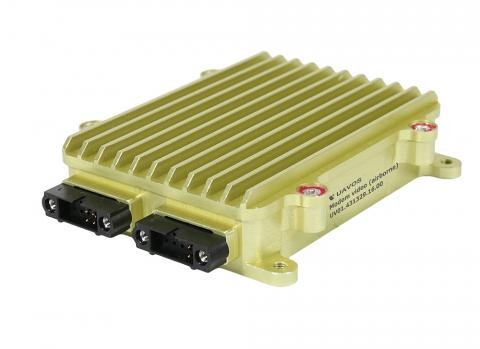
UAVOS has released its pMDDLRadio Data Link, which the company describes as an advanced UAS communication system designed for the unmanned systems market.
According to UAVOS, the pMDDLRadio is an “easy plug & play device” that packages all UAS communication into a single RF channel, with the exception of using separate technologies for control, telemetry and payload, which reduces costs and weight.
The system, which uses open architecture, enables “full duplex wideband with cybersecurity protection, digital link, error correction techniques and high-rate communication in the Uplink (UPL) and Downlink (DNL) channels,” UAVOS says.
Milrem Robotics' Multiscope UGV used to determine condition of pillars in mine
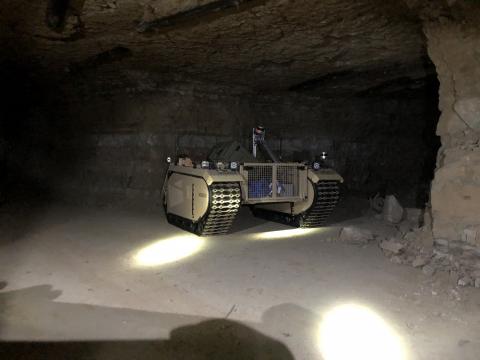
Milrem Robotics has announced that an energy company in Estonia called Enefit used its Multiscope UGV to determine the condition of the pillars in a mine in which mining ended ten years ago.
Equipped with 3D lidars, the Multiscope UGV was used in the Estonia Mine in closed underground locations. People are no longer allowed to enter these areas being that the anchor structure used to support the ceiling is being removed following the end of mining operations.
“An unmanned vehicle is an excellent solution for conducting surveys in an area which may be unsafe or prohibited for people to enter,” says Veljo Aleksandrov, development project director at Enefit.
FLIR Systems announces plans to acquire Endeavor Robotics
Just a few weeks after announcing its acquisition of Aeryon Labs Inc., FLIR Systems Inc. has announced that it has entered into a definitive agreement to acquire Endeavor Robotic Holdings Inc. (Endeavor Robotics) from Arlington Capital Partners for $385 million in cash.
Known for developing UGVs for the global military, public safety, and critical infrastructure markets, Endeavor’s robots use advanced sensing and actuation to provide explosive ordnance disposal, reconnaissance, inspection, and hazardous materials support for troops, police, and industrial users at stand-off range.
Endeavor Robotics awarded contract to modernize and maintain Army's fleet of robot platforms
The U.S. Army has awarded Endeavor Robotics a firm-fixed-price, Indefinite Delivery/Indefinite Quantity (IDIQ) contract to modernize and maintain its current fleet of robot platforms.
The five-year contract is potentially worth $32.4 million.
“We’re pleased to win this opportunity to help the Army keep its UGV inventory at an optimum state of readiness,” says Tom Frost, Endeavor Robotics president.
Newly launched Wave Relay Ecosystem designed to deliver true networked battlefield to warfighters
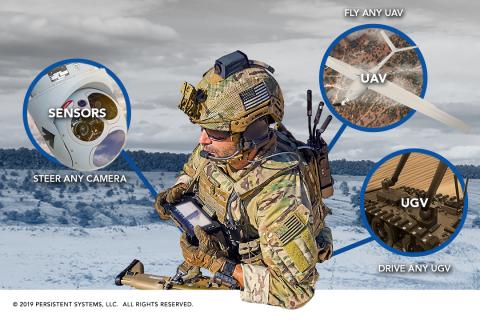
Persistent Systems has announced the launch of the Wave Relay Ecosystem, which the company describes as an alliance of unmanned systems and sensor companies working together to deliver a “true networked battlefield to warfighters.”
There were six formally announced partners for the Wave Relay Ecosystem as of Tuesday, Jan. 15, including the likes of Insitu, Endeavor Robotics, and MartinUAV. All of the Ecosystem partners are building products that seamlessly operate on Persistent’s Wave Relay mobile ad hoc network (MANET), which allows warfighters to carry less equipment and do more through connected devices on a single, unified network.
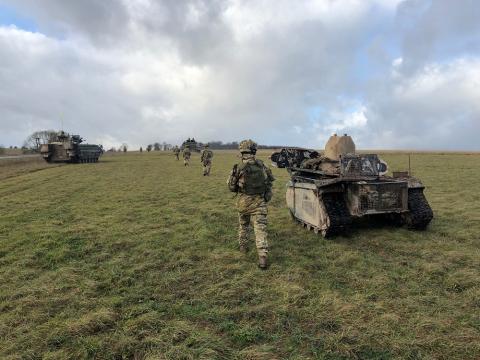
Milrem Robotics' UGVs tested during Army Warfighting Experiment 2018
During the Army Warfighting Experiment 2018 (AWE18) - Autonomous Warrior (Land), British troops thoroughly tested four Milrem Robotics’ and QinetiQ Titan UGVs.
Milrem Robotics was the most represented UGV manufacturer in the exercise with its four vehicles.
“The main goal of the experiment, which concluded last week, was to determine how new unmanned technologies can enhance soldier's survivability and effectiveness on the modern battlefield,” says Juri Pajuste, program director at Milrem Robotics, who took part in the exercises.