Business Solutions
News
Business Solutions

Over the years, drones have proven to be extremely beneficial for the insurance sector, offering safe and efficient tools for companies to use during various tasks.
In 2014, State Farm — a pioneer in the insurance sector for using this technology — began looking at how to use drones for claims. Just a few short years later in Aug. 2017, the company began using drones for real-life claims and hasn’t looked back.
“They’ve definitely provided a tool that we did not necessarily have in the past,” drone pilot Jared Brose tells Unmanned Systems. “They allow us to get out there and get in the air as quickly as possible and handle a claim as quickly as possible.”
For Brose, one of the main benefits that this technology has provided State Farm is safety, as the company routinely has to access steep and high roofs during its claim processes. With UAS at its disposal, State Farm can keep its workers out of harm’s way.
Using unmanned aircraft “allows us to access these areas in a safe manner,” Brose says. “We don’t have to put ourselves at risk as much if we have this in our tool belt.”
Fellow insurance giant Allstate has also been using UAS for years, and like State Farm, Allstate also touts the safety benefit that UAS provide by keeping its workers from perilous situations.
The use of drones “reduces safety concerns for individuals to be on steep roofs or multi-story structures completing physical inspections,” Allstate tells Unmanned Systems via email.
Another benefit that Allstate touts is the efficiency that UAS provide, noting this technology allows drone pilots to complete more inspections in a day than traditional inspectors, which allows Allstate’s adjusting staff to be more productive, resulting in faster claims for the consumer.
While State Farm has an in-house drone program, Allstate does not actually own or operate a drone fleet. Instead, the company is partners with a company called EagleView, which provides high-resolution aerial imagery, property data analytics and structural measurements for government agencies, insurance carriers, roofing contractors and energy utilities.
According to EagleView’s COO, Jay Martin, “the use of drones improves an agent’s productivity and effectiveness by providing them a comprehensive view of these properties without the hassle of driving to a property to conduct an inspection, climbing a roof, or potentially dealing with a homeowner’s pet.
“For the end customer, they get their claims resolved without having to schedule time off work to be home to host the agent. It’s a win-win.”
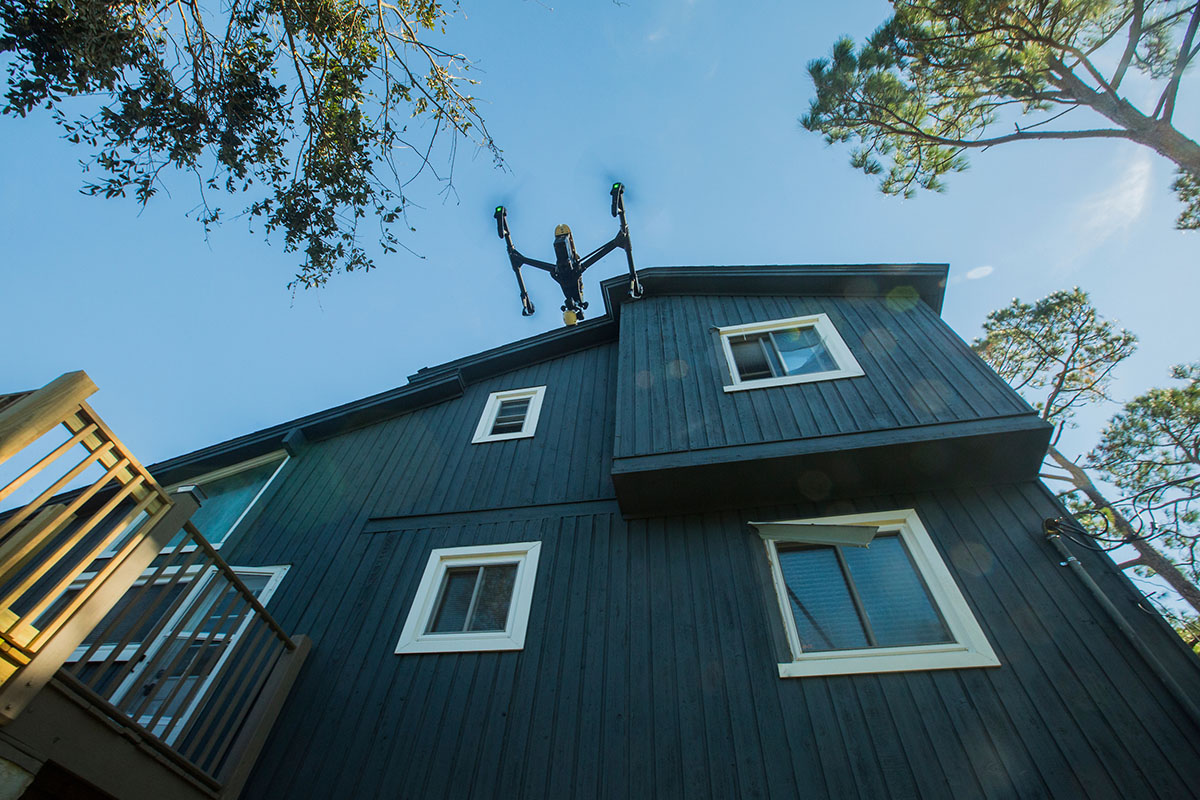
Allstate, in collaboration with EagleView, has been using UAS for years on claims. Photo: Allstate
Disaster response
Following disasters and catastrophic events, infrastructure can be badly damaged, making impacted areas difficult, if not impossible, to access. With UAS, however, Allstate and State Farm have both been able to respond to these disasters in a timely manner to assist their customers.
Allstate has focused the use of UAS on claims including hurricanes, isolated wind storms, hailstorms and other weather events, the company tells Unmanned Systems, adding that it makes business decisions based on the uniqueness of the weather events and storms in question.
The initial partnership between Allstate and EagleView actually began following Hurricane Matthew in August 2016. EagleView’s Martin says an influx of property claims and poor weather conditions required an alternative solution to the claims process that was in place.
With this in mind, Allstate used EagleView’s reports, which allow adjusters to virtually inspect hurricane damage for claims.
EagleView says based on this partnership with Allstate, it introduced its EagleView OnSite platform, which uses the power of multiple image platforms for optimal capture under different conditions. According to the company, EagleView OnSite “delivers high-resolution imagery from multiple camera sources directly to the claims adjuster’s desk following a weather event anywhere in the country.”
MAAP assist
Earlier this year, State Farm announced it had become the first company in the United States to receive a national waiver from the FAA that allows it to conduct UAS operations over people and flights beyond the pilot’s visual line of sight through November 2022. Previously, State Farm received waivers that were limited to a short time frame and to specific geographic areas impacted by hurricanes.
A member of Virginia’s UAS Integration Pilot Program team, State Farm said the waiver would open up new innovation opportunities for the company by allowing longer-distance flights.
“It’s been a team effort to make drone technology a reality,” Robert Yi, senior vice president for property and casualty claims, said at the time of the announcement. “The waiver will provide our claims specialists with another way to efficiently help customers. We can use drones to assess on-the-ground damage and deploy resources. This is a huge win for our customers and demonstrates we’re recognized as a leader in drone technology.”
Virginia Tech’s Mid-Atlantic Aviation Partnership (MAAP) played an integral role in helping State Farm obtain this waiver, as the company has worked with MAAP on UAS safety case research for nearly two years.
State Farm and MAAP conducted several tests that evaluated senseFly’s fixed-wing eBee Classic UAS, designed for longer-distance damage assessment flights. The strength of the research and resulting safety case documentation resulted in the FAA approving temporary waivers for State Farm to conduct damage-assessment UAS flights over people and beyond the operator’s visual line of sight in states effected by hurricanes Florence and Michael.
State Farm says successful flights following the two hurricanes provided “valuable real-world experience and insights” that were incorporated into the national waiver request.
“State Farm had a compelling proposal for how drones could improve their customer experience and an unwavering commitment to safety,” says Mark Blanks, director of MAAP. “MAAP had the operational expertise and the research experience to help them navigate the approval process and collect supporting data. This success shows how powerful it can be when industry and academia collaborate to break new ground.”
MAAP says it tackles demanding waivers such as these by “starting with a broad, generalized version” of the operation, and going through it to evaluate every hazard it could conceive. For MAAP, this outline serves as a guide as it refines the parameters of the operation and selects conditions that “winnow down their list of risks.”
For every risk the team couldn’t eliminate, they proposed at least one strategy for dealing with it. In some cases, they proposed several strategies. Over the course of several months of field tests, the team rigorously collected the data to prove that those mitigations worked.
This process added up to hundreds of experiments testing dozens of parameters, including how far the aircraft could fly before a visual observer couldn’t see it, and when the observer could spot a manned aircraft nearby. They also tested what happened if the aircraft suddenly lost power, if the communications link was severed, and if the UAS climbed above its prescribed altitude.
MAAP’s team worked with Virginia Tech’s team of injury biomechanics experts to simulate the different ways a UAS could potentially collide with a human being during the operation and evaluate the injury risk of each one.
The team was in the middle of putting this data into the waiver application when Hurricane Florence hit the coast.
“We put everyone on it to get the waivers in time,” Blanks said.
The team worked quickly to get the paperwork in just before the storm hit, and the FAA’s approval came back a day later.
The original waiver covered four states. When Hurricane Michael hit, it was expanded to include Florida, MAAP notes. A month or so later, State Farm applied to have the waiver extended across the country, and the FAA approved.
For Blanks, the extensive process to get these waivers shows the industry that the right kind of research can win approvals for operations with legitimate commercial value.
“Sometimes it takes a while to solve the hard problems,” Blanks says. “This was a hard problem, but what it shows is that it’s possible to make progress in a way that works for the industry and for the regulator. It shows a reproducible path forward.”
Public acceptance
Many people believe that one of the keys to the widespread implementation of this technology across the country will be public acceptance.
With this in mind, State Farm always talks to its customers to make sure they are comfortable with this technology being used around their property. If the customer gives the OK for drones to be used, State Farm lays the groundwork necessary for the safe use of this technology.
State Farm’s Brose says many customers are receptive to this technology, especially after they see it in action and see the data it can collect. State Farm’s drone pilots also explain the technology to customers, how they’re using it, and how it benefits the claims process. The company always makes sure to point out that they’re ultimately using drones for efficiency, as they want to gain the best information they possibly can to help customers get through the claims process.
Allstate, meanwhile, has found the public to be “curious and fascinated by the use of technology.” The company has a similar view to State Farm’s when it comes to informing customers about the benefits of this technology.
“Education and communication to gain greater understanding of the process is critical to success and acceptance as we continue to evolve in our world where the use of technology becomes the norm,” Allstate says.
For Allstate, if this technology does become the norm, there is no limit in sight to the future of this technology.
“In a nutshell, the ‘sky’ is the limit.”
Above: State Farm drone pilots conduct drone flights with Mid-Atlantic Aviation Partnership at Virginia Tech. Photo: MAAP Below: Allstate and EagleView, a drone service company, have an insurance partnership. Photo: EagleView

Related