
AeroVironment Inc. and Kratos Defense & Security Systems Inc. are teaming up to develop and demonstrate “highly integrated and operationally effective” multi-domain unmanned platforms for near-peer, denied environments.
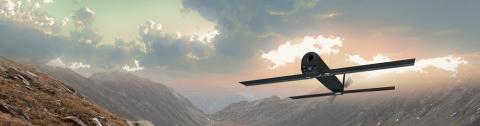
The companies say that their first collaborative project is designed to demonstrate the ability to launch, communicate with, and control a small, tube-launched loitering aircraft from a larger runway-independent UAS.
“Kratos and AeroVironment offer complementary capabilities while sharing an intense focus on disruptive and affordable unmanned aircraft solutions for the DoD,” says Steve Fendley, president of Kratos Unmanned Systems Division.
Business Solutions
Business Solutions
May Mobility equipping its autonomous shuttles with LeddarTech's lidar technology
In an effort to provide its autonomous shuttle deployments with enhanced safety, May Mobility will equip its autonomous shuttles with lidar technology from automotive and mobility lidar technology company LeddarTech.
May Mobility has conducted more than 50,000 real-condition test drives to validate the technology, before launching in full mass production.
Designed to create a “complete 360-degree cocoon,” LeddarTech’s solid-state Cocoon lidar technology provides a higher degree of safety related to collision prevention in autonomous shuttle applications, according to LeddarTech.

Drone Aviation receives first contract award for its WASP Lite system
Drone Aviation Holding Corp. has received a contract award valued in excess of $1.1 million for its newly designed aerostat product, the WASP Lite. This is the company's first contract award for the product.
Under the contract, which is from a U.S. Army customer, Drone Aviation will provide multiple WASP Lite aerostat systems capable of enhancing and extending the modern networked battlefield supporting specialized waveform communications equipment and day/night Intelligence, Surveillance and Reconnaissance (ISR) payloads.
Iris Automation launches detect and avoid tech to enable BVLOS operations for UAS
Iris Automation has launched Casia, which the company describes as the “first commercially available computer vision detect-and-avoid solution to enable beyond visual line of sight (BVLOS) operations for autonomous vehicles.”
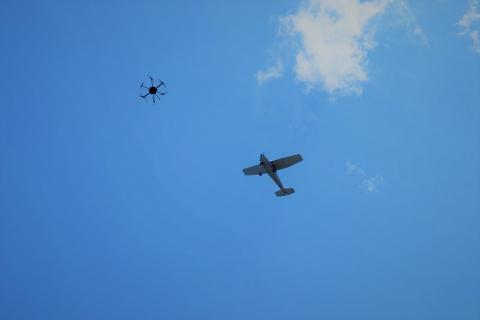
According to Iris, Casia allows a UAS to truly understand the aviation environment around it as if a pilot were on board, as it detects other aircraft, classifies them using machine learning, and makes intelligent decisions about the threat they may pose to the vehicle, and triggers automated maneuvers to avoid collisions.
Ashtead Technology strengthens its ROV positioning with Aqua-Tech Solutions acquisition
Ashtead Technology, a provider of the rental and sale of survey and ROV equipment, has announced that it has acquired Aqua-Tech Solutions, a subsea equipment rental and cutting services specialist.
Ashtead Technology says that the acquisition “significantly strengthens” its ROV and mechanical tooling offering, as it broadens its already established survey sensor rental fleet.
With the introduction of subsea cutting equipment, the acquisition also extends the firm’s specialist subsea services capability.

ESAero to support Planck Aerosystems' defense and commercial UAS business through new partnership
Aerospace manufacturer Empirical Systems Aerospace Inc. (ESAero) will support the defense and commercial UAS business of Planck Aerosystems (Planck Aero) through a new partnership between the two companies.
In support of increasing demand across Planck’s customer base, both domestically and internationally, ESAero will manufacture Planck Aero’s Group 1 UAS, Shearwater, in its manufacturing plant in San Luis Obispo, California, which will support Planck’s strategy to scale the company.
The companies note that the Shearwater UAS is the preferred small multi-rotor platform to host the Planck Autonomous Control Engine – ACETM navigation system, which enables the UAS to operate autonomously from moving vehicles and vessels, including vision-based precision landing.
uAvionix integrating its ADS-B IN receive capability into CubePilot's Carrier Board
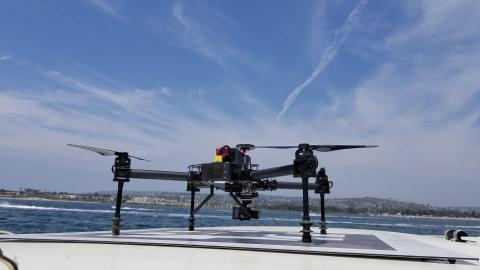
uAvionix has partnered with CubePilot (ProfiCNC and Hex), a designer and manufacturer of “The Cube” autopilot—formerly known as “Pixhawk”—for UAS.
Through the partnership, CubePilot will equip its Carrier Board with uAvionix’s ADS-B IN receive capability.
Available in July, the new Carrier Board integrates uAvionix’s custom ADS-B silicon for 1090MHz ADS-B reception for worldwide Detect and Avoid (DAA) functionality.
Previously, CubePilot, which utilizes the open-source ARDUPILOT platform, provided plug-and-play functionality for several uAvionix ADS-B IN and OUT products. The companies note that support for these products is retained in the new design, which allows for “978MHz ADS-B reception or integration of ADS-B OUT functionality.”
Australian Government purchasing second MQ-4C Triton UAS from Northrop Grumman
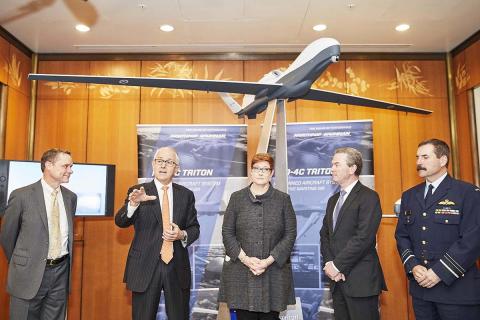
Northrop Grumman has announced that the Australian government will purchase a second MQ-4C Triton UAS from the company.
The UAS will be delivered through a cooperative program between Northrop Grumman and the United States Navy.
“Northrop Grumman is excited to develop this unrivaled capability for the Royal Australian Air Force,” says Doug Shaffer, vice president and program manager, Triton programs, Northrop Grumman. “Triton will provide the Australian Defence Force a high-altitude, long-endurance system for intelligence, reconnaissance and broad area surveillance missions to enhance the security of Australia’s borders.”
Charles River Analytics receives funding to enhance its MANTA system
Through the US Army’s Combat Vehicle Robotics (CoVeR) program, Charles River Analytics Inc. has received funding to enhance its Modular Appliqué Enabling Natural Teaming with Autonomy (MANTA) system.
The goal of the CoVeR program is to develop technologies that support scalable integration of multi-domain robotic and autonomous systems. Along those lines, MANTA, described as a “platform-independent, natural control and autonomy robot appliqué,” allows a user to easily direct or more host platforms to perform various autonomous behaviors.
U-M's Automotive Research Center shifting focus to autonomous technologies for military ground vehicles
The University of Michigan has announced that its Automotive Research Center (ARC) has been awarded a $50 million contract from the U.S. Army, extending the ARC’s 25-year partnership with the Army through 2024.
With the funding, the ARC will shift its focus to autonomous technologies for military ground vehicles.
Launched in 1994, the ARC has served as a source of technology, modeling and simulation for the Army’s fleet of vehicles, which is the largest in the world.