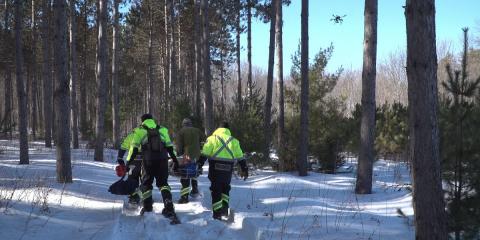
Public Safety Canada has selected Kongsberg Geospatial, Larus Technologies, and the Civil Air Search and Rescue Association of Canada (CASARA) to help develop new methods for using drones in search and rescue operations in remote communities in Canada using geospatial software, artificial intelligence, and machine vision software.
Dubbed OVERSEE—an acronym for Optical Vision Enhancement and Refinement of Sensor Exploitation Effectiveness—the project will seek to address the unique challenges of conducting search and rescue operations using UAS platforms in remote areas such as indigenous communities in the Arctic and their immediate surrounding area.
Artificial Intelligence
Artificial Intelligence
Parrot, RIIS partner to develop custom applications of AI for Parrot's ANAFI drone platform
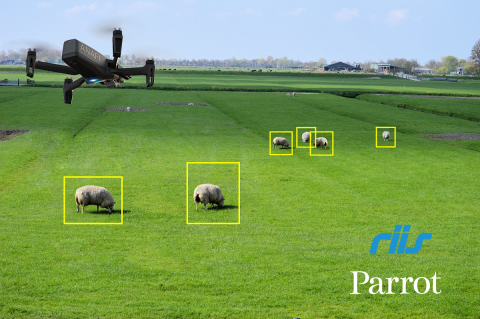
Parrot has partnered with mobile app, web development and IT consulting services provider RIIS to develop custom applications of artificial intelligence for Parrot’s ANAFI drone platform.
Together, the companies will explore how AI and computer vision technology, combined with drone data capture, can be used to solve a number of industry challenges using an efficient and cost-effective approach.
“We are excited to explore the immense capabilities AI and drones will deliver to our clients through our ongoing partnership with RIIS,” says Jerome Bouvard, Parrot director of Strategic Partnership.
“At Parrot, we are always looking for innovative solutions for our enterprise partner’s every-day pain points.”
AI robotics company Covariant launches from stealth
Artificial intelligence (AI) robotics company Covariant launched from stealth on Wednesday, Jan. 29, with the announcement that its AI has been deployed and is fully operational at customer facilities in several industries.
Covariant has spent the last two and a half years since being founded researching, developing, testing and deploying its AI, which has led to the development of the Covariant Brain. Covariant describes the Covariant Brain as “universal AI for robots that can be applied to any use case or customer environment.” Covariant robots are capable of quickly learning how to manipulate objects without being told what to do thanks to their ability to learn various general abilities.

Miso Robotics unveils next generation robotic kitchen assistant platform
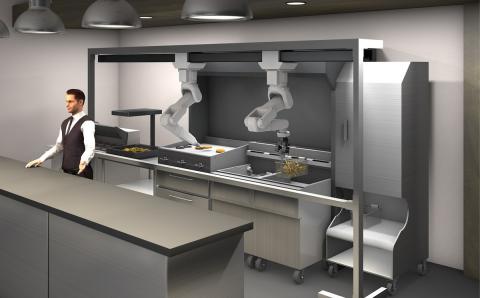
Miso Robotics has announced a prototype for its newest product, the Miso Robot on a Rail (ROAR), which the company describes as the “next generation of zero-footprint, cost-efficient robotic kitchen assistant solutions for evolving commercial kitchens.”
Thanks to feedback from top Quick Service Restaurants (QSRs), Miso Robotics has moved its robotic kitchen assistant Flippy to an upside-down rail. Designed to be installed under a standard kitchen hood, the newest generation of Flippy will be able to move along a line of kitchen equipment while staying out of the path of busy cooks.
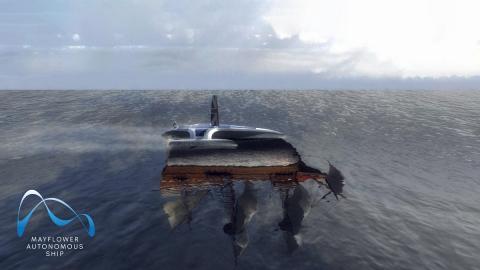
Mayflower Autonomous Ship to utilize IBM AI and other tech to autonomously cross Atlantic
Led by marine research organization ProMare, a global consortium of partners is building an unmanned, fully-autonomous ship that will cross the Atlantic on the fourth centenary of the original Mayflower voyage in September 2020.
IBM has joined that consortium, and the Mayflower Autonomous Ship (MAS) will utilize IBM’s artificial intelligence (AI), most powerful servers, cloud and edge computing technologies to autonomously navigate and avoid ocean hazards as it travels from Plymouth, England to Plymouth, Massachusetts.
If the voyage proves successful, MAS will be one of the first self-navigating, full-sized vessels to cross the Atlantic Ocean.
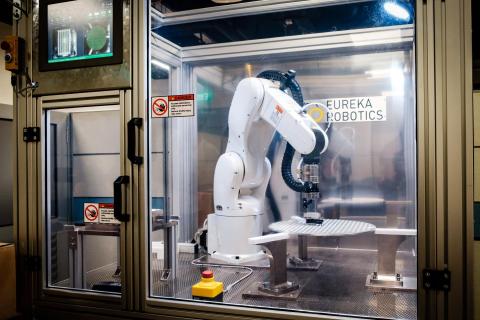
Eureka Robotics unveils robot with the precision and dexterity of a human hand
Eureka Robotics has unveiled Archimedes, a new robot capable of picking up delicate optical lenses and mirrors with the care and precision of a human hand.
A robotics technology start-up from Nanyang Technological University, Singapore (NTU Singapore), Eureka says Archimedes can slot lenses and mirrors of different sizes into a custom loading tray to prepare them for coating.
Archimedes features a six-axis robot arm controlled by algorithms that use Artificial Intelligence (AI) to plan its motion and how much force to exert in its grip, creating a system that can mimic the dexterity of human fingers and the visual acuity of human eyes.
Boeing Australia announces partnership aimed at creating smarter unmanned systems through AI tech
In an effort to create smarter unmanned systems for global forces, Boeing Australia and Australia’s Trusted Autonomous Systems Defence Cooperative Research Centre (DCRC) will collaborate on the development of advanced artificial intelligence (AI) technologies.
According to Boeing Australia, equipping unmanned systems with machine learning techniques will help them better understand and react to threat environments.
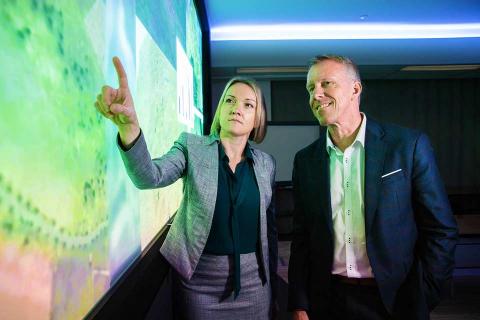
Recogni seeks to make autonomous vehicles a reality with low-power AI processing
A company called Recogni Inc. that designs a vision-oriented artificial intelligence (AI) platform for autonomous vehicles has emerged from stealth with the announcement of $25 million in Series A financing.
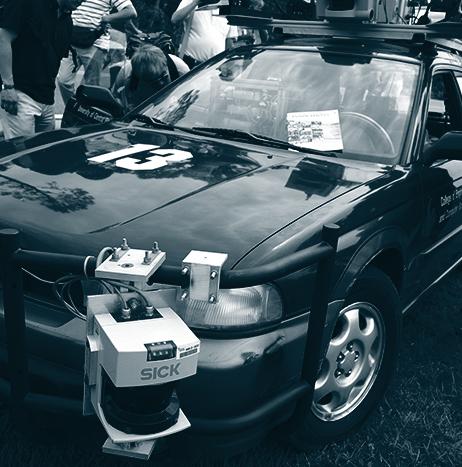
MIT, U.S. Air Force launching program to advance artificial intelligence
In an effort to make “fundamental advances” in artificial intelligence (AI) that could improve Air Force operations, while also addressing broader societal needs, MIT and the U.S. Air Force have signed an agreement to launch a new program called the MIT-Air Force AI Accelerator.
Leveraging the expertise and resources of MIT and the Air Force, the effort will be used to conduct fundamental research directed at “enabling rapid prototyping, scaling, and application of AI algorithms and systems.”
Building off of its five-decade relationship with MIT, the Air Force plans to invest approximately $15 million per year in the effort.
AMP Robotics launches dual-robot system for recycling industry
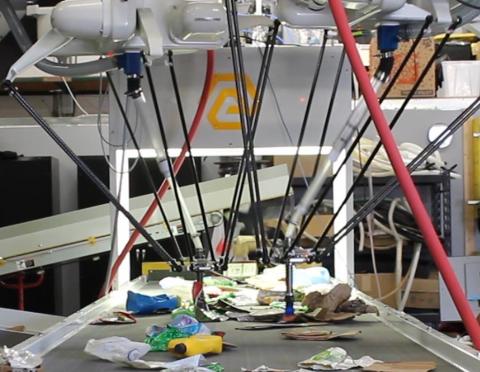
AMP Robotics Corp. (AMP), a developer of artificial intelligence (AI) and robotics for the recycling industry, has launched its new AMP Cortex dual-robot system (DRS), which focuses on material recovery in Municipal Solid Waste (MSW), Electronic Waste (E-waste), and Construction and Demolition (C&D).
Expanding on AMP’s existing product line of high-speed recycling robotics, the AMP Cortex DRS uses two high-performance robots that quickly sort, pick, and place materials at a speed of 160 pieces per minute, which creates optimum productivity, AMP says.